
By Nuzhat Nazar
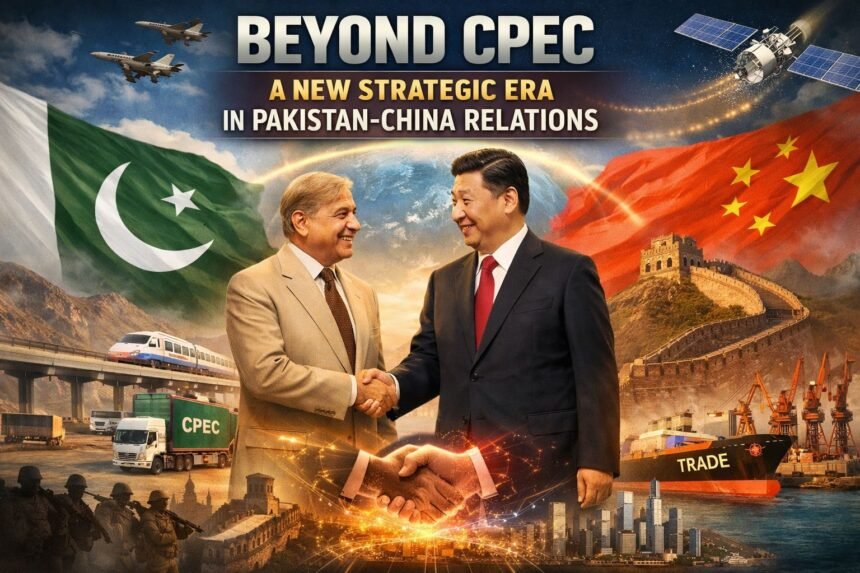
Prime Minister Shehbaz Sharif’s visit to China this week was officially framed as part of the celebrations marking 75 years of diplomatic relations between Pakistan and China. Yet to view the visit merely through the lens of a historic anniversary would be to miss its broader strategic significance. The joint statement issued at the conclusion of the visit reveals something much larger: Pakistan and China are actively redesigning their partnership for a world that looks very different from the one in which their relationship was originally forged.
The international environment today is defined by intensifying competition between major powers, the rise of new technologies, disruptions in global supply chains, growing regional instability, and the gradual emergence of a multipolar world order. In such an environment, traditional diplomatic friendships alone are insufficient. States increasingly seek partnerships that can simultaneously address security concerns, economic challenges, technological transformation and geopolitical uncertainty.
It is within this context that Prime Minister Shehbaz Sharif’s visit should be understood.
For decades, Pakistan-China relations have been described through familiar expressions such as “all-weather friendship” and “iron brotherhood.” These descriptions remain valid. However, the latest visit suggests that the relationship is evolving beyond its traditional foundations into a far more comprehensive strategic framework encompassing security, technology, industrial modernization, artificial intelligence, regional connectivity, space cooperation, economic transformation and global governance.
The visit may ultimately be remembered not simply as a diplomatic milestone but as a strategic turning point.
From Historical Friendship to Future-Oriented Partnership
The evolution of Pakistan-China relations has been remarkable.
Pakistan was among the first Muslim countries to recognize the People’s Republic of China. The relationship deepened through the 1963 border agreement, strengthened through defense cooperation, and acquired global significance when Pakistan facilitated the historic rapprochement between China and the United States in the early 1970s.
Over the following decades, the partnership expanded into defense production, infrastructure development, energy cooperation and strategic coordination on regional affairs.
The launch of the China-Pakistan Economic Corridor (CPEC) in 2015 marked another historic milestone. CPEC transformed Pakistan into a central component of China’s Belt and Road Initiative and elevated economic cooperation to unprecedented levels.
Today, however, another transition appears to be underway.
The joint statement demonstrates that Beijing and Islamabad are no longer discussing only roads, ports and power plants. Artificial intelligence, digital economy, scientific innovation, industrial cooperation, space exploration and advanced technologies have become key pillars of the relationship.
This reflects a partnership that is adapting to the strategic realities of the twenty-first century.
Why Pakistan Matters More to China Today
Understanding the significance of this visit also requires understanding China’s changing strategic environment.
China today faces growing strategic competition with the United States. The Indo-Pacific framework, technological restrictions, supply-chain diversification efforts and broader geopolitical competition have compelled Beijing to reassess its strategic partnerships and regional priorities.
At the same time, instability in the Middle East, uncertainty in Afghanistan, and tensions across several regions have increased the value of reliable strategic partners.
Within this environment, Pakistan’s importance to China has arguably increased rather than diminished.
Pakistan provides China with direct access to the Arabian Sea through Gwadar. It offers connectivity between Western China and international markets. It serves as an important security partner in combating extremist threats. It remains one of China’s most trusted diplomatic partners in the Muslim world and consistently supports Beijing on key international issues.
This explains why the joint statement repeatedly emphasizes strategic trust, security cooperation and long-term coordination.
The relationship is no longer merely historical; it is increasingly becoming strategically indispensable for both countries.
The Emergence of a China-Pakistan Security Partnership
Perhaps the most consequential outcome of the visit is the agreement to establish a China-Pakistan Security Partnership.
For years, security cooperation existed primarily through military exchanges, defense collaboration and intelligence coordination. The new framework suggests a more institutionalized and comprehensive approach.
The timing is significant.
China’s investments and personnel in Pakistan have increasingly become targets of terrorist groups seeking to undermine bilateral cooperation. Beijing’s concerns regarding the security of Chinese nationals and projects have become more pronounced in recent years.
The creation of a dedicated security partnership indicates that both countries recognize that economic cooperation and security cooperation can no longer be treated separately.
For Pakistan, ensuring the security of Chinese personnel and projects is not merely a bilateral obligation. It is directly linked to the future success of CPEC, foreign investment and broader economic cooperation.
The emphasis on counterterrorism cooperation, opposition to double standards and enhanced security coordination reflects the growing strategic convergence between Islamabad and Beijing on regional security challenges.
CPEC 2.0: The Real Story
Much attention has understandably focused on CPEC since its launch in 2015. However, the latest visit suggests that the real story is no longer CPEC itself but rather what comes after the initial infrastructure phase.
The first phase of CPEC largely focused on roads, power generation and connectivity projects.
CPEC 2.0 is fundamentally different.
Its priorities include industrial parks, mineral development, agriculture modernization, digital economy, technological innovation, manufacturing, logistics and trade facilitation.
This shift is critical for Pakistan.
Infrastructure creates potential. Industrialization creates growth.
The emphasis on industrial cooperation reflects a recognition that Pakistan’s long-term economic success depends on expanding productive capacity, increasing exports, attracting manufacturing investment and integrating into regional supply chains.
The inclusion of mining, oil and gas exploration, agricultural cooperation and advanced manufacturing projects further demonstrates that both countries are attempting to broaden the economic foundation of the partnership.
For Pakistan, this represents an opportunity to move beyond infrastructure-led development toward sustainable industrial growth.
Gwadar’s Strategic Future
The renewed commitment to developing Gwadar as a regional connectivity hub deserves particular attention.
For years, Gwadar has been viewed primarily through the lens of strategic geography. Located near some of the world’s most important maritime trade routes, the port has often been portrayed as one of Pakistan’s greatest strategic assets.
However, geography alone does not create economic success.
The significance of the latest joint statement lies in the fact that Gwadar is now being discussed not merely as a port but as part of a broader connectivity ecosystem linking South Asia, Central Asia, Western China and the Middle East.
Combined with the focus on the Khunjerab Pass and improved land connectivity, the vision appears aimed at transforming Pakistan into a regional trade and logistics corridor.
If realized, such connectivity could reshape Pakistan’s economic landscape over the coming decades.
Technology Becomes the New Frontier
One of the most striking aspects of the visit is the attention given to emerging technologies.
Artificial intelligence, telecommunications, digital economy, scientific innovation and space cooperation occupy a prominent place in the joint statement.
This is significant because the global balance of power is increasingly influenced by technological capabilities rather than traditional military strength alone.
The announcement regarding the training of Pakistani astronauts in China and the possibility of a Pakistani astronaut joining the Chinese Space Station is symbolically important. Yet its significance extends beyond symbolism.
It demonstrates China’s willingness to include Pakistan in high-technology domains that were previously beyond Islamabad’s reach.
Similarly, cooperation in artificial intelligence and digital technologies indicates that future Pakistan-China cooperation may increasingly revolve around knowledge, innovation, data governance and technological ecosystems.
In many ways, this could become as important as CPEC itself.
South Asia, Kashmir and Regional Stability
The regional dimension of the visit is equally important.
China’s reiteration of support for Pakistan’s sovereignty, territorial integrity and security remains a central pillar of the relationship.
Equally significant is Beijing’s continued position on Jammu and Kashmir.
By describing Kashmir as a dispute left over from history and supporting its peaceful resolution in accordance with relevant United Nations resolutions, China continues to provide Pakistan with important diplomatic backing on one of its core foreign policy issues.
The broader emphasis on dialogue, diplomacy and opposition to unilateral actions also carries significance in the context of recent regional tensions.
At a time when South Asia faces persistent strategic mistrust and periodic crises, the joint statement reflects a shared preference for stability, dialogue and conflict management.
Pakistan’s Expanding Diplomatic Role
Another notable feature of the joint statement is China’s appreciation of Pakistan’s role in facilitating the temporary ceasefire between Iran and the United States and hosting the Islamabad Talks.
This is strategically important.
Traditionally, discussions about Pakistan-China relations focused primarily on bilateral cooperation.
The latest statement, however, highlights Pakistan’s role beyond South Asia.
It reflects growing recognition of Pakistan’s diplomatic utility as a bridge-builder capable of engaging multiple regional actors.
For China, a stable Middle East is essential for energy security and economic interests.
For Pakistan, successful diplomatic engagement enhances its international standing and reinforces its image as a constructive regional stakeholder.
The convergence of interests in the Middle East therefore adds another dimension to the evolving strategic partnership.
Looking Ahead
Seventy-five years after establishing diplomatic relations, Pakistan and China find themselves at another important moment in their shared history.
Unlike earlier periods that were defined primarily by political trust, defense cooperation or infrastructure development, the current phase is broader, deeper and more ambitious.
Security cooperation is becoming more institutionalized.
Economic cooperation is shifting toward industrialization and technology.
Regional diplomacy is becoming more coordinated.
Space and artificial intelligence are emerging as new frontiers of collaboration.
Most importantly, both countries appear to view their partnership not only as a bilateral relationship but as a platform for navigating an increasingly complex international environment.
Prime Minister Shehbaz Sharif’s visit therefore represents more than a successful diplomatic engagement. It reflects the emergence of a new strategic framework designed for a rapidly changing world.
The true significance of this visit lies in the recognition that Pakistan-China relations are no longer simply about preserving a historic friendship. They are about shaping the future—through connectivity, technology, security cooperation, economic transformation and a shared vision for a more stable and multipolar world order.
If the last decade was defined by the launch of CPEC, the decade ahead may well be defined by how effectively Pakistan and China translate this broader strategic vision into tangible outcomes. The joint statement suggests that both capitals intend to try.