

CDS Web Desk
Pakistan’s government and military continue to reiterate their commitment to eradicating terrorism in Balochistan. However, events on the ground show a complicated situation. While senior officials were meeting in Quetta to discuss security, tribal elders in Hanna Urak were negotiating directly with an armed group to secure the release of kidnapped civilians. The hostages were freed without any visible role from the local administration or provincial government. This reflects the increasing gap between official claims and the realities faced by local communities.
The government often presents a temporary drop in attacks as evidence that terrorism is being eradicated. But this can be misleading. Groups such as the Balochistan Liberation Army (BLA) have recurrently shown that they reduce attacks for a period, only to regroup and launch new operations later. Even during a recent decline in violence, 17 attacks were reported across 13 districts, while the BLA remained active in nine districts. A single month of lower violence does not necessarily mean the insurgency has weakened.
The BLA is also changing the way it operates. It now combines large, coordinated attacks with revenge attacks linked to important dates in the Baloch nationalist movement. The attack targeting Shafiq Mengal is one recent example.
At the same time, militants are increasingly targeting economic infrastructure. Gas tankers, bridges, electricity transmission lines, and workers linked to state-owned companies have all come under attack. These attacks not only disrupt economic activity but also discourage investment and weaken public confidence in the state’s ability to provide security and basic services.
On the other hand, Afghanistan has also influenced the security situation through cross-border militant activity, which is leading Pakistan to carry out operations against Tehrik-e-Taliban Pakistan (TTP) hideouts. Afghanistan’s behaviour is non-cooperative on Pakistan’s security concerns regarding the TTP. However, a comprehensive approach is needed; blaming external factors alone does not explain why violence continues. Internal weaknesses in security and governance also need serious attention.
Ethnic violence has become another worrying trend. The recent killing of Punjabi workers in Mashkel is part of a pattern in which militants target civilians because of their ethnic identity. Such attacks are meant to spread fear, create divisions among Pakistan’s communities, and undermine national unity.
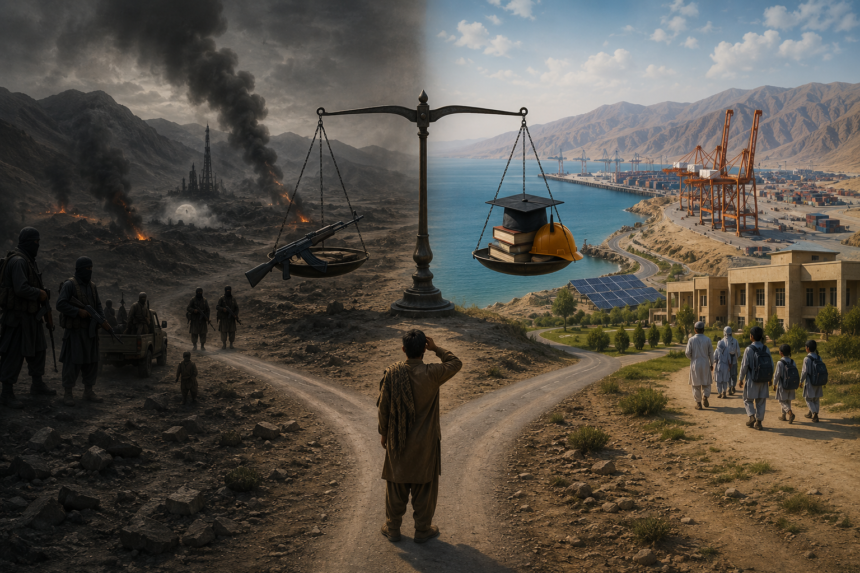
Pakistan needs a broader strategy that combines effective security measures with political reforms, economic development, better governance, and stronger engagement with local communities. Without addressing these deeper issues, it will be difficult to achieve stability in Balochistan.