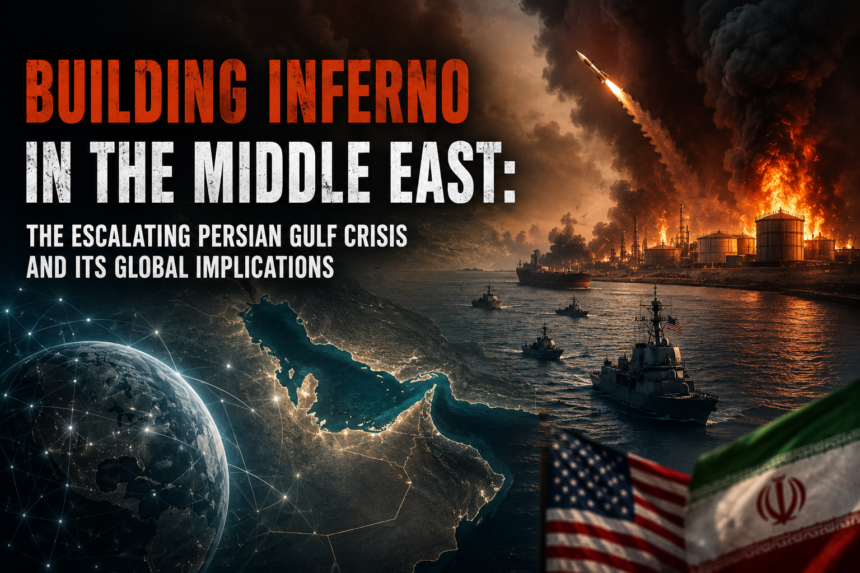

The Gulf crisis has evolved beyond a dispute over Iran’s nuclear programme into a broader geopolitical struggle for regional and maritime dominance, particularly over the Strait of Hormuz. It emphasizes that continued military escalation threatens global energy security, trade, and stability, while sustained diplomacy led by mediators such as Pakistan, Qatar, and Oman ,offers the only realistic path to preventing a wider regional war.
Asif Haroon Raja
The War that Failed to Achieve Its Objectives
The war launched by the United States and Israel against Iran on 28 February, aimed at inducing regime change, dismantling Iran’s nuclear programme, and degrading its missile capability, failed to achieve its strategic objectives.
Iran’s determined resistance, coupled with its effective use of asymmetric warfare, offset the overwhelming conventional military superiority of the US-Israeli alliance.
Unable to secure a decisive military victory and facing mounting international criticism, Washington sought an honourable exit rather than risking the perception of strategic defeat.
Iran, meanwhile, emerged with enhanced regional prestige and considerable international sympathy.
Pakistan’s Diplomatic Breakthrough
Recognising the dangers of a wider regional conflagration, Pakistan assumed an active mediatory role. Its balanced diplomacy earned the confidence of Iran, the Gulf Cooperation Council (GCC) States, and ultimately Washington.
Following the ceasefire of 7 April, Pakistan facilitated the first direct meeting between the United States and Iran in forty-seven years on 11 April.
The Switzerland Peace Accord
Although that initiative was temporarily derailed by spoilers, Pakistan—supported by Qatar—continued its diplomatic engagement, culminating in the signing of a Memorandum of Understanding (MoU) in Switzerland on 22 June.
A Fragile Peace
The agreement brought immediate relief. The US naval blockade was lifted, the Strait of Hormuz reopened, and global energy markets stabilised.
Under the fourteen-point MoU, technical committees were tasked with resolving outstanding issues within sixty days.
Iran was permitted to resume oil exports and was promised reconstruction assistance, gradual release of frozen financial assets, and phased sanctions relief.
Nevertheless, critics in both Washington and Tel Aviv condemned the agreement as excessively favourable to Tehran.
Why the Ceasefire Collapsed?
The fragile peace soon unravelled. Israeli military operations in Lebanon, coupled with increasingly hostile rhetoric from President Trump, undermined confidence in the agreement.
On 27 June, CENTCOM struck against Iranian positions near the Strait of Hormuz reignited hostilities, initiating a new and more dangerous phase of the conflict.
The Middle East on the Brink: The Battle for the Strait of Hormuz
The confrontation soon shifted towards control of the world’s most strategic maritime choke point.
Iran’s missile attacks on commercial tankers passing through Hormuz on 7 July triggered massive US retaliation against more than 140 Iranian military targets, including Kharg and Qeshm Islands.
Iran responded by attacking American military facilities across Kuwait, Bahrain, Qatar, Jordan and Oman, while also targeting US naval assets.
Maritime Dominance
Washington, in turn, expanded its campaign against Iran’s energy infrastructure, transportation networks, naval facilities and strategic ports including Bandar Abbas, Abadan and Chabahar.
The conflict has increasingly become a struggle over maritime dominance rather than solely a dispute over Iran’s nuclear programme.
President Trump’s declaration that the United States would act as the “guardian” of the Strait of Hormuz, accompanied by proposals to impose transit charges on international shipping, has further heightened tensions.
Military Preparations
Military preparations reportedly include plans to seize Kharg Island, tighten the naval blockade, neutralise Iran’s naval capabilities and, if necessary, conduct limited ground operations.
Iran has responded by warning that any foreign interference in Hormuz would constitute an act of war.
Economic Shockwaves Across the Globe
The conflict now extends well beyond the battlefield.
Attacks on Iran’s petrochemical infrastructure threaten global energy security, with oil prices already registering sharp increases.
The Risk of a Wider Regional War
Any prolonged disruption of Hormuz—or closure of the Bab al-Mandab Strait due to expanding Houthi involvement—would severely affect global shipping, supply chains, inflation and economic stability.
Changing Regional and Global Alignments
The renewed conflict is reshaping regional calculations.
NATO appears increasingly willing to cooperate with Washington in safeguarding maritime navigation.
The GCC States, which had been exploring a broader regional security architecture involving Pakistan, Saudi Arabia, Türkiye and Egypt while simultaneously improving ties with Iran, are now reassessing their strategic options.
Saudi Arabia and the UAE are accelerating efforts to establish alternative energy export routes that bypass the Strait of Hormuz.
The Diplomatic Challenge
Despite repeated setbacks, Pakistan, Qatar and Oman continue their diplomatic efforts to revive negotiations.
The principal obstacle remains political rather than military.
Neither Washington nor Tehran wishes to appear to have conceded defeat or compromised its strategic objectives. Domestic political pressures, coupled with the influence of hardliners on both sides, continue to impede meaningful progress.
Conclusion
The Persian Gulf crisis has evolved from a dispute over Iran’s nuclear programme into a broader contest for strategic dominance in the Middle East.
The Strait of Hormuz has become the principal theatre of confrontation, transforming the conflict from a bilateral military engagement into a global economic and geopolitical challenge.
Unless restraint prevails, further escalation could engulf the wider Gulf region, threaten international energy security, disrupt global commerce and draw additional regional and extra-regional powers into the conflict.
Military escalation may satisfy domestic political constituencies in the short term, but it offers no sustainable solution to the underlying disputes.
The only viable path forward lies in sustained diplomacy, mutual security guarantees, respect for international law and confidence-building measures.
Pakistan, Qatar and Oman have demonstrated that impartial mediation remains possible even under the most adverse circumstances.
Their continued engagement, supported by responsible regional and international stakeholders, offers perhaps the last realistic opportunity to prevent the Middle East from sliding into a prolonged and potentially catastrophic regional war.
End Note
History has repeatedly shown that wars in the Middle East rarely remain confined to the Middle East. When energy routes become battlefields and diplomacy gives way to brinkmanship, the consequences are felt not only by the combatants but by the entire world.
Preventing the Persian Gulf from becoming the epicentre of another prolonged conflict is therefore not merely a regional necessity—it is a global imperative.
About the Author
Brigadier (Retd) Asif Haroon Raja, SI (M) is a war veteran. He is Command and Staff Course and War Course qualified, holds an MSc in War Studies, and served as Defence Attaché in Egypt and Sudan, as well as Dean of the Corps of Military Attachés in Cairo.
He is a defence, security, and geopolitical analyst, columnist, featured columnist of IntelDrop magazine Washington, author of five books, former Chairman of Thinkers Forum Pakistan, Patron-in-Chief of Centre for Development Studies Think Tank, Director of Meesakh Research Centre; he regularly appears on media platforms.