
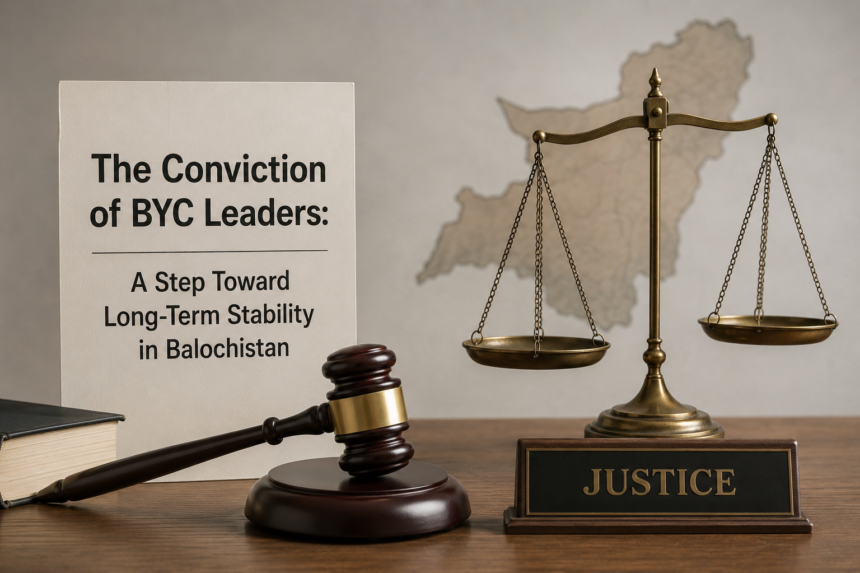

The Quetta Anti-Terrorism Court (ATC) found the chief organiser of the Baloch Yakjehti Committee (BYC) guilty in a case involving the death of a security personnel during a protest in Gwadar in July 2024. That protest turned violent when the protesters attacked Frontier Corps (FC) personnel with stones, resulting in injuries and the death of one FC soldier. On June 22, 2026, after hearing the case, ATC Quetta announced the verdict and handed life sentences to Dr. Mahrang Baloch and Sibghatullah Shahji. The recent court verdict has reignited a national debate about security, political activism, and the future of peace in Balochistan.
The decision is viewed as a necessary step toward restoring stability in the Balochistan province that has suffered decades of insurgency, violence, and political unrest. According to multiple First Information Reports (FIRs) registered by police in Quetta, Dr. Mahrang Baloch and several other leaders and supporters of the BYC have been accused of involvement in a range of activities that authorities describe as unlawful, violent, and detrimental to public order.
Similarly, there are charges against BYC members that they stormed the morgue at Civil Hospital Quetta and forcibly removed the bodies of five militants killed during a security operation against train hijacker protesters. They unlawfully entered the hospital premises, breached security arrangements, intercepted a private ambulance at Hockey Chowk, assaulted the driver, and used the vehicle to transport the bodies.
Moreover, the FIR, registered at Sariab Police Station on March 22, 2025, includes charges under different sections of the Anti-Terrorism Act (ATA) and the Pakistan Penal Code (PPC). The FIRs also include BYC leaders for inciting violence and encouraging protesters to engage in confrontations with law-enforcement personnel. According to police, these actions contributed to riots and clashes that resulted in the deaths of three individuals and injuries to multiple police officers.
In addition, police have accused BYC leaders and activists of promoting rebellion, creating public unrest, raising anti-state slogans, and encouraging actions that authorities consider harmful to national security and social stability. The FIRs further contain allegations of promoting racial hatred, damaging public and private property, and organizing demonstrations that disrupted normal life in various parts of Balochistan.
Another case registered at Brewery Police Station alleges that BYC leaders and supporters blocked the Western Bypass Road in Quetta, disrupted traffic, chanted anti-state slogans, and attempted to mobilize public unrest.
For years, Balochistan has remained at the center of Pakistan’s security challenges. While various groups have presented themselves as rights-based movements advocating for issues such as missing persons and political grievances, state institutions have repeatedly argued that some actors have crossed the line between activism and the facilitation of narratives that indirectly benefit militant organizations. Security officials maintain that extremist groups often rely not only on armed networks but also on supportive narratives that help create sympathy, legitimacy, and recruitment opportunities among vulnerable segments of society.
According to the state’s position, one of the most concerning aspects of the insurgency has been the gradual radicalization of educated youth. Authorities have frequently pointed to cases in which university students and young activists became involved with militant organizations after prolonged exposure to separatist narratives. From this perspective, the battle against insurgency is not confined to the mountains. It also involves contesting the narratives that encourage alienation, victimhood, and hostility toward the state.
Sustainable peace cannot be achieved solely through military operations. Long-term stability requires addressing the ideological and political environments that militants exploit for recruitment. Therefore, allowing organizations that repeatedly generate anti-state sentiments to create conditions that militant groups later exploit.
The broader lesson is that states must act before narratives evolve into security threats. They point to historical examples around the world where political grievances, identity-based mobilization, and separatist rhetoric eventually contributed to violent conflicts. From this standpoint, preventive measures are viewed as essential for protecting national cohesion and preventing further cycles of violence.
In prospect, the ultimate success of this decision will depend on whether it contributes to a more peaceful and inclusive Balochistan. Reducing the influence of divisive narratives may help discourage youth from embracing militancy and instead encourage greater participation in education, economic development, and democratic engagement. If combined with governance reforms, economic opportunities, and effective political outreach, the decision can represent an important step toward long-term peace and stability in the province.
This decision will boost the confidence of international investors who are interested in investing in Balochistan. One of the longstanding concerns has been that groups promoting anti-state and anti-development narratives were operating openly, while the government appeared reluctant to challenge them effectively. This development will therefore reassure not only investors but also the broader international and business community that the state is committed to protecting economic and development initiatives.
The challenge for Pakistan now is not only to maintain security but also to ensure that the current and next generations of Balochistan’s youth find hope, opportunity, and a sense of belonging within the constitutional framework of the state. Only then can lasting peace become a reality.
The author, Dr. Irfan Ashraf, is the Director General at the Centre for Development and Stability (CDS).