
China, the Global South, and the Battle for the Future of World Order
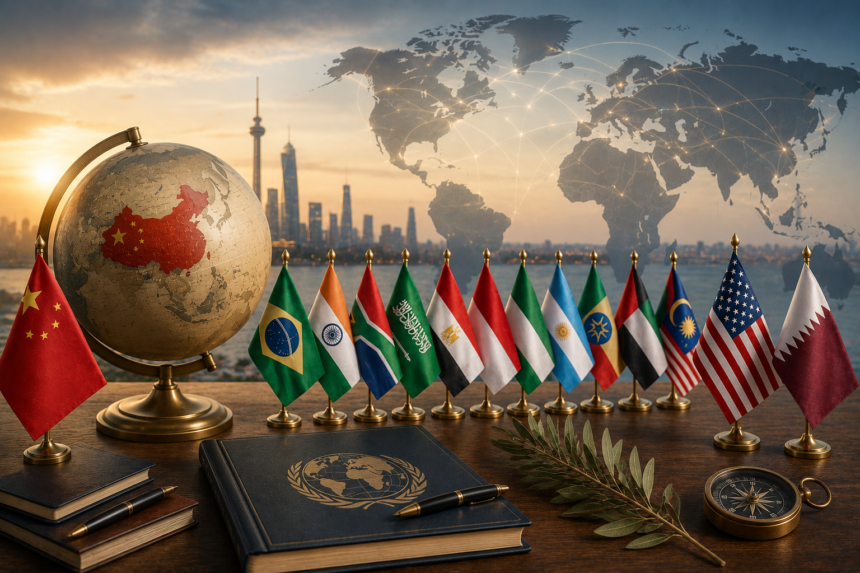
A profound structural transformation is reshaping contemporary international relations, driven by Beijing’s deliberate and systematic campaign to anchor itself as the primary leader of the Global South. Moving aggressively beyond its traditional focus on regional hegemony, China is utilizing its vast diplomatic, economic, and institutional statecraft to organize developing nations across Asia, Africa, and Latin America into a unified political bloc. This strategy aims to fundamentally challenge the normative foundations of the post-Second World War, Western-led international order.
For foreign policy journals and strategic think tanks, this shifting alignment indicates that major multilateral organizations most visible within the United Nations system have become the primary arenas for a systemic competition over who will write the rules of global governance.
The intellectual framework of Beijing’s strategy is built upon a sustained critique of current international institutions, which Chinese officials regularly describe as outdated, unrepresentative, and structurally biased toward Western interests. China has intensified its diplomatic demands for a radical redistribution of power within global governance, advocating for significantly expanded voting shares, reform of international financial institutions, and greater representation for developing states within the UN Security Council.
By framing its own spectacular economic modernization as a reproducible alternative to Western models, Beijing presents a non-interventionist template for infrastructure financing, industrial investment, and technological partnerships that directly appeals to countries seeking development without political conditionalities.
This approach finds an exceptionally receptive audience across the Global South, where many developing states harbor deep-seated, historical grievances against Western powers. These nations frequently point to a long pattern of structural adjustment programs, selective humanitarian interventions, and perceived double standards in the enforcement of international legal norms as evidence of an unequal global system.
To these states, China’s policy of strict non-interference in domestic political affairs offers a highly attractive alternative, allowing sovereign governments to secure vital developmental capital and modernization assistance without conforming to Western liberal standards regarding domestic governance or human rights. Consequently, many capitals see Beijing not as a revisionist threat, but as a useful counterweight that enhances their own international leverage.
Western capitals view this expanding network of influence with profound skepticism and growing strategic alarm, interpreting China’s initiatives as a sophisticated mechanism designed to construct a vast network of dependent client states. Critics frequently highlight the long-term risks of unsustainable debt accumulation, resource-extraction contracts, and the widespread export of digital surveillance infrastructure as proof of a highly self-serving geopolitical strategy.
They express concern that a Beijing-aligned voting majority in multilateral forums could systematically dismantle universal human rights standards, normalize state-centric cyber governance, and neutralize the traditional mechanisms of international law. The United Nations has thus become an intensely competitive diplomatic theater where competing definitions of sovereignty are continuously debated.
Ultimately, the evolving relationship between China and the Global South cannot be accurately understood through a simplistic, binary East-versus-West narrative. For developing countries, alignment with Beijing is rarely an outright ideological commitment; rather, it is a highly pragmatic strategy to maximize their own strategic autonomy within an emerging multipolar world.
By maintaining active partnerships with both Western and Chinese institutions, these states can leverage superpower competition to extract the best possible terms for their own national development. The rise of this loose, Beijing-anchored coalition signals the definitive end of the unipolar era, ushering in a fragmented global order where the Global South acts as an independent, decisive force in shaping the global distribution of power.
The author Rimsha Saleem is a researcher at Centre for Development and Stability (CDS).