
Why Pakistan Must Prioritise Security Over Afghanistan’s Internal Politics
By Maimona Saleem
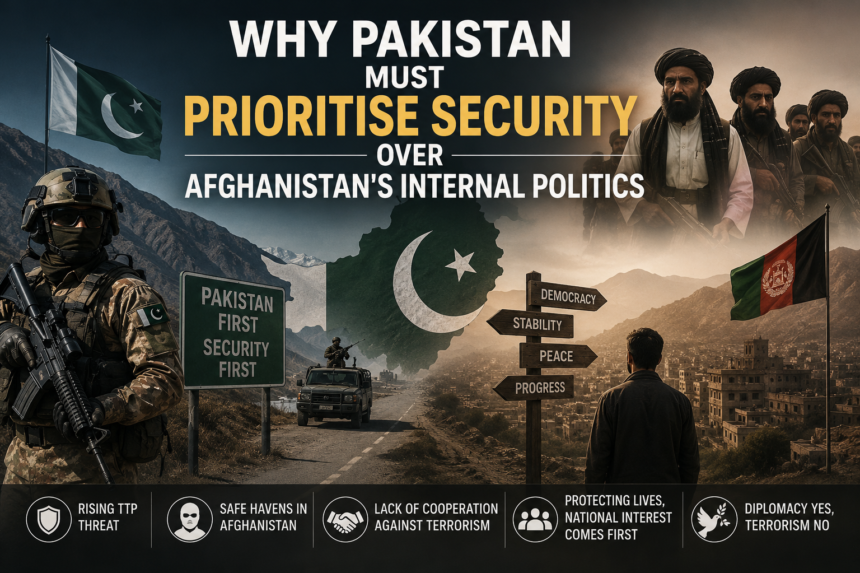
Pakistan today faces a difficult policy dilemma. On one hand, many Afghan politicians, activists, journalists, and former officials have taken refuge in Pakistan after the Taliban returned to power in 2021. On the other hand, Pakistan is facing an increasing terrorist threat from the Tehreek-e-Taliban Pakistan (TTP), whose leadership and fighters are operating from the territory of Afghanistan. In this situation, Pakistan must prioritise its own national security while continuing to support peace and stability in Afghanistan.
The foremost reality is that Afghanistan cannot build a democratic political system if its democratic voices remain outside the country. The only way to move toward an inclusive government in Afghanistan is to reconnect its political leaders, civil society, and democratic forces with the Afghan people. In the current situation, the Taliban’s restrictions and repression make this extremely difficult, and relying on neighbouring countries as a permanent political base is not a sustainable path for rebuilding Afghanistan. It would not be possible.
Another immediate concern is Pakistan’s national security. Terrorist attacks linked to the TTP have increased in recent years, causing heavy losses to civilians and security forces. Pakistan has repeatedly expressed apprehensions that the territory of Afghanistan is being used by the TTP to plan and launch attacks. Despite repeated diplomatic engagement and meaningful cooperation from the Afghan Taliban, action against the TTP has remained limited. This has deepened mistrust between the two neighbours and left Pakistan with growing, intense security challenges.
Every state has the primary responsibility to protect its citizens. When cross-border terrorism threatens lives and national stability, security naturally becomes the government’s highest priority. Although Pakistan may sympathise with the humanitarian situation in Afghanistan and support the Afghan people, it cannot ignore terrorist threats that directly affect its own population.
This does not mean that Pakistan should abandon relations with Afghanistan. Relatively, Pakistan should continue diplomatic dialogue, humanitarian assistance, and economic cooperation where possible. But these efforts must be accompanied by clear objectives that Afghan soil should not be used against Pakistan. Sustainable peace between the two countries depends on cooperation against terrorism and respect for each other’s security concerns.
The point, in fact, is that Pakistan faces a strategic reality rather than an easy choice. Until the Afghan Taliban demonstrate sincere action against the TTP and other anti-Pakistan militant groups, Pakistan is likely to continue placing national security above broader political questions regarding Afghanistan’s internal future. Protecting its citizens is not only a strategic necessity but also the fundamental responsibility of any sovereign state.
The author, Maimona Saleem, is a senior researcher at CDS and a PhD scholar in Peace and Conflict Studies. Her research focuses on terrorism and extremism. Her work also focuses on peace-based approaches to economic development, growth, and regional cooperation. She also writes on geopolitics, regional security, and global power dynamics