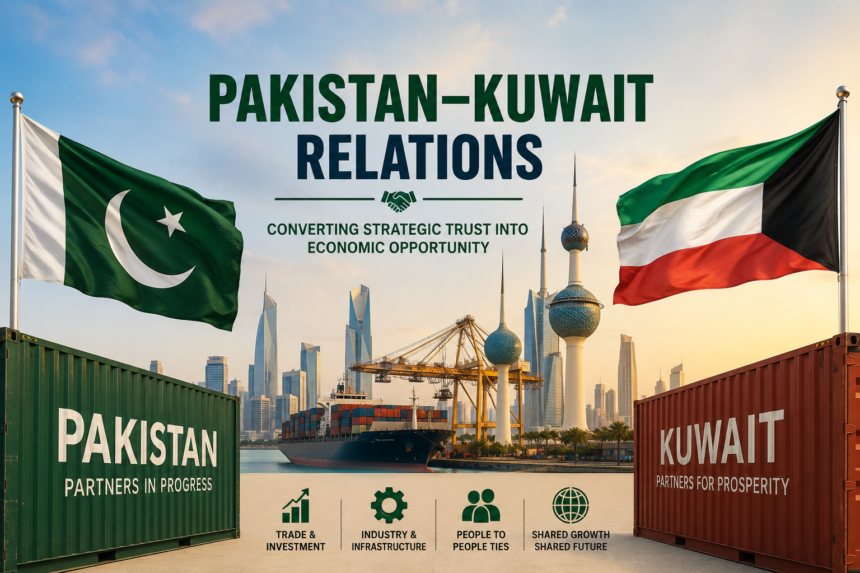

The true value of a defence agreement is not measured by military cooperation alone, but by the opportunities it creates beyond security. Kuwait’s ratification of its defence pact with Pakistan offers both countries a chance to transform decades of trust into a broader partnership driven by trade, investment and technology.
Nuzhat Nazar
Some bilateral relationships are defined by frequent headlines. Others develop quietly through institutional trust, sustained diplomatic contact and the movement of people, skills and capital.
Pakistan and Kuwait fall into the second category. Their relationship has remained stable for more than six decades, supported by political understanding, defence engagement, energy ties and a Pakistani community that has contributed to Kuwait’s economy. Kuwait’s ratification of a comprehensive defence cooperation agreement now offers both countries an opportunity to give this longstanding relationship greater strategic and economic depth.
Ratified through Decree-Law No. 73 of 2026, the agreement was originally signed in June 2023. It creates a formal framework for cooperation between the armed forces of Pakistan and Kuwait in military education, training, intelligence, logistics, scientific research, defence technology, electronic communications and military manufacturing.
It also provides for joint exercises, exchanges of instructors and specialists, official visits and the establishment of a Joint Military Committee to supervise implementation. The agreement will remain in force for five years and renew automatically unless either side decides otherwise.
Its importance lies in the structure it provides. Defence cooperation will no longer depend mainly on periodic visits or individual initiatives. It can now advance through regular institutional coordination, defined areas of work and long-term planning.
Pakistan and Kuwait established diplomatic relations in the early 1960s, shortly after Kuwait gained independence. Since then, they have maintained close political engagement and supported each other at international forums, including the United Nations and the Organisation of Islamic Cooperation.
The relationship has also been sustained by human connections. Pakistani doctors, engineers, teachers, technicians, bankers and construction workers have served in Kuwait for decades. Their contribution has strengthened Kuwait’s economy while creating a durable social link between the two countries.
The new agreement gives this historic relationship a stronger security dimension at a time when the nature of regional threats is changing.
Gulf security is no longer shaped by conventional military risks alone. Cyberattacks, drones, maritime insecurity, artificial intelligence and threats to critical energy infrastructure have become central concerns. Kuwait is modernising its defence capabilities in response to this environment, while Pakistan offers practical experience in counterterrorism, intelligence coordination, border management, military training and disaster response.
Pakistan’s defence institutions also provide scope for more specialised cooperation. Pakistan Aeronautical Complex, Heavy Industries Taxila and Karachi Shipyard have developed capabilities in aviation, armoured platforms, naval engineering, maintenance and defence production.
The agreement’s reference to military manufacturing and technology could therefore lead to collaboration in aircraft servicing, communications systems, defence electronics, unmanned platforms and technical support. Such projects would create a more durable partnership than a conventional buyer-seller relationship.
The larger opportunity, however, lies in using strategic trust to expand economic ties.
Trade between Pakistan and Kuwait remains limited and concentrated in a relatively narrow range of products. Pakistan exports rice, meat, textiles, fruits, vegetables, sports goods and surgical instruments, while its imports from Kuwait largely consist of petroleum products, petrochemicals and industrial inputs.
This pattern does not reflect the full capacity of either economy.
Kuwait is a high-income market that depends heavily on imports. Pakistan could increase its presence by supplying processed food, halal meat, pharmaceuticals, medical equipment, construction materials, engineering services and information technology solutions. Greater attention to packaging, certification, logistics and regular shipping links would help Pakistani businesses compete more effectively.
Food security presents a particularly strong area of cooperation. Pakistan has agricultural capacity, while Kuwait seeks reliable long-term food supplies. Investment in cold storage, warehousing, food processing and agricultural value chains could support both Pakistani producers and Kuwaiti consumers.
Investment offers an even larger opening.
The Kuwait Investment Authority is one of the world’s most influential sovereign investors. Pakistan, meanwhile, is seeking long-term capital in energy, mining, agriculture, ports, logistics, digital infrastructure, tourism and Special Economic Zones.
But diplomatic goodwill alone will not attract sovereign investment. Pakistan must offer bankable projects, regulatory predictability, credible feasibility studies and clear commercial returns. Rather than presenting Kuwait with broad lists of sectors, Islamabad should identify a small number of mature projects that can move quickly from discussion to financial closure.
Renewable energy, mineral development, port logistics, food processing and digital infrastructure could provide realistic starting points.
Human capital should form another pillar of the relationship. As Kuwait diversifies its economy, demand is likely to grow for skilled workers in healthcare, engineering, information technology, hospitality, energy and technical services.
Pakistan should align vocational training and professional certification with Kuwait’s labour requirements. This would allow Pakistani workers to move into higher-paying positions while giving Kuwait access to a trained and dependable workforce.
Education and research can further broaden bilateral ties. Universities, military institutions and technical organisations could collaborate in cybersecurity, artificial intelligence, water management, medical sciences, disaster preparedness and climate resilience.
These areas would give the partnership relevance beyond traditional defence, labour and energy cooperation.
For Pakistan, stronger ties with Kuwait would diversify its engagement with the Gulf Cooperation Council and reduce the tendency to view Gulf relations mainly through emergency financing or manpower exports. For Kuwait, Pakistan offers a large consumer market, experienced security institutions, agricultural capacity, skilled professionals and a strategic location connecting the Gulf with South Asia, China and Central Asia.
The defence agreement has created a useful institutional opening. Its value will ultimately depend on implementation.
Joint exercises, technology projects and military exchanges will be important, but they should be accompanied by higher exports, completed investments, industrial partnerships and expanded employment opportunities.
Pakistan and Kuwait do not need to build trust from the beginning. They already possess it. Their challenge is to turn that trust into measurable outcomes.
The defence pact can provide the strategic foundation. Trade, investment, technology and human capital must now give the relationship its economic substance.