
Asif Haroon Raja
Partition and Divergent Beginnings (1947–1950s)
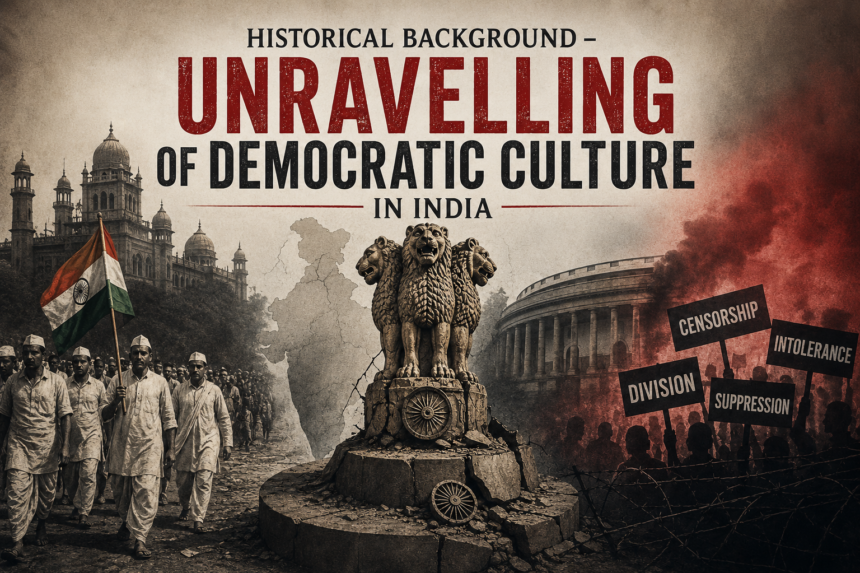
The article argues that although India developed a strong democratic image after independence, deep social inequalities, communal tensions, and the rise of Hindu nationalist politics particularly under the BJP have, according to the author, weakened democratic institutions, secularism, and civil liberties. It contends that recent student protests over exam leaks and unemployment reflect broader public frustration with governance, shrinking democratic space, and declining trust in state institutions rather than being isolated incidents.
Following the partition of the Indian subcontinent in August 1947, India and Pakistan emerged as two independent States.
Pakistan began its journey virtually from scratch and faced enormous political, economic and administrative challenges.
These difficulties were compounded by strained relations with India, which was reluctant to accept partition as a permanent reality.
Pakistan was denied the timely transfer of several financial and material assets due under the Partition Agreement, while the suspension of canal waters in 1948 further deepened tensions between the two newly independent states.
The death of the founder of Pakistan, Quaid-e-Azam Muhammad Ali Jinnah, in September 1948 deprived the fledgling nation of its most unifying leader at a critical juncture.
The country subsequently faced political instability, a leadership crisis and constitutional delays.
Pakistan’s Early Political Challenges
During its first democratic phase, seven prime ministers assumed office within seven years. It took nine years to frame Pakistan’s first Constitution in 1956, while disputes over power-sharing between East and West Pakistan further widened political divisions.
Congress Era and Democratic Image
India, by contrast, inherited the well-established organisational structure of the Indian National Congress under Prime Minister Jawaharlal Nehru, along with the larger share of the subcontinent’s administrative institutions, industrial base and financial resources.
It also enjoyed continuity in governance and international recognition.
India’s Constitution came into force in 1950, and the integration of more than 560 Princely States proceeded rapidly. Land reforms and administrative consolidation strengthened the authority of the central government.
Nehru remained in office until his death in 1964 and was succeeded by Lal Bahadur Shastri, followed by his daughter, Indira Gandhi. The Congress Party remained India’s dominant political force for several decades.
Mistrust Spoiled Bilateral Relations
Pakistan viewed India as its principal security challenge, while many in Pakistan believed that influential circles in India had never fully reconciled themselves to Partition and hoped that Pakistan would eventually fail as a state.
The resulting mistrust shaped bilateral relations and contributed to repeated military confrontations.
Pakistan’s Security Concerns
Faced with growing security concerns on both its eastern and western borders, Pakistan gradually abandoned its initial non-aligned posture and joined Western security alliances during the Cold War.
Although these alliances brought military assistance, they also increased Pakistan’s dependence on the United States and constrained the development of an independent foreign policy.
India’s Institutional Consolidation
For nearly five decades, India cultivated an international image as the world’s largest democracy.
The Congress-led political system promoted constitutional governance, electoral continuity, political pluralism and secularism, earning India considerable diplomatic goodwill and soft power.
Underlying Social Contradictions
Yet beneath this democratic image, deep structural inequalities persisted. The centuries-old caste system continued to shape social relations despite constitutional safeguards, while communal tensions periodically erupted into violence.
India’s Muslim community, the country’s largest religious minority, frequently bore the brunt of these disturbances, alongside other minority groups.
Despite significant constitutional protections, social discrimination, economic inequality and communal polarisation continued to undermine the ideals of equality and secularism.
Large segments of the population remained affected by poverty, illiteracy and inadequate access to education, healthcare and other essential public services.
Rise of the BJP and Hindu Nationalism
A major political shift occurred with the rise of the Bharatiya Janata Party (BJP), widely regarded as the political arm of the Rashtriya Swayamsevak Sangh (RSS).
The Ram Janmabhoomi movement and the demolition of the Babri Mosque in Ayodhya in 1992 marked a turning point in Indian politics, accelerating the growth of Hindu nationalist ideology.
Narendra Modi emerged as a national political figure after serving as Chief Minister of Gujarat.
The 2002 Gujarat riots, in which over one thousand people—most of them Muslims according to many official and independent accounts—lost their lives, remain one of the most controversial episodes in modern Indian history.
Critics have continued to question his administration’s handling of the violence, while his supporters reject allegations of official complicity.
Modi Era: Economic Achievements
Despite the controversy, Modi led the BJP to a decisive electoral victory in 2014 and has remained India’s dominant political leader since then.
During his tenure, India has achieved impressive gains in economic growth, infrastructure development, digital services, technological innovation and foreign exchange reserves. The country has increasingly projected itself as a rising global power and an attractive investment destination.
India’s Failures
At the same time, critics contend that India’s democratic institutions have experienced growing strain. They argue that press freedom, judicial independence, academic autonomy and civil liberties have come under increasing pressure, while religious minorities have become more vulnerable to discrimination and intimidation.
Youth unemployment, allegations of corruption, recurring examination paper leaks and accusations of political interference in educational institutions have fuelled growing frustration among students and educated young people.
Many graduates struggle to secure meaningful employment despite years of higher education.
According to critics of the present government, democratic space has narrowed considerably, dissent is increasingly discouraged and protests are often met with heavy-handed policing.
They argue that political opponents, journalists, academics and civil society activists face growing pressure, creating an atmosphere of fear and self-censorship.
The enactment of the Citizenship Amendment Act (CAA) in 2019 became one of the most contentious developments in recent years.
Opponents viewed the legislation as discriminatory towards Muslims and inconsistent with India’s secular constitutional ethos, while the government defended it as a humanitarian measure intended to protect persecuted religious minorities from neighbouring countries.
The controversy triggered nationwide protests and episodes of communal violence.
Mob lynchings related to cow slaughter or beef consumption, together with instances in which homes of accused individuals have been demolished by local authorities, have attracted widespread domestic and international criticism.
Human rights organisations have argued that such incidents have disproportionately affected Muslims and have contributed to increasing communal polarisation.
The Students Backlash
Against this historical backdrop, the recent wave of student protests should not be viewed as an isolated reaction to examination irregularities.
Rather, they reflect the cumulative frustration of a generation grappling with unemployment, allegations of institutional decay, shrinking democratic space and diminishing confidence in the fairness of public institutions.
The protests therefore represent more than a demand for educational reforms; they are a manifestation of a deeper crisis confronting India’s democratic order.
Against this backdrop, student organisations have emerged as an important voice of dissent. Their recent protests over recurring examination paper leaks, alleged irregularities in recruitment processes and perceived failures of governance have become symbolic of a broader crisis of public confidence in India’s democratic institutions and administrative accountability.
I will address the growing wave of youth-led protests in India in my next write-up, placing them in the broader context of the Hindu majoritarian ideology espoused by the BJP and other like-minded organisations.
I will examine how this ideology has progressively eroded India’s democratic culture, weakened its secular foundations, and fuelled increasing political and social polarisation.
About the Author
Brigadier (Retd) Asif Haroon Raja, SI (M) is a war veteran. He is Command and Staff Course and War Course qualified, holds an MSc in War Studies, and served as Defence Attaché in Egypt and Sudan, as well as Dean of the Corps of Military Attachés in Cairo.
He is a defence, security, and geopolitical analyst, columnist, featured columnist of IntelDrop magazine Washington, author of five books, former Chairman of Thinkers Forum Pakistan, Patron-in-Chief of Centre for Development Studies Think Tank, Director of Meesakh Research Centre; he regularly appears on media platforms.