
The Indian student protests were peaceful and focused on educational issues, while political protests in Pakistan have been more disruptive and politically motivated. The author believes the two movements should not be compared and advocates for peaceful, issue-based protests.
Part Two
Asif Haroon Raja
Stark Difference in Approaches of Dealing with Protests in India and Pakistan
In Pakistan, some political activists have drawn comparisons with the Indian protests led by students over the alleged leaking of an examination paper. However, such comparisons overlook the significant differences in the nature, conduct, and objectives of the two movements.
They then adopt an emotional tone, trying to create the impression that, “Look, at least India has enough freedom for people to protest, whereas in Pakistan even that freedom does not exist.”
The question is: Is this claim accurate? The answer is no—not at all. It is, in fact, a classic example of the tactics employed by those who excel at post-truth narratives and the art of repeating falsehoods.
Pakistan, too, had the freedom to protest—indeed, considerable freedom. The demonstrations held at D-Chowk witnessed scenes rarely seen elsewhere: graves were dug symbolically, shalwars were hung on the railings of the Supreme Court, loud music blared, people danced, and the entire spectacle resembled a picnic rather than a political protest. Such theatrics were virtually unprecedented.
Even after that, the protesters continued to enjoy extraordinary latitude. At one stage, when they themselves were in power in Punjab, their supporters blocked Murree Road precisely when schoolchildren were returning home. A journey that normally took twenty-five minutes stretched to eight or nine hours for many families.
No one appeared to consider the hardship inflicted on women and children trying to get home safely.
While their own children were reportedly living comfortably abroad, they seemed to have lost all sense of empathy or responsibility. The roads were deliberately blocked at the busiest hour for schoolchildren, reflecting what many regarded as the height of irresponsibility.
Thereafter, protests became a recurring spectacle. Roads were blocked, cities were paralysed, and repeated calls were made to shut down the entire country. From public stages, leaders openly declared that they would “bring the country to a standstill.”
One outspoken speaker from Rawalpindi repeatedly threatened to “set the entire country on fire.”
The manner in which the right to protest and freedom of expression were misused and weaponised in Pakistan by a few political parties has no parallels.
There has been no comparable campaign demanding the appointment of an army chief of one’s own choosing, nor threats to shut down the country over such appointments.
Nor has there been an attempt to mobilise a provincial government and its supporters to march on the federal capital, block roads, close cities, or repeatedly announce protests whenever a foreign dignitary visits the country or on every national occasion.
For these reasons, the student movement in India cannot reasonably be compared with the disruptive and destabilising agitation witnessed in Pakistan.
Merely because a particular group may be highly skilled at propagating false narratives does not mean those narratives should be accepted as truth.
Those drawing such comparisons should also remember the days when female teachers in Islamabad staged a protest, were allegedly subjected to force, and were detained along with their children.
At the time, a federal minister reportedly remarked, “We had expired tear-gas shells lying around, so we thought we might as well use them.”
A Critical Appraisal
Since the removal of the PTI government in April 2022, political agitation in Pakistan has, at times, been accompanied by violence and confrontations with state institutions.
By contrast, supporters of the Indian protests have portrayed their movement as being centred on educational reforms, examination integrity, and youth grievances. These differing contexts make direct comparisons difficult and open to debate.
We also need to understand what was the purpose of the demonstration? Was it a political or social issue ? Were the protestors from a political party or representing the whole nation by keeping themselves away from political parties and slogans .
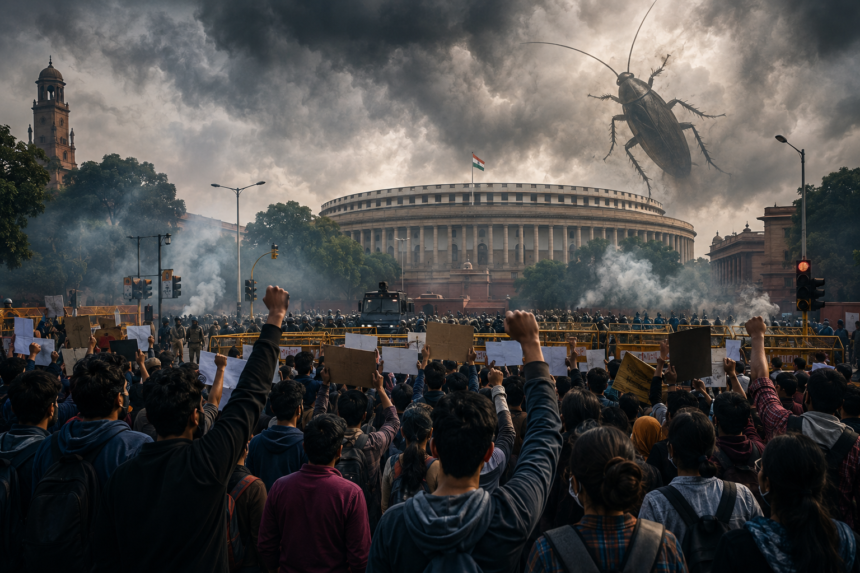
They didn’t abuse India nor their armed forces. They only took to the street, faced police brutality stoically , only for a very genuine public concern , not for the release of a prisoner or to dismantle the government , that’s why they had the support of the whole nation and succeeded .
Did anyone from the so-called “Cockroach Party” raise slogans of “Death to India”? Did anyone mock their own armed forces over their salaries?
Did anyone say that Modi’s army was defeated by Pakistan in May? Did anyone say that Pakistan captured Abhinandan? Did anyone demand that Modi be held accountable for it?
Did anyone say that China occupied Ladakh and demanded an explanation for how hundreds of soldiers were killed?
Did anyone say that soldiers dying in Jammu or elsewhere are paid from our taxes, so why should ceremonies be held in their honour?
Did anyone ask Pakistan for help? Did anyone ask Pakistan to provide them with weapons? Did you see any of them carrying sticks, explosives, or stones to attack police personnel? Absolutely not.
They endured police action, yet they neither attacked their own security personnel nor abused their own country. That is how protests are conducted.
Here, however, four people gather and the first thing they do is abuse their own country, portray Modi as their “father figure,” attack the armed forces, and start raising slogans for secession from the country.
That is why they end up disgraced and humiliated and fail to achieve success.
I wish people here also followed the same pattern and purpose to resolve their social and economic issues.
To be Concluded
About the Author
Brigadier (Retd) Asif Haroon Raja, SI (M) is a war veteran. He is Command and Staff Course and War Course qualified, holds an MSc in War Studies, and served as Defence Attaché in Egypt and Sudan, as well as Dean of the Corps of Military Attachés in Cairo.
He is a defence, security, and geopolitical analyst, columnist, featured columnist of IntelDrop magazine Washington, author of five books, former Chairman of Thinkers Forum Pakistan, Patron-in-Chief of Centre for Development Studies Think Tank, Director of Meesakh Research Centre; he regularly appears on media platforms.