
Asif Haroon Raja
A Dangerous Stalemate and the Prospect of Renewed Hostilities
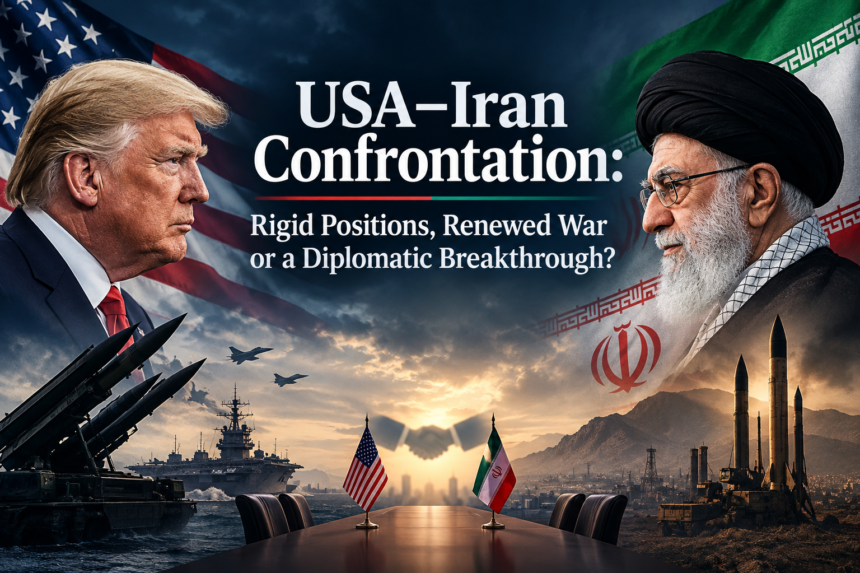
The US–Iran war, which began on 28 February 2026 with US-Israeli strikes on Iran, has entered a dangerous and increasingly unpredictable phase after nearly eight months of attritional warfare. Despite intermittent ceasefires and repeated diplomatic initiatives, the fundamental causes of the confrontation remain unresolved.
The conflict has evolved into a contest of military endurance, economic coercion, strategic deterrence and political will. Neither side appears willing to concede what it considers vital to its national security and strategic interests.
The Approaching Elections
The upcoming Israeli elections on October 27 and the US midterm elections on November 3 have added another layer of uncertainty to an already volatile situation. Domestic political considerations could influence the timing and nature of military decisions.
Both Netanyahu and Trump face significant political challenges. In Israel, the far-right factions are exerting growing pressure on Likud, while in the United States, Trump’s declining approval ratings could complicate his party’s prospects in the midterm elections.
These domestic pressures may shape their respective calculations regarding any renewed military confrontation with Iran.
Nuclear Concerns
The immediate impasse revolves around Iran’s enriched uranium stockpile, its nuclear programme, the US naval blockade, economic sanctions and the future security architecture of the Persian Gulf.
Washington seeks verifiable restrictions to prevent Iran from advancing towards a nuclear weapons capability, while Tehran regards its nuclear programme as an assertion of national sovereignty and a source of strategic leverage.
The two positions have hardened to the point where compromise is becoming increasingly difficult. The central question is no longer simply whether hostilities will resume, but whether Washington and Tehran can devise a formula that allows both to disengage without appearing to surrender their principal objectives.
- The Nuclear Impasse: Sovereignty versus Security
A significant recent development was Tehran’s unequivocal rejection of transferring its enriched nuclear material outside Iran.
On 20 October, Mohsen Rezaei, Secretary of Iran’s Supreme National Security Council, conveyed this position to Pakistan’s Chief of Defence Forces, Field Marshal Asim Munir, during the latter’s visit to Tehran as part of Pakistan’s renewed mediation efforts.
Rezaei declared that not even a particle of enriched nuclear material would leave Iran, describing the stockpile as a national asset intended for domestic use.
Iran’s parliamentary speaker and chief negotiator, Mohammad Bagher Ghalibaf, also stressed that negotiations could not progress without Washington taking steps to rebuild trust. (Dawn, 20 October 2026.)
This declaration has elevated the uranium stockpile from a technical negotiating issue to a question of national dignity, sovereignty and strategic survival.
Iran’s reported stockpile of uranium enriched to 60 per cent purity is particularly sensitive. Although below the approximately 90 per cent enrichment commonly associated with weapons-grade uranium, it is far above the levels ordinarily required for civilian nuclear power.
Such material can be further enriched if the necessary facilities and technical capabilities remain available. Its possession, however, does not by itself establish that Iran has decided to manufacture a nuclear weapon.
Tehran insists that it will not surrender its accumulated nuclear assets under military pressure. Washington, meanwhile, is unlikely to accept an arrangement that leaves Iran with an inadequately monitored stockpile of highly enriched uranium and the capacity to advance its nuclear programme.
Iran has also demanded the lifting of the US naval blockade, the release of frozen assets, sanctions relief and credible assurances against renewed attacks. Tehran argues that negotiations conducted under military coercion cannot produce a durable settlement.
The result is a strategic deadlock. If Washington insists on removing the enriched material from Iran while Tehran refuses to permit its transfer abroad, negotiations will remain paralysed unless an alternative arrangement can reconcile the two positions.
- Is Washington Preparing for Another Military Offensive?
The possibility of renewed US-Israeli military action has gained prominence following reports that the two countries have developed plans for a short but intensive campaign against Iran.
A report published by The New York Times on 21 October and subsequently carried by other international media, taking cue from Israeli fighter jets conducting sorties close to Iran’s border, described preparations for possible renewed strikes against Iranian nuclear facilities, missile and drone arsenals, and selected energy infrastructure.
The report indicated that military exercises had intensified and that planners were examining options for operations following the US midterm elections. Potential targets reportedly include the deeply buried Pickaxe Mountain nuclear facility. (Dawn, 22 October 2026.)
The reported objective would be to inflict sufficient additional damage on Iran’s military and economic capabilities to compel Tehran to make concessions at the negotiating table.
Nevertheless, military planning must not be confused with a final political decision to resume hostilities. The timing, scope and authorisation of any offensive remain uncertain.
Reporting on 22 October also indicated that the White House had ruled out renewed attacks before the midterm elections, although this does not settle what might happen afterwards.
The MOAB Question
One dramatic claim circulating in connection with a possible offensive concerns the alleged deployment of GBU-43/B Massive Ordnance Air Blast bombs, commonly known as MOABs or the “Mother of All Bombs”.
The MOAB weighs approximately 9,800 kilograms, or 21,600 pounds, often rounded to 22,000 pounds. It is among the largest conventional bombs in the US inventory, designed primarily to produce an enormous blast effect over a broad area.
However, its destructive mechanism must be distinguished from that of a specialised earth-penetrating weapon. The MOAB is not designed primarily to penetrate deeply buried granite facilities, and its delivery requires a suitable aircraft and specialised arrangements.
Consequently, the suggestion that MOABs alone could destroy a deeply buried installation such as Pickaxe Mountain should not be treated as an established military assessment.
The challenge is not merely to deliver an exceptionally powerful weapon, but to destroy or disable facilities protected by depth, hardened structures, dispersed infrastructure and potentially redundant systems.
Even a major air campaign might damage entrances, utilities and supporting infrastructure without conclusively eliminating every underground capability.
The strategic significance of a renewed offensive would therefore depend less on the spectacle of a particular weapon and more on whether the campaign could achieve its political objectives without provoking a wider war.
- Military Build-up, Diplomatic Warnings and the Risk of Miscalculation
Washington’s regional posture provides another indication of the deteriorating security environment.
On 21–22 October, reports confirmed that the US State Department had ordered non-emergency personnel and their families to leave Saudi Arabia amid escalating Houthi attacks and concerns over regional security.
The State Department specifically confirmed the departure order for Saudi Arabia; reports of similar measures elsewhere in the Gulf should be treated separately unless officially confirmed. (Reuters, 21 October 2026.)
These developments illustrate how the confrontation has expanded beyond the immediate US-Iran theatre. Gulf infrastructure, maritime routes, diplomatic missions and regional military installations are increasingly exposed to retaliatory action.
Separately, reports describe US military preparations for a possible renewed campaign, potentially involving additional aircraft, naval forces and Marines.
Such deployments would expand Washington’s offensive and defensive options, but would not, by themselves, prove that an attack had been authorised.
Naval and air deployments can serve several purposes: deterring Iranian action, protecting shipping, reinforcing regional allies, defending American installations and maintaining the ability to strike if ordered.
Yet military preparations can also increase the risk of escalation if either side interprets defensive measures as evidence of an imminent offensive.
A particularly dangerous scenario would emerge if Washington launched operations while Iran was preparing retaliatory measures against American bases, Gulf energy facilities or commercial shipping. An initially limited exchange could then develop into a wider regional confrontation.
- Could Iran Reconsider Its Nuclear Doctrine?
Another development requiring attention is the reported debate within Iranian academic and political circles over the country’s longstanding religious prohibition on nuclear weapons.
Some commentators close to the establishment have reportedly suggested that the doctrine associated with the Supreme Leader’s fatwa against nuclear weapons may require reconsideration in the face of what they regard as an existential threat.
Such statements, if accurately reported, indicate that the war may be influencing Iran’s internal strategic debate. However, public advocacy by individual academics or political figures is not equivalent to a formal change in state policy, nor does it establish that Iran has decided to manufacture a nuclear weapon.
Nevertheless, the issue cannot be dismissed. If Iranian decision-makers conclude that conventional deterrence, diplomacy and international guarantees have failed to prevent repeated attacks, pressure to reconsider the country’s nuclear posture could intensify. This would produce a strategic paradox:
Military action intended to prevent Iran from acquiring a nuclear weapon could strengthen the arguments of those who believe that only a nuclear deterrent can protect the country against future attacks.
Such an outcome would undermine the central justification for the war and potentially create a more dangerous long-term security environment.
The international community therefore has a direct interest in preventing the conflict from pushing Iran towards a fundamental reassessment of its nuclear doctrine.
- The Midterm Elections and the Possibility of an “October Surprise”
The US midterm elections that are only ten days away have introduced an additional political dimension to the crisis.
According to the reported US-Israeli military planning, renewed strikes are being considered for the period after the elections. The political and economic consequences of a new offensive are likely to weigh heavily in Washington’s calculations.
First, a major conflict before the elections could impose immediate economic and political costs. Any substantial disruption to Gulf oil supplies would threaten energy markets, raise fuel prices and expose the administration to criticism over the consequences of its foreign policy.
Second, supporters of military action might present a new offensive as a decisive effort to neutralise Iran’s nuclear and missile capabilities. Its political impact, however, would depend on the outcome.
A swift operation perceived as successful might strengthen the administration’s position, whereas prolonged fighting, American casualties or a sharp rise in energy prices could produce the opposite effect.
Third, postponing military action until after the elections would allow Washington to reassess its political position, military deployments and diplomatic options. It would not necessarily mean that an attack would follow.
The expression “October Surprise” is therefore better understood as a political possibility than as a confirmed operational timetable.
The more specific scenario suggested by recent reporting is a potential post-midterm offensive in November.
Military preparations may also be intended to increase negotiating pressure without ultimately being followed by an attack.
The possibility of renewed hostilities is serious, but the available reporting does not establish that a final decision has been taken.
- Three Possible Scenarios After the Midterms
Scenario One: A Renewed US-Israeli Offensive
One possibility is a short but intensive campaign against selected Iranian nuclear facilities, missile and drone infrastructure, military installations and, potentially, elements of the energy sector.
The objective would be to weaken Iran’s retaliatory capacity and impose additional economic costs, thereby persuading Tehran to accept stricter nuclear restrictions.
Pickaxe Mountain is among the targets reportedly under consideration. Iranian missile bases, drone production facilities and other military infrastructure could also feature in operational planning.
Attacks on energy facilities would carry particularly serious risks. They might reduce Iran’s revenue and damage its economic capacity, but they could also encourage retaliation against Gulf oil installations, refineries, pipelines, ports and maritime infrastructure.
Iran retains several potential means of imposing costs on its adversaries, including missiles, drones, naval capabilities and the ability to threaten commercial shipping.
The effectiveness of these options would depend on the damage inflicted on its forces and the performance of American and allied defences.
The Strait of Hormuz would be central to any escalation. Roughly one-fifth of global petroleum liquids consumption has historically passed through this waterway. A prolonged disruption could raise oil prices, insurance premiums and shipping costs, with consequences extending far beyond the Middle East.
A new offensive might inflict substantial damage on Iran without achieving a durable political settlement. Unless military pressure were accompanied by a credible diplomatic exit, Tehran could interpret the campaign as further evidence that it must expand its deterrent capabilities.
Scenario Two: Renewed Diplomacy and a Compromise over Uranium
A second possibility is the resumption of negotiations, potentially facilitated by Pakistan, Oman, Qatar or other intermediaries.
Iran’s refusal to transfer enriched uranium abroad does not necessarily make a diplomatic solution impossible. It does, however, require an approach that does not depend exclusively on removing the stockpile from Iranian territory.
A possible compromise could include the following elements:
Dilution Inside Iran:
Iran could agree to dilute its 60 per cent enriched uranium to a substantially lower enrichment level under an internationally verified arrangement.
Enhanced IAEA Verification:
The International Atomic Energy Agency could be granted agreed access, monitoring arrangements and accounting procedures to verify the disposition of the material, subject to the necessary legal and technical agreements.
Temporary Enrichment Framework:
Iran could accept defined limits on enrichment levels, quantities and activities, with compliance monitored by the IAEA.
Reciprocal Sanctions Relief:
The United States could phase in specified sanctions relief as Iran meets verifiable milestones.
Security Assurances:
The parties could negotiate reciprocal commitments concerning attacks on nuclear facilities and other agreed restrictions, supported by appropriate international participation.
Maritime De-escalation:
The US naval blockade and Iranian restrictions affecting shipping could be addressed through a staged agreement restoring safe and predictable commercial navigation.
A Russian role in technical arrangements could be considered if acceptable to both parties. Pakistan might contribute as a facilitator or diplomatic guarantor, provided that the parties agree to a clearly defined mandate.
Neither country could independently guarantee compliance without credible monitoring and enforcement mechanisms.
Dilution inside Iran would not, by itself, resolve every concern about the nuclear programme. The quantity, location, chemical form and accessibility of the material, together with Iran’s remaining enrichment capacity, would all matter. Verification would therefore be indispensable.
The advantage of this approach is that Tehran could maintain that it had not surrendered its national assets, while Washington could argue that the immediate proliferation risk had been reduced.
A face-saving formula of this kind offers a potential bridge between sovereignty and security. Whether either side would accept it remains uncertain.
Scenario Three: A Prolonged Stalemate and War of Attrition
A third possibility is that neither side launches a decisive offensive and neither accepts the other’s principal conditions.
Under this scenario, the United States would continue economic pressure, maritime restrictions and military deterrence, while Iran would preserve its nuclear leverage, resist concessions and retain the ability to threaten regional interests.
Intermittent attacks, maritime incidents, regional proxy activity and diplomatic initiatives could continue without producing a comprehensive settlement.
Although this might appear less dangerous than a major offensive, it would remain unstable. A miscalculation, an attack causing substantial casualties or a strike against critical energy infrastructure could trigger another round of escalation.
A prolonged stalemate would impose mounting costs on Iran, the United States, Israel and the Gulf countries. It would discourage investment, disrupt shipping and complicate regional stabilisation.
For Iran, economic hardship and military attrition could deepen domestic pressures.
For Washington, the cost of maintaining forces and defending regional partners could grow. For Gulf States, the prospect of becoming the battlefield of a renewed confrontation would remain a major strategic concern.
The principal danger is that a conflict without a clear political end-state could continue until an incident forces both sides into a much larger war.
- Israel’s Calculations and the Wider Regional Dimension
Israel’s security concerns remain closely linked to the outcome of the confrontation.
Reports of discussions between Prime Minister Benjamin Netanyahu and US Defence Secretary Pete Hegseth, alongside reports of renewed operational planning, indicate that military coordination remains important.
They do not, however, establish that the two governments have agreed on a final date for renewed hostilities.
Israel has long regarded Iran’s nuclear programme, missile arsenal and regional military relationships as major security concerns. It may therefore favour additional military pressure if it concludes that existing arrangements cannot adequately constrain Iran.
Washington must weigh the potential benefits of further strikes against the risks of Iranian retaliation, disruption to global energy markets and the possibility of being drawn into a prolonged regional war.
Domestic political considerations in both countries may influence the debate, but the electoral consequences of a new offensive cannot reliably be predicted.
The wider regional equation is equally important. Saudi Arabia and other Gulf States have a direct interest in preventing their energy infrastructure, ports and population centres from becoming targets in a renewed US-Iran confrontation.
The Houthis’ attacks on Saudi Arabia demonstrate how the conflict can spread across multiple theatres. Although Iran has supported the movement, the degree of Iranian control over individual Houthi decisions should not be assumed to be absolute.
A wider war could therefore involve multiple actors pursuing overlapping but not necessarily identical objectives.
For the Gulf States, the challenge will be to preserve their security relationships with Washington while avoiding unnecessary exposure to retaliatory attacks.
They must also consider whether a military victory against Iran, even if achieved in the short term, would produce a more stable regional order.
Spoilers Wanting to Prolong the War
Israel, Hardliners in Washington , Houthis, IRGC and India
- Implications for Pakistan
Pakistan has an especially important stake in preventing a wider regional war. Its geographical proximity to Iran, extensive ties with the Gulf countries, dependence on imported energy and need for regional stability make escalation particularly costly.
Disruption to oil supplies and shipping would place additional pressure on Pakistan’s economy, foreign-exchange position and energy security.
The diplomatic engagement involving Field Marshal Asim Munir provides Pakistan with an opportunity to facilitate communication between Tehran and Washington.
Iran’s recent statements to the Pakistani leadership underline the importance Tehran attaches to conveying its conditions through an interlocutor involved in the mediation effort.
Pakistan should build upon this opening without assuming that access to either side guarantees an agreement.
Its Diplomatic Priorities Should Include:
*Preventing renewed hostilities:
*Encouraging both sides to maintain communication channels.
- Avoiding actions that could trigger a wider conflict.
Promoting a Verifiable Nuclear Compromise:
Explore whether dilution inside Iran, enhanced IAEA verification and reciprocal sanctions relief could provide a workable basis for negotiations.
Protecting Gulf Stability:
Maintain close consultations with Saudi Arabia and other Gulf partners while avoiding commitments that could unnecessarily draw Pakistan into a direct confrontation.
Safeguarding Maritime Trade:
Support arrangements that restore safe navigation through the Strait of Hormuz and protect commercial shipping.
Maintaining Balanced Relations:
Preserve constructive ties with Iran, Saudi Arabia, the United States and China, resisting pressure to turn the crisis into a wider contest between rival blocs.
Preparing for Economic Disruption:
Assess contingency arrangements for oil supplies, shipping costs, insurance premiums and possible interruptions to regional trade.
Pakistan’s role should be one of principled facilitation rather than assuming ownership of a dispute that ultimately requires decisions by Washington and Tehran. Any agreement must be acceptable to both principal parties and supported by credible verification.
- Future Prospects: What Could Break the Deadlock?
The immediate outlook remains uncertain because both sides face conflicting strategic incentives and spoilers are active.
Washington may believe that additional military pressure can force Iran to accept restrictions it has so far rejected.
Tehran, on the other hand, may calculate that surrendering its nuclear leverage under pressure would invite further demands and leave the country vulnerable to future attacks.
Both calculations carry serious risks. A military offensive could damage Iranian infrastructure and delay elements of its nuclear programme, but it would not automatically eliminate Iran’s scientific knowledge, technical capabilities or political determination. It could also strengthen domestic support for a more confrontational security policy.
Conversely, Iran’s continued refusal to accept meaningful restrictions and sufficiently intrusive verification could reinforce American and Israeli arguments that diplomacy has failed.
The most consequential development would be a change in the negotiating framework. Rather than insisting that Iran first surrender its enriched material as a precondition for progress, the parties could negotiate a simultaneous, phased exchange of verifiable nuclear restrictions for reciprocal economic and security measures.
Such an arrangement would require detailed technical provisions, credible monitoring, a clear response to violations and a mechanism for resolving disputes.
It would also require both governments to accept that a durable agreement may not deliver everything either originally demanded.
The alternative is a continuing contest in which military preparations are used to influence diplomacy, negotiations repeatedly falter, and each escalation makes the next compromise more difficult.
Conclusion: A Choice Between Escalation and a Verifiable Settlement
The US–Iran confrontation has reached a stage at which the dispute over enriched uranium is inseparable from the wider questions of sovereignty, security, deterrence and regional order.
Iran’s declaration that its enriched nuclear material will not leave the country has narrowed the negotiating space.
Washington, meanwhile, faces the challenge of securing verifiable nuclear restrictions without triggering a wider war that could disrupt Gulf energy supplies and expose American forces and regional partners to retaliation.
Reports of renewed US-Israeli military planning and possible post-midterm operations must be taken seriously.
Nevertheless, military deployments and strike plans do not establish that an offensive is inevitable. Its timing and scale remain contingent on political decisions, military assessments and diplomatic developments.
The controversy surrounding the MOAB illustrates why such distinctions matter: a weapon’s enormous explosive power does not establish its suitability for destroying a deeply buried nuclear facility.
Similarly, a military campaign that damages Iranian infrastructure would not necessarily achieve the political objective of securing a durable nuclear settlement.
The most constructive way forward is a reciprocal and verifiable agreement addressing the principal concerns of both sides. Iran must accept meaningful restrictions and effective monitoring of its nuclear material and activities.
The United States, in turn, must be prepared to offer credible, phased sanctions relief and address the security concerns that have become central to Tehran’s position. A settlement must also reduce the danger of renewed attacks and restore safe maritime navigation.
Pakistan and other intermediaries can help develop such a formula, but success will depend on the willingness of Washington and Tehran to accept reciprocal obligations.
The central strategic lesson is that military superiority does not automatically translate into a sustainable political outcome, just as national sovereignty does not remove the need to address legitimate international concerns over nuclear proliferation.
A renewed offensive remains a serious possibility if diplomacy fails in the coming weeks. Yet a post-midterm attack should be treated as a contingency, not a predetermined outcome.
The choice before Washington and Tehran is stark: they can continue a confrontation in which each new round of military pressure deepens mistrust and raises the cost of compromise, or they can negotiate a verifiable settlement that protects legitimate security interests without forcing either side into unconditional surrender.
The international community, particularly the United Nations and countries capable of communicating with both sides, must intensify efforts to prevent another round of destruction.
Pakistan should continue its mediation with determination, while urging all parties to exercise restraint. It should pursue a dual pronged strategy of maintaining deterrence and credible defence through Makkah Pact and Badr defence cooperation pact in West Asia, and also promote diplomacy. Deterrence and Diplomacy should go hand-in-hand.
The ultimate test of statesmanship is not the ability to inflict greater destruction on an adversary, but the wisdom to secure one’s vital interests without plunging an entire region into a wider war.
A diplomatic breakthrough may be difficult, but it remains far less costly—and strategically more sustainable—than another cycle of military escalation.
About the Author
Brigadier (Retd) Asif Haroon Raja, SI (M) is a war veteran. He is Command and Staff Course and War Course qualified, holds an MSc in War Studies, and served as Defence Attaché in Egypt and Sudan, as well as Dean of the Corps of Military Attachés in Cairo. He commanded the largest brigade in Kashmir.
He is a defence, security, and geopolitical analyst, columnist, featured columnist of IntelDrop magazine Washington, author of five books, former Chairman of Thinkers Forum Pakistan, Patron-in-Chief of Centre for Development Studies Think Tank, Director of Meesakh Research Centre; he regularly appears on media platforms.