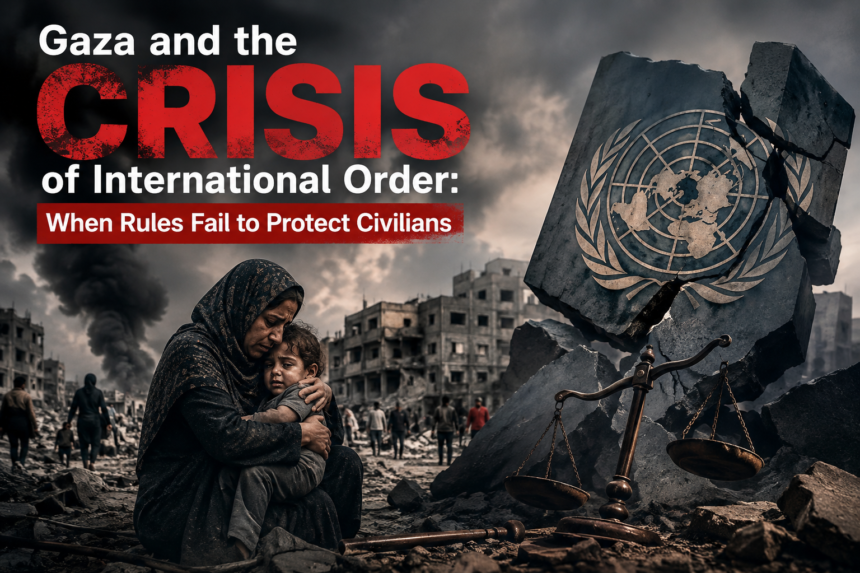

Gaza and the Crisis of International Order: When Rules Fail to Protect Civilians
A study of the ongoing Gaza crisis as a structural test of international law, UN enforcement mechanisms, and the legitimacy of the rules-based global order.
The ongoing situation in Gaza has evolved into something far more consequential than a localized humanitarian disaster. It now stands as an existential test of post-World War II international architecture. Despite the formal implementation of a ceasefire framework in October 2025, peace remains profoundly illusory for the enclave’s civilian population. United Nations human rights monitors and field agencies continue to report persistent civilian casualties, with roughly 160 Palestinians killed in July 2026 alone, alongside recurring localized strikes and severe access restrictions. This disconnect between high-level diplomatic proclamations, and the daily reality of violent attrition highlights a fundamental collapse in the global governance framework: international law exists in text but lacks the enforcement mechanisms necessary to protect vulnerable populations.
The human toll in Gaza cannot be reduced to statistical accounting, yet the data compiled by international institutions reveals the depth of structural failure. Reports from the World Food Programme in August 2026 indicate that despite modest improvements from peak crisis levels, roughly 1.4 million people nearly two-thirds of Gaza’s surviving population remain severely food insecure. Basic survival continues to depend almost entirely on rationed external aid subject to border bottlenecks, political posturing, and funding shortfalls. When an entire society is forced into perpetual dependence for basic nutrition and medical care while residing under military encirclement, the international system’s primary claim that human dignity is universally protected under international humanitarian law loses its practical credibility.
This reality exposes a profound institutional paralysis within the United Nations and associated multilateral bodies. While the UN Security Council, International Court of Justice, and human rights bodies have repeatedly articulated the legal imperatives of civilian protection and unhindered humanitarian access, their resolutions lack binding operational force when opposed by major global powers. The multilateral framework was designed on the premise that collective security and legal norms would constrain state behavior. In Gaza, however, international institutions have been relegated to the status of emergency relief coordinators, managing the fallout of state actions rather than enforcing compliance with international humanitarian statutes.
Central to this dynamic is the role of the United States. Washington continues to position itself as the indispensible diplomatic mediator, managing complex settlement talks involving high-level envoys, including delegations featuring Jared Kushner, visiting regional capitals like Cairo and Tel Aviv. Yet this approach reflects a broader contradiction in American foreign policy. By attempting to manage a political transition while simultaneously insulating key allies from international legal accountability, Washington undermines the universality of the very rules-based order it claims to uphold. Diplomatic management that prioritizes geopolitical convenience over legal enforcement reduces international law from a binding set of rules to an instrument of selective policy projection.
For Arab and Muslim states, the Gaza crisis has heightened domestic pressures and deepened geopolitical frustration. While capitals across the Middle East have consistently condemned civilian suffering, endorsed UN resolutions, and supported diplomatic initiatives, their collective influence has struggled to alter the operational realities on the ground. This gap between public outrage and diplomatic leverage has reignited calls for a tangible, sovereign pathway toward Palestinian statehood. Across much of the Global South, the persistent denial of self-determination to Palestinians is viewed not as an isolated political dispute, but as a defining symbol of systemic inequality within global decision-making bodies.
The broader consequence of this dynamic is a rapidly accelerating crisis of legitimacy for the international system itself. When norms governing civilian protection, proportional force, and sovereign rights are enforced vigorously in certain geopolitical conflicts but ignored or excused in others, the concept of a “rules-based international order” forfeits its moral authority. Observers across developing nations increasingly view the global security framework as fundamentally hypocritical in a system where legal obligations are contingent upon power alignment rather than universal principle. This erosion of trust threatens the stability of multilateral governance far beyond the borders of the Middle East.
Restoring credibility to the international system requires moving beyond symbolic resolutions and conditional diplomatic frameworks toward genuine accountability. Meaningful international accountability cannot be treated as a political luxury to be granted during peace talks; it must function as a non-negotiable legal threshold applied uniformly across all conflicts. This requires binding mechanisms to enforce international legal rulings, uninterrupted humanitarian access independent of strategic bargaining, and a diplomatic process anchored in equal sovereignty and international law.
Ultimately, Gaza demonstrates that an international order relying on selective enforcement cannot endure. If global institutions fail to uphold the fundamental rules protecting civilian life against state power, the entire multilateral architecture risks devolving into an arena of unconstrained geopolitics. The crisis in Gaza is not merely a test of regional diplomacy, but a decisive juncture for whether the international community can reclaim a rules-based system grounded in universal human dignity.
Author
I am an independent researcher with a passion for exploring global affairs through the lens of critical thinking and evidence-based analysis. My writing examines contemporary political, economic, and strategic issues, with the aim of presenting balanced perspectives that inform, engage, and encourage meaningful discourse.