
Part One
Asif Haroon Raja
India’s Expansionist Trajectory and Regional Hegemonic Ambitions
Since the end of British rule in 1947, India has pursued a policy that its critics describe as one of regional dominance, seeking to establish itself as the pre-eminent power in South Asia.
Although New Delhi maintains that its policies have been driven primarily by national security, territorial integrity, and the consolidation of the Indian Union, several neighbouring states have viewed aspects of its conduct through the prism of expansionism and hegemonic ambition.
At independence, more than 560 Princely States had to determine their future political status and were subsequently integrated into either India or Pakistan through a combination of accession, negotiation, political pressure and, in some cases, military intervention.
Critics point to India’s integration of States such as Hyderabad, Junagadh, Manavadar, Mangrol, Babariawad, Bhopal, Jodhpur, willing to join Pakistan, together with India’s consolidation of control over roughly two-thirds of the former Princely State of Jammu and Kashmir following the 1947–48 war, as evidence of an assertive approach to territorial consolidation.
Pakistan, meanwhile, contends that India’s continued claim over Azad Jammu and Kashmir (AJK) and Gilgit-Baltistan reflects an enduring determination to bring the entire former Princely State of Jammu and Kashmir under its control—a claim that India strongly disputes.
India subsequently incorporated other territories as well. Goa, Daman and Diu were taken from Portuguese control through military action in 1961, while Sikkim became India’s 22nd State in 1975 following a period of political turmoil and a referendum.
While India regards these developments as legitimate and historically justified, critics cite them as further examples of New Delhi’s willingness to alter territorial realities in pursuit of strategic and political objectives.
India has Disputes with all Neighbours
Relations between India and almost all of its neighbours have, at various times, been marked by disputes involving territory, borders, water resources or political influence.
Pakistan and India remain divided over Jammu and Kashmir, while disagreements have also emerged over the interpretation and implementation of the Indus Waters Treaty.
China and India continue to contest their disputed Himalayan boundary. Nepal has periodically raised concerns over border issues, while Bangladesh has historically had disagreements with India over the sharing of river waters, although progress has also been made in resolving several longstanding boundary disputes.
Maritime boundaries and fishing rights have likewise periodically strained India’s relations with Sri Lanka.
India’s Regional Interventions
India has frequently faced allegations of interfering in the internal affairs of neighbouring countries.
During the 1971 Bangladesh Liberation War, India provided extensive political, military and logistical support to the Mukti Bahini, publicly justifying its intervention in part on humanitarian grounds and by pointing to the massive influx of refugees from former East Pakistan.
Indian journalist and writer Kuldeep Nayar subsequently wrote in his book ‘Distant Neighbours’ in 1972 that the refugee issue had been exaggerated or presented out of context, claiming that a large majority of those who migrated to India in March 1971 were Hindus who, in his view, should have migrated in 1947.
Subsequently, India has faced allegations from regional observers of supporting, influencing or intervening in various political and ethnic movements in neighbouring countries.
Bangladesh has, at different times, expressed concerns regarding the Chakma issue and developments involving the Chittagong Hill Tracts.
Sri Lanka, meanwhile, endured decades of Indian involvement during its three-decade-long Tamil conflict. India’s intervention culminated in the deployment of the Indian Peace Keeping Force (IPKF) in 1987, following the Indo-Sri Lankan Accord.
Nepal strongly criticised the 2015 border blockade, which it regarded as coercive economic pressure and an infringement on its sovereignty.
The Maldives and Myanmar have likewise experienced periods of tension concerning India’s perceived political influence and regional policies.
Rise of the Bharatiya Janata Party (BJP)
The rise of the BJP from the 1980s onward transformed India’s political landscape by bringing Hindu nationalist Hindutva ideology increasingly into the political mainstream.
This ideological transformation reached a defining moment in December 1992, when the Babri Masjid in Ayodhya was demolished by Hindu nationalist activists, triggering widespread communal violence across India.
The subsequent construction of the Ram Mandir at the disputed site has remained one of the most powerful symbols of the political ascendancy of Hindu nationalism.
Concerns over religious intolerance in India have also become more pronounced in recent decades.
Incidents of communal violence, hate speech and attacks against religious minorities have periodically raised concerns among domestic and international human-rights organisations regarding the protection of India’s secular and pluralistic traditions.
The military operation at the Golden Temple in Amritsar in June 1984, known as Operation Blue Star, remains one of the most painful chapters in modern Indian history.
While the Indian government described the operation as necessary to remove heavily armed militants who had occupied the shrine complex, many Sikhs regarded the military assault on one of their holiest sites as a profound desecration.
The assassination of Prime Minister Indira Gandhi later that year was followed by large-scale anti-Sikh violence in which thousands of Sikhs were killed, leaving deep and enduring scars on the community.
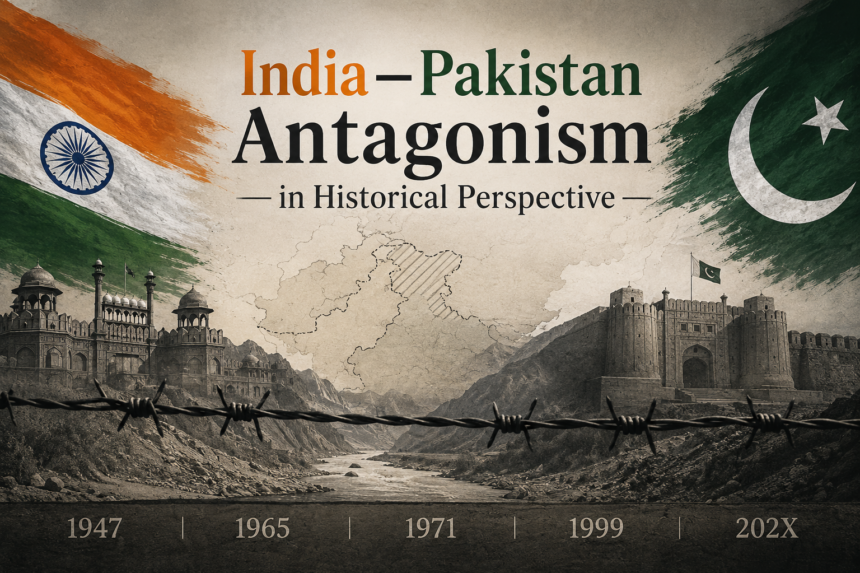
Jammu and Kashmir: The Core of India–Pakistan Antagonism
Jammu and Kashmir has remained the most enduring and contentious dispute in South Asia.
Since 1947, the region has witnessed repeated wars, insurgencies, prolonged military deployments and recurring allegations of human-rights violations.
India maintains that its security measures are necessary to combat cross-border terrorism, prevent militancy and maintain public order.
Pakistan and many Kashmiris, however, contend that the people of the territory have been denied their internationally recognised right to self-determination.
The constitutional changes introduced by India in August 2019—including the abrogation of Jammu and Kashmir’s special constitutional status and the subsequent reorganisation of the former state—further intensified tensions between India and Pakistan and attracted widespread international attention.
The Kashmir dispute, therefore, remains not merely a territorial disagreement but the central issue underlying the enduring antagonism between the two nuclear-armed neighbours.
To be continued
About the Author
Brigadier (Retd) Asif Haroon Raja, SI (M) is a war veteran. He is Command and Staff Course and War Course qualified, holds an MSc in War Studies, and served as Defence Attaché in Egypt and Sudan, as well as Dean of the Corps of Military Attachés in Cairo.
He is a defence, security, and geopolitical analyst, columnist, featured columnist of IntelDrop magazine Washington, author of five books, former Chairman of Thinkers Forum Pakistan, Patron-in-Chief of Centre for Development Studies Think Tank, Director of Meesakh Research Centre; he regularly appears on media platforms.