
Nuzhat Nazar
For decades, Pakistan’s foreign policy was largely interpreted through the strategic priorities of major powers. During the Cold War, it was Washington’s ally; following the Soviet invasion of Afghanistan, a frontline state; and after 9/11, a central partner in the US-led war on terrorism. Its geopolitical importance was undeniable, but its diplomatic role was frequently defined by crises originating beyond its borders.
In 2026, that equation appears to be changing.
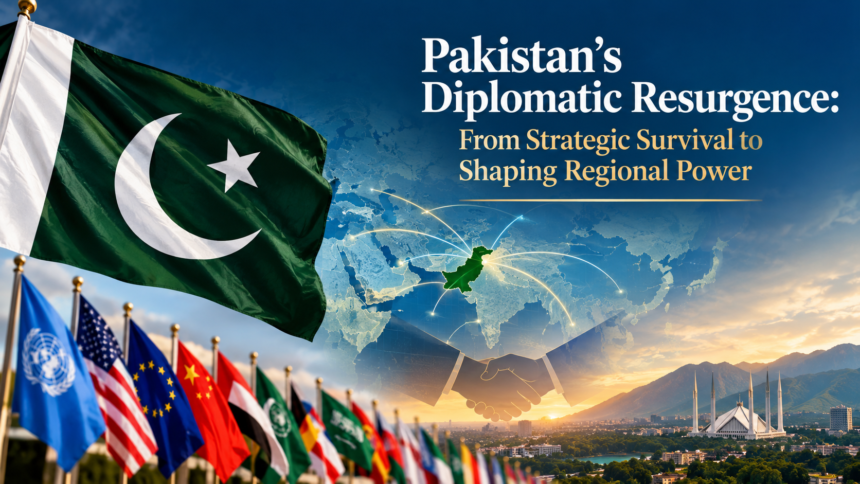
From facilitating US-Iran diplomatic engagement to forging a collective defence framework with Saudi Arabia and Türkiye, strengthening ties with China, re-engaging Washington and taking a firmer position on Afghanistan, Pakistan is demonstrating a more proactive diplomatic approach.
These developments suggest something beyond routine foreign policy adjustments. They reflect an effort to transform Pakistan’s strategic location, military capabilities and historical relationships into greater diplomatic influence.
Five established foreign policy theories help explain this transformation, but their significance lies in how they illuminate Pakistan’s emerging strategic choices.
From Strategic Dependence to Rational Statecraft
The Rational Actor Model assumes that states evaluate costs, benefits and national interests before making strategic decisions. Pakistan’s contemporary diplomacy increasingly reflects this approach.
Historically, Islamabad’s participation in SEATO and CENTO was intended to strengthen its security through Western alliances. However, the wars of 1965 and 1971 exposed the limitations of depending on external powers. Pakistan subsequently diversified its partnerships, particularly through its strategic relationship with China.
Today, Islamabad is pursuing a broader version of that strategy.
Its relationship with Beijing remains central, while engagement with Washington has regained diplomatic importance. Simultaneously, Pakistan has strengthened its defence cooperation with Saudi Arabia and Türkiye without abandoning dialogue with Iran.
This balancing became particularly significant during the US-Iran confrontation, when Pakistan’s ability to communicate with both sides provided an opportunity to facilitate diplomatic engagement.
Rather than choosing between competing powers, Islamabad sought to use its relationships to advance regional stability and protect its economic and security interests.
This is strategic autonomy in practice: maintaining multiple partnerships without allowing any single relationship to dictate the entirety of national policy.
From Security Contributor to Regional Security Architect
The Makkah Joint Defence Agreement of August 2026 between Pakistan, Saudi Arabia and Türkiye represents a significant development in Pakistan’s regional security diplomacy.
For decades, Pakistan’s defence cooperation with Gulf states largely involved military training, advisory support and bilateral arrangements. The new collective defence framework expands that relationship into a formal multilateral security partnership.
Pakistan’s role is particularly important because the arrangement brings together three complementary strengths: Pakistan’s military experience, Türkiye’s defence-industrial capabilities and Saudi Arabia’s economic resources and strategic influence.
The subsequent establishment of institutional mechanisms, including Pakistan’s representation in the alliance’s leadership, indicates an effort to move beyond symbolic cooperation towards coordinated defence planning, interoperability and technological collaboration.
Viewed through the Bureaucratic Politics Model, this development also demonstrates how coordination between political leadership, diplomatic institutions and military authorities can translate strategic objectives into formal international arrangements.
Pakistan is therefore seeking to move from providing security assistance to participating in the design of regional security mechanisms.
Afghanistan: Assertiveness as a Diplomatic Instrument
Pakistan’s changing approach towards Afghanistan illustrates how historical experience can reshape strategic calculations.
For decades, Islamabad pursued engagement with successive Afghan political actors, expecting cooperation to contribute to stability along its western border.
The Taliban’s return to power in 2021 initially raised expectations of improved bilateral relations. However, continuing terrorist attacks and Islamabad’s concerns about groups operating from Afghan territory have fundamentally altered that assessment.
The October 2026 Moscow Format consultations demonstrated this shift.
Pakistan refused to endorse a regional communiqué that it considered inadequate in addressing terrorism emanating from Afghanistan, even though the disagreement prevented a consensus declaration.
The decision reflected an important diplomatic principle: multilateral engagement should not require Pakistan to dilute its national security position.
The Organisational Process Model helps explain the significance of this development. States often remain attached to established policies despite changing circumstances. Pakistan’s more assertive Afghanistan policy suggests an effort to reassess longstanding assumptions and prioritise verifiable security commitments over diplomatic accommodation.
Islamabad’s objective is increasingly to ensure that regional discussions about Afghanistan address Pakistan’s security concerns rather than treating them as secondary considerations.
The Power of Diplomatic Balance
Robert Putnam’s Two-Level Game Theory explains how governments must reconcile international negotiations with domestic political and economic interests.
Pakistan’s Middle East diplomacy offers a relevant example.
Its security commitments to Saudi Arabia coexist with its geographical proximity to Iran, dependence on Gulf energy supplies and interest in uninterrupted maritime trade.
A regional confrontation could directly affect Pakistan’s economy, expatriate communities and national security.
Maintaining communication with competing regional actors is therefore not merely a diplomatic preference; it serves identifiable national interests.
Pakistan’s participation in de-escalation efforts demonstrates how relationships that might otherwise create competing pressures can also provide diplomatic opportunities.
This approach strengthens Pakistan’s relevance as a country capable of engaging across geopolitical divisions.
Leadership, Continuity and Diplomatic Initiative
Foreign policy is shaped not only by national capabilities but also by how leaders interpret opportunities.
Pakistan’s diplomatic history reflects this interaction. Ayub Khan pursued Western alliances, Zulfikar Ali Bhutto expanded engagement with China and the Muslim world, and later governments adapted to changing regional security environments.
In 2026, high-level engagement involving Prime Minister Shehbaz Sharif, Deputy Prime Minister Ishaq Dar and Field Marshal Syed Asim Munir has accompanied an expansion of Pakistan’s diplomatic and defence initiatives.
The Leader Personality and Cognitive framework helps explain how leadership priorities can influence the pace and direction of international engagement.
However, the more consequential development is the effort to institutionalise these initiatives through formal agreements and sustained cooperation.
Diplomatic influence becomes durable when it extends beyond individual meetings and survives changes in leadership.
From Geographical Importance to Diplomatic Influence
Pakistan’s location between China, Central Asia, Afghanistan, Iran and the Gulf has always given it strategic significance. Yet geography alone does not translate into international influence.
What distinguishes the emerging diplomatic approach is the attempt to combine geographical advantages with military capabilities, diversified partnerships and active regional engagement.
Pakistan’s participation in the SCO, its relationships with Beijing and Washington, its collective defence partnership with Riyadh and Ankara, and its engagement in regional crisis diplomacy provide multiple channels through which it can advance national interests.
The challenge ahead is to translate this diplomatic reach into lasting economic opportunities, stronger security arrangements and regional stability.
Pakistan’s foreign policy evolution is therefore not simply about changing alliances. It reflects a broader ambition to move from reacting to geopolitical developments towards helping shape them.
For much of its history, Pakistan’s strategic importance was measured by what major powers needed from it. Today, Islamabad is increasingly seeking to define that importance through what it can contribute to regional security, diplomacy and stability.
That shift—from strategic necessity to diplomatic agency—may prove to be the defining feature of Pakistan’s emerging foreign policy doctrine.