

Asif Haroon Raja
Restoring Security, Governance and Public Confidence
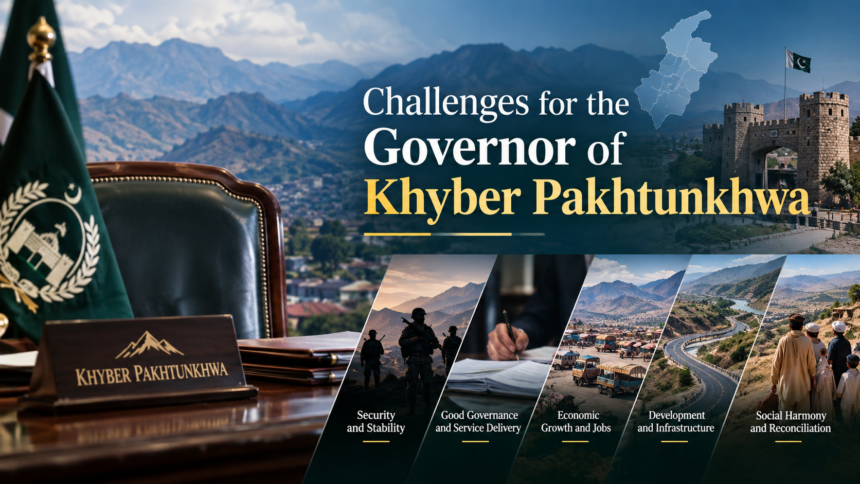
Khyber Pakhtunkhwa (KP) is facing a grave security and governance crisis. The restoration of the writ of the state, the containment of terrorism, the rehabilitation of public institutions and the welfare of the people constitute the foremost challenges for Governor Faisal Karim Kundi and the interim administrative arrangement established in the province.
The task is formidable, time is limited, and the consequences of failure could be far-reaching.
- The Afghan Refugee Question and Cross-Border Terrorism
More than 600,000 Afghan nationals including the 4,13000 Afghan refugees are reportedly residing in Khyber Pakhtunkhwa, including a substantial number whose legal status and documentation require verification.
Pakistan’s security agencies have repeatedly raised concerns about the alleged involvement of some Afghan nationals in facilitating militant networks, including the Tehreek-e-Taliban Pakistan (TTP), and in providing logistical support, intelligence and safe havens for terrorist activities.
There are also concerns about their involvement in smuggling, narcotics trafficking and other criminal activities.
The challenge for the provincial administration is to distinguish genuine refugees and law-abiding residents from undocumented foreign nationals and individuals involved in militancy or organised crime.
Effective border management, intelligence-led operations and the lawful repatriation of those not entitled to remain in Pakistan are essential components of a comprehensive security policy.
- Political Polarisation and the Failure of Counterterrorism Cooperation
A major obstacle to counterterrorism efforts has been the confrontation between the former PTI-led provincial government and the federal government.
The former administration was accused of adopting a soft and compromising approach towards the TTP and the Afghan Taliban authorities and of failing to extend the necessary cooperation to federal institutions and security agencies.
Counterterrorism cannot succeed when political rivalry takes precedence over national security. The provincial government, federal administration, police, intelligence agencies and armed forces must work in concert against a common threat.
The restoration of coordination among these institutions is therefore an immediate priority for the Governor Faisal Karim Kundi and the new administrative set-up.
- The Strategic Dimension of the Terrorism Challenge
The US led Western forces withdrew from Afghanistan in August 2021 without achieving their strategic goals in Pakistan during the 20 years of war on terror. The planners decided to once again rekindle terrorism in KP and Baluchistan in order to achieve their unfinished objectives of denuclearizing Pakistan and scuttling the CPEC.
From 2020 onwards, Pakistan experienced a renewed wave of militant violence, particularly in KP and Balochistan. The resurgence of terrorism has raised serious questions about the regional security environment, the availability of American weapons left over in Afghanistan from the Afghan conflict, cross-border militant sanctuaries and the policies of the Afghan Taliban authorities.
The hostile external actors seek to exploit Pakistan’s internal vulnerabilities to weaken its stability, constrain its strategic autonomy and undermine its nuclear deterrent.
Whatever the wider strategic calculations of hostile actors, the immediate reality is that Pakistan faces a persistent and evolving terrorist threat.
The State must address this challenge through sustained intelligence operations, effective border security, improved governance and a united national response.
According to figures cited in the current debate, terrorist attacks and suicide bombings have increased by 34% over the past five years. The broader deterioration in the security environment demands urgent attention. During this period, Pakistan suffered 12000 casualties.
- Why KP Is Particularly Vulnerable
The security situation in KP is especially alarming, where in the last five years, 80% of the total 3800 terror acts occurred in KP. Balochistan’s provincial administration has generally cooperated with the federal government and security forces in counterterrorism efforts, although the province continues to face serious security challenges of its own.
In KP, political confrontation between the former provincial government and Islamabad weakened coordination and complicated the counterterrorism response.
The situation in twelve southern districts deteriorated to the point where the effective writ of the State was seriously challenged.
The TTP’s ability to intimidate local populations, attack security personnel, establish clandestine networks and exploit administrative weaknesses has created an environment of insecurity.
Reports of militant expansion towards major urban centres, including Peshawar, underscore the need for preventive action before the threat becomes more difficult to contain.
The objective must be to deny terrorists any opportunity to establish parallel authority, impose their own version of law or intimidate citizens and public officials into submission.
- Alleged Plans to Escalate Political and Security Disorder
The adversaries of Pakistan have plans to combine militant activity with political unrest to destabilise the province and exert pressure on the federal government.
Intelligence agencies reported that weapons, ammunition and explosives were being stockpiled at strategic locations and that armed elements were being prepared for a coordinated escalation on 27 September, subsequently postponed to 4 October 2026.
Reportedly, the long march from KP intended to replicate 9 May 2023 on a larger or more organised scale. The possibility of militant networks exploiting political demonstrations or civil disorder couldn’t be dismissed.
The State had to remain vigilant against any attempt to turn legitimate political activity and peaceful dissent into a cover for violence, armed insurrection or attacks on public institutions.
The law enforcement agencies were well prepared to deal with organised violence. Security measures taken were intelligence-led, proportionate and consistent with the Constitution and the law.
- The Former Provincial Government’s Record
Despite repeated appeals from Islamabad for greater cooperation against terrorism and for progress on the repatriation of undocumented Afghan nationals, relations between the federal and provincial governments remained strained.
The former provincial leadership declined proposals intended to secure its cooperation in counterterrorism efforts. Confrontational activities and threatening rhetoric of PTI leaders in KP including the chief minister indicated their aggressive designs.
Chief Minister Sohail Afridi, who hails from Khyber District, was criticised by the federal government and the army leadership for his unduly accommodating attitude towards the Taliban resulting in heavy human and material losses in the province.
He was blamed for failing to upgrade the police and Counter Terrorism Department (CTD) to combat the terrorists equipped with the latest weapons and equipment.
It was also gathered that Afridi took political direction from absconding PTI leader Murad Saeed, the blue eyed boy of Imran Khan, reportedly staying in Afghanistan. Intercepted telephone conversations further revealed his location in Paktika province under the protection of the Hafiz Gul Bahadur militant network.
During his tenure, Afridi was criticised for concentrating disproportionately on the release of jailed PTI founder Imran Khan instead of addressing the province’s deteriorating security and governance situation, employment, education, healthcare and public services. He was criticised for preferring confrontation over cooperation with Islamabad.
- Imposition of Governor’s Rule and Emergency Measures
After political negotiations and other efforts reportedly failed to produce the required cooperation, the federal coalition government proceeded with extraordinary constitutional measures in KP to deal with the extraordinary security situation.
The Governor’s Rule under Article 234 and emergency measures under Article 232 came into effect on 11 October 2026, with emergency arrangements covering 12 disturbed districts.
The armed forces have been called upon to assist the civil administration under Article 245 in restoring peace and re-establishing the writ of the state in the 12 restive districts. They would operate directly under the prime minister.
These measures have generated strong opposition from PTI leaders and other critics, who have challenged their constitutionality and announced plans to contest them before the courts. Petitions have reportedly been filed in the Peshawar High Court.
Irked by being denied a share of the power pie, JUI-F chief Maulana Fazlur Rehman has joined the ranks of the opposition, casting aspersions on the imposition of the governor’s rule and the role of the Army. His deleterious stance has drawn sharp criticism from ruling-party MNAs, the media and the general public alike.
The legality of the measures will ultimately be determined by the courts in light of the Constitution, the relevant facts and the applicable law. It would be premature to assume that the measures are immune from judicial review.
The administration must therefore ensure that its actions remain within constitutional limits, that fundamental rights are respected and that extraordinary powers are not used for political victimisation.
- The Advisory Council and Immediate Priorities
A 12-member Advisory Council comprising experts and technocrats has been constituted to assist Governor Faisal Karim Kundi. The Governor has chaired two meetings at which priorities for the coming period were discussed and the Provincial Action Plan laid out. He also chaired the Apex Committee in which security related issues were discussed.
The principal objectives are clear:
*Fight terrorism with full force, restore law and order and re-establish the writ of the state.
*Improve the operational capacity of the police and counterterrorism institutions.
*Protect citizens from militant intimidation, extortion and targeted violence.
*Improve healthcare, education and other essential public services.
*Address unemployment, poverty and the economic distress of vulnerable communities.
*Strengthen accountability, transparency and administrative efficiency.
The new arrangement has 180 days to demonstrate results. This is a short period in which to reverse years of institutional weakness, political confrontation, worsening insecurity and to cleanse the piled up mess.
The administration must therefore avoid bureaucratic delays, complacency and the temptation to pursue too many initiatives without measurable outcomes. A clear timetable, district-level targets and regular public reporting would help establish credibility.
- Accountability, Corruption and the Rule of Law
Another challenge concerns the alleged presence in KP of individuals wanted in connection with the events of 9 May 2023, including PTI leaders and activists facing criminal proceedings or convictions. Some are reportedly in hiding, and the province has been accused of becoming a refuge for fugitives from justice.
There are also allegations that certain former provincial officials and political figures were involved in large-scale corruption, narcotics trafficking, illegal smuggling or payments to militant groups. Reportedly, 45 officials have been arrested on charges of selling 3500 identity cards to the Afghan nationals on exorbitant prices.
The administration should establish a transparent accountability mechanism that applies equally to political leaders, public officials, business interests and individuals suspected of facilitating terrorism.
Lawful arrest, fair investigation, due process and timely judicial proceedings are indispensable. Accountability will strengthen public confidence only if it is demonstrably impartial and free from political vendettas.
- Strengthening the Police and Counterterrorism Capacity
Some constructive measures have already been initiated by the Governor and the new administration. These include improvements in police pay and allowances, welfare assistance for the families of police personnel killed in the line of duty, provision of better weapons and bulletproof vehicles to the police.
These steps are welcome, but their success will depend on sustained implementation.
The police require modern equipment, reliable intelligence, specialised training, effective communications, forensic capabilities and protection against political interference.
The CTD must be strengthened to investigate terrorist financing, recruitment, logistics and support networks, not merely responding after attacks have occurred.
A zero-tolerance policy towards corruption within law-enforcement agencies is equally important.
Personnel must be protected from undue pressure while being held accountable for misconduct and operational failures.
The prompt response to the tragic collapse of a school building, reportedly resulting in the deaths and injuries of around 80 to 90 students, has also been encouraging. However, the incident underlines the need for systematic inspections of public buildings, school safety audits and strict enforcement of construction standards.
Public confidence is built not only by security operations but also by visible improvements in the everyday lives of citizens.
- Repatriation of Undocumented Afghan Nationals
A province-wide operation against undocumented Afghan nationals has reportedly been planned from 1 November 2026, with an intended target of approximately 500,000 people for repatriation.
Such an exercise will require careful coordination among the provincial administration, federal authorities, law-enforcement agencies and border-management institutions.
The process must distinguish undocumented residents from those holding valid visas or other lawful status, and it must comply with applicable legal obligations and humanitarian safeguards.
The operation should be organised, orderly and transparent, with adequate arrangements for documentation, transport and border processing.
Particular attention must be paid to prevent harassment, arbitrary detention, family separation and the wrongful removal of people entitled to legal protection.
At the same time, no individual should be permitted to exploit refugee status as a shield for terrorism, organised crime or unlawful activities. Security screening and lawful enforcement must be firm, professional and evidence-based.
- Restoring the State’s Authority in Southern KP
The most difficult operational challenge lies in the 12 disturbed districts of Southern KP, where the security situation has deteriorated considerably.
The Army, in coordination with paramilitary forces, the police and pro-Pakistan tribal elders, intends to restore order through a phased approach.
Under the proposed plan, responsibility for frontline security in five districts would initially be transferred to the Frontier Corps once the State’s writ has been re-established there.
A phased approach could help consolidate gains and prevent security vacuums. However, military operations alone cannot provide a durable solution. They must be accompanied by reliable intelligence, police reform, functioning courts, administrative services, economic opportunities and the protection of local communities from militant retaliation.
Tribal elders, community representatives and local civil society can play an important role, provided their participation is voluntary, inclusive and directed towards lawful peacebuilding.
The ultimate objective should be to restore civilian administration and normal life, with security forces supporting a sustainable system of local law enforcement rather than allowing disturbed districts to remain dependent indefinitely on extraordinary deployments.
- The Road Ahead: Results, Not Rhetoric
The expectations of the people of KP are understandably high. They want peace, personal security, employment, functioning schools, accessible hospitals and relief from extortion, corruption and administrative neglect. They also expect the State to protect their dignity and rights.
The Governor and his Advisory Council will face criticism from political opponents, civil society and the media. Their credibility will depend on whether they can produce tangible improvements within the limited time available.
The first 90 days should therefore be treated as a decisive performance period, with a public action plan covering security, policing, education, healthcare, employment and accountability.
Monthly progress reports should identify achievements, shortcomings and corrective measures.
Political opponents must not be treated as enemies merely because they disagree with the administration. Equally, no political party or individual should be allowed to use political influence to obstruct lawful counterterrorism efforts or shield criminal conduct.
The State must act firmly against terrorism while preserving constitutional governance, public trust and the distinction between peaceful political opposition and violence.
Conclusion
Governor Faisal Karim Kundi and the new administrative arrangement have inherited an exceptionally difficult situation. The immediate challenge is to restore security in the disturbed districts, strengthen the police and CTD, improve coordination with Islamabad, address the Afghan documentation and repatriation issue, and revive neglected public services.
The broader challenge is to prevent terrorism from becoming entrenched in the province’s political, social and economic life.
The task demands urgency, discipline, institutional coordination and political neutrality.
Security operations must be effective, governance must be responsive, and accountability must be impartial.
Extraordinary measures should remain subject to the Constitution and the law, while public welfare must remain central to every administrative decision.
Time is short, and the challenges are formidable. The Governor and his team must therefore work on a war footing in the administrative sense: setting clear priorities, meeting deadlines, measuring performance and delivering visible results.
The ultimate measure of success will not be the number of operations conducted or statements issued, but whether the people of Khyber Pakhtunkhwa can live in peace, exercise their rights, earn their livelihoods and trust that the state is both capable of protecting them and committed to serving them.
About the Author
Brigadier (Retd) Asif Haroon Raja, SI (M) is a war veteran. He is Command and Staff Course and War Course qualified, holds an MSc in War Studies, and served as Defence Attaché in Egypt and Sudan, as well as Dean of the Corps of Military Attachés in Cairo. He commanded the largest brigade in Kashmir.
He is a defence, security, and geopolitical analyst, columnist, featured columnist of IntelDrop magazine Washington, author of five books, former Chairman of Thinkers Forum Pakistan, Patron-in-Chief of Centre for Development Studies Think Tank, Director of Meesakh Research Centre; he regularly appears on media platforms.