
Rimsha Saleem
An analysis of the growing gap between United Nations ambitions and operational capacity, highlighting the rise of regional organizations and functional minilateralism in managing global crises.
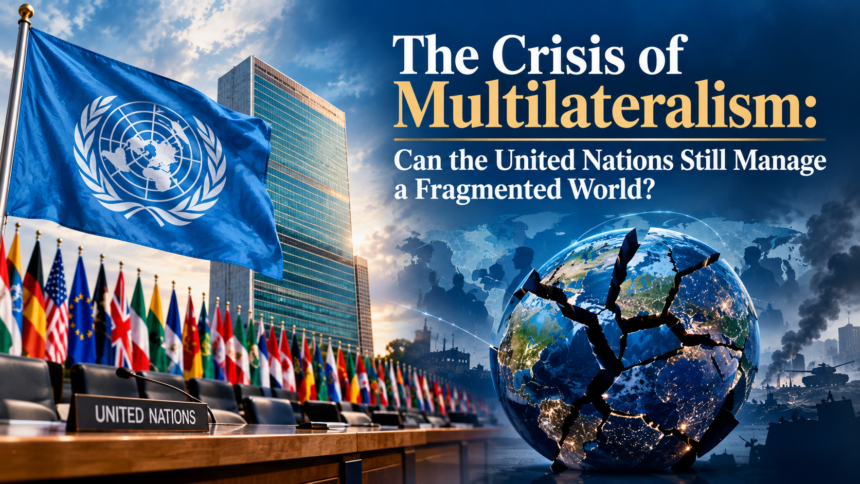
The high-level week of the 81st United Nations General Assembly in late September 2026 unfolded against a backdrop of severe global structural strain. From the intractable devastation in Gaza and ongoing cross-border escalations in Yemen to the war of attrition in Ukraine, protracted state collapse in Sudan, and compounding climate security threats, the global security environment is testing the limits of post-World War II multilateralism. Concurrently, international humanitarian agencies are managing unprecedented funding shortfalls, forcing reductions in basic rations and emergency medical aid across multiple conflict zones. This widening gulf between the United Nations’ institutional ambitions and its practical capacity to enforce international norms, prevent aggression, and deliver emergency relief has reignited debate over whether the UN system can effectively manage an increasingly multipolar, fragmented world.
Assessing the contemporary crisis of multilateralism requires avoiding twin analytical errors: viewing the United Nations as either wholly obsolete or fully functional. The structural gridlock choking by the UN Security Council is fundamentally a crisis of geopolitical power dynamics rather than administrative incapacity. The systemic exercise of veto power by permanent members in crises involving major power interests has repeatedly paralyzed the Council’s primary mechanism for maintaining collective security. When major powers prioritize sovereign strategic rivalries over international legal commitments, institutional mechanisms designed in 1945 struggle to compel compliance. Beyond geopolitical deadlocks, mounting national sovereignty concerns and fiscal retrenchment among traditional donor nations further constrain UN specialized agencies, limiting their operational scope precisely as humanitarian requirements expand.
Despite these severe political constraints, declaring the complete breakdown of multilateralism misrepresents the global institutional architecture. In technical, normative, and operational domains that lie outside direct major-power confrontation, multilateral frameworks remain vital. Specialized UN bodies continue to coordinate essential global public goods, including international civil aviation safety, maritime navigation standards, global disease surveillance, telecom spectrum allocation, and international atomic energy safeguards. Furthermore, multilateral climate negotiations under the United Nations Framework Convention on Climate Change (UNFCCC) continue to provide the primary global forum for establishing carbon reduction commitments and coordinating adaptation financing. The UN system retains unmatched global legitimacy, administrative infrastructure, and operational capacity to deploy peacekeepers, coordinate complex disaster relief, and convene sovereign states across ideological divides.
Faced with Security Council paralysis on major political conflicts, international diplomacy has increasingly shifted toward regional organizations and flexible monoliteral arrangements. Regional bodies such as the African Union, the Association of Southeast Asian Nations (ASEAN), the European Union, and the Gulf Cooperation Council are stepping into security vacuums to lead localized conflict mediation, peacekeeping deployments, and economic stabilization efforts. Simultaneously, targeted monoliteral coalitions, ad hoc naval task forces, and bilateral defense alignments are emerging to address specific security challenges, such as maritime protection in contested sea lanes or defense-industrial cooperation. While these flexible arrangements offer operational agility and localized responsiveness, they lack universal legal mandates, risking the further fragmentation of international law into regional security spheres.
For middle powers and developing nations, particularly states like Pakistan, this shifting multilateral landscape presents profound strategic challenges alongside tactical imperatives. Developing nations rely heavily on rules-based international order, international law, and UN institutions to defend their territorial integrity, secure development of capital, and amplify their voice against major-power coercion. When global multilateral bodies weaken, smaller and developing states face greater vulnerability to economic shocks, unmediated regional friction, and reduced access to concessional multilateral financing. To safeguard their sovereign interests, middle states are increasingly adopting dynamic diplomatic strategies engaging actively in traditional UN forums to defend international legal norms while simultaneously joining pragmatic regional partnerships, monoliteral economic groupings, and bilateral security arrangements to buffer against global instability.
The ongoing transformation of international relations demonstrates that the United Nations cannot single-handedly engineer global stability in an era defined by intense geopolitical rivalry. Yet, replacing universal multilateralism with unchecked power politics would compound global volatility. Realistically, preserving multilateral cooperation requires reforming multilateral governance to better reflect contemporary global power distributions and expanding functional burden-sharing between the UN and regional organizations. By focusing on areas of mutual interest such as climate security, humanitarian coordination, debt restructuring, and managing emerging technologies multilateral institutions can remain indispensable anchors for international order, ensuring that global dialogue persists even within a fragmented world.
Author
I am an independent researcher with a passion for exploring global affairs through the lens of critical thinking and evidence-based analysis. My writing examines contemporary political, economic, and strategic issues, with the aim of presenting balanced perspectives that inform, engage, and encourage meaningful discourse.