
Rimsha Saleem
An investigation into how asymmetric threats along vital Middle Eastern straits weaponize global supply chains, inflating energy, freight, and commodity costs worldwide.
The Red Sea–Hormuz Nexus: When Maritime Chokepoints Become Global Economic Weapons
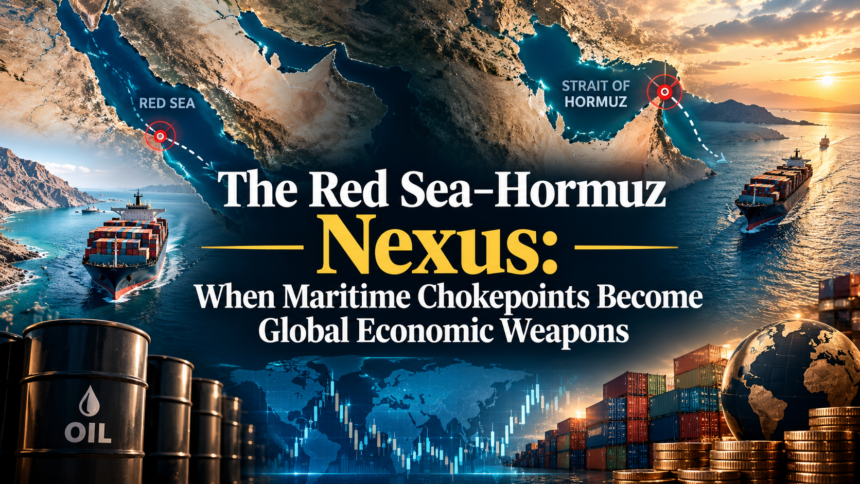
The global economy is anchored to maritime geography, where narrow maritime corridors dictate the flow of essential commodities. The dual chokepoints of the Middle East the Bab el-Mandeb Strait connecting the Red Sea to the Indian Ocean and the Strait of Hormuz linking the Persian Gulf to the open seas form a vulnerable security nexus. In the ongoing regional friction, these maritime transit routes are no longer merely conduits for commerce; they have transformed into deliberate instruments of economic leverage. Disruption across this maritime arc exposes how localized asymmetric military tactics can trigger macroeconomic volatility worldwide, turning regional security threats into systemic shocks for energy and food systems.
The strategic weight of these waterways’ rests on their immense throughput and sheer lack of viable alternatives. Under international maritime law, specifically the United Nations Convention on the Law of the Sea (UNCLOS), straits used for international navigation guarantee the right of transit passage for all vessels. However, legal frameworks offer minimal physical protection when non-state actors or regional powers deploy low-cost, high-impact capabilities. By utilizing anti-ship ballistic missiles, uncrewed aerial vehicles, and explosive motorboats, the Houthi movement in Yemen has effectively contested the Bab el-Mandeb Strait. Simultaneously, Iran’s naval posture near the Strait of Hormuz serves as a persistent threat to global oil supplies. These actions demonstrate how limited, non-conventional forces can offset conventional military inferiority, exerting influence over global markets without requiring a traditional naval fleet.
The mechanics of this leverage work through supply chain disruption and financial compounding rather than total physical blockades. When commercial vessels face targeted attacks, major ocean carriers re-route ships around the Cape of Good Hope. This detour adds thousands of nautical miles, extending transit times between Asia and Europe by up to two weeks. The resulting reduction in effective shipping capacity drives up container freight rates, while marine insurers impose steep war-risk premiums or withdraw coverage altogether. Increased maritime transport costs quickly filter down into consumer price indexes, fueling persistent global inflation and complicating central bank monetary policies.
Energy markets remain particularly vulnerable to instability in the Persian Gulf and Red Sea. The Strait of Hormuz alone accommodates over twenty percent of the world’s petroleum liquids and a significant share of liquefied natural gas (LNG). Saudi Arabia and other Gulf producers retain limited overland pipeline capacity to bypass these choke points, but such alternatives cannot replace lost sea-lane volume. A prolonged bottleneck at Hormuz or Bab el-Mandeb immediately raises global crude benchmarks, compounding production costs across industrial manufacturing, aviation, and agriculture. Higher fuel prices increase freight overheads for agricultural distribution, while natural gas disruptions directly impact fertilizer manufacturing, creating compound pressures on global food production.
The economic fallout hits developing economies with particular severity. Developing nations in South Asia and Africa, already managing fiscal constraints and foreign exchange shortages, face rising import bills for energy and staple foods. For Pakistan, dependent on imported LNG and crude oil to meet its primary energy needs, supply chain disruptions at Hormuz or Bab el-Mandeb threaten currency reserves, drive domestic inflation, and weaken industrial production. Furthermore, port delays directly affect Pakistan’s export sectors, such as textiles, reducing international competitiveness. Similar structural vulnerabilities exist across South Asia, where maritime instability threatens food security and fiscal stability.
Western responses highlight the limits of naval power against asymmetric tactics. Multilateral operations, including the U.S.-led Operation Prosperity Guardian and the European Union’s Operation Aspides, have deployed warships to escort commercial vessels and intercept incoming threats. However, the EU’s internal debates over whether its naval deployment possesses sufficient operational assets to underscore the unsustainable cost ratio of modern air defense. Expending multi-million-dollar interceptor missiles to destroy low-cost drones strains naval inventories and highlights the operational challenges of protecting commercial shipping across vast, contested maritime zones.
The ongoing crisis along the Red Sea–Hormuz nexus demonstrates that contemporary geopolitical competition is shifting toward economic infrastructure and trade corridors. Freedom of navigation can no longer be treated as a permanent background condition for global commerce, nor can it be secured solely through reactive naval presence. As regional powers and non-state actors integrate low-cost weapon systems to exploit geographic chokepoints, maritime security is moving to the center of national security planning. For policymakers, preserving economic stability now demands integrated strategies that combine naval deterrence, diplomatic de-escalation, and redundant trade infrastructure to mitigate vulnerabilities across the world’s vital sea lanes.
Author
I am an independent researcher with a passion for exploring global affairs through the lens of critical thinking and evidence-based analysis. My writing examines contemporary political, economic, and strategic issues, with the aim of presenting balanced perspectives that inform, engage, and encourage meaningful discourse.