
Rimsha Saleem
An analysis of the sharp deterioration in Islamabad-Kabul relations as cross-border counter terrorism strikes and sovereignty disputes dismantle post-2021 convergence expectations.
Pakistan–Afghanistan: From Strategic Partnership to Security Dilemma
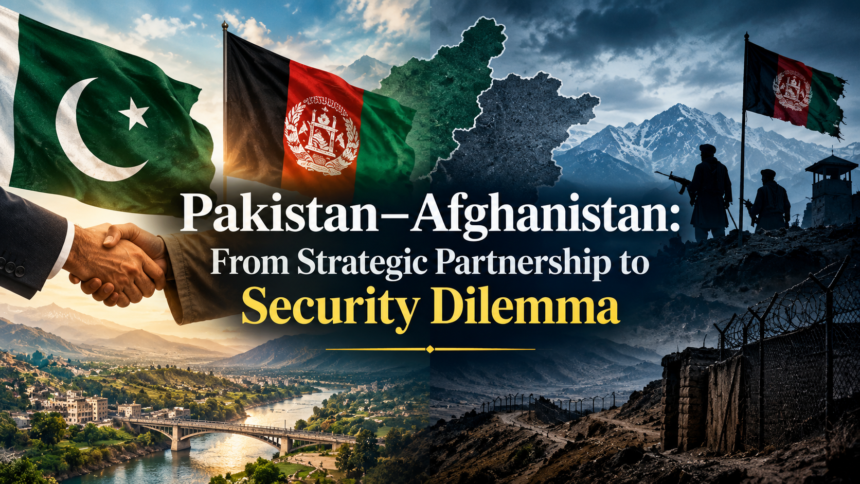
The relationship between Pakistan and Afghanistan has traversed a dramatic trajectory, evolving from expectations of strategic convergence into a classic security dilemma. The events of October 1, 2026, vividly encapsulated this deterioration, as Pakistan executed kinetic strikes against targeted locations in eastern and southern Afghanistan, specifically in Kunar and Helmand provinces. Official sources in Islamabad characterized the operations as highly calibrated actions that successfully eliminated 22 militant combatants operating from cross-border sanctuaries. Conversely, authorities in Kabul and reporting from the United Nations Assistance Mission in Afghanistan (UNAMA) indicated that the strikes caused significant civilian casualties, including women and children, damaging residential structures and heightening local grievances. This latest kinetic exchange underscores how mutual accusations over sanctuary, sovereignty, and cross-border violence have structuralized a persistent state of tension along the Durand Line.
To understand the current impasse, it is essential to trace the shift in Islamabad’s policy calculations following the U.S. withdrawal and the Taliban’s return to power in Kabul in August 2021. Historically, elements within Pakistan’s strategic establishment viewed an anti-Western or friendly administration in Kabul as a prerequisite for securing its western frontier, eliminating the risk of a two-front security challenge, and facilitating trade access to Central Asia. However, the expectation that an Islamic Emirate in Kabul would systematically neutralize anti-Pakistan militant formations most notably Tehreek-e-Taliban Pakistan (TTP) has collided directly with the internal political dynamics of the Afghan Taliban. Rather than serving as a submissive partner, the Taliban administration has prioritized its own internal cohesion, ideological solidarity, and domestic legitimacy, proving unwilling or unable to forcibly dismantle TTP networks operating within its borders.
From the perspective of Islamabad, the primary driver of bilateral hostility is the sharp escalation in cross-border terrorism emanating from Afghan soil. Pakistani security officials maintain that the TTP operates with relative impunity in eastern Afghanistan, utilizing safe havens to plan, logistics-support, and execute complex suicide attacks and ambushes against military checkpoints, security personnel, and critical infrastructure inside Pakistan. For Pakistan, the persistent loss of military personnel and civilian lives transforms the issue from a manageable border dispute into an existential threat to internal security and economic stability. Consequently, Pakistani policymakers argue that kinetic strikes across the border constitute legitimate self-defense aimed at targeting non-state actors when local authorities fail to fulfill their international counter-terrorism obligations.
From the perspective of the Taliban administration in Kabul, cross-border military operations represent an unacceptable violation of Afghan national sovereignty and territorial integrity. Afghan officials categorically deny providing state sponsorship or safe havens to foreign militant groups, maintaining that the TTP issue is an internal Pakistani security failure that cannot be offloaded onto Afghanistan. Kabul asserts that unilateral air raids and artillery shelling infringe upon international law, inflame public hostility, and cause non-combatant casualties claims supported by civilian damage reports documented by UN oversight bodies. Furthermore, the Afghan Taliban’s refusal to formally accept the Durand Line as an international boundary continues to complicate border management, as Kabul views unilateral fencing, strict visa enforcement, and forced deportations of undocumented Afghan refugees as coercive measures intended to undermine Afghan sovereignty.
This bilateral friction operates within a broader, rapidly shifting regional context. Regional powers including China, Iran, Russia, and Central Asian republics share a strong desire for regional stability, counter-terrorism compliance, and transit connectivity, yet their strategic priorities vary. Beijing seeks to protect its Belt and Road infrastructure investments and prevent the spillovers of Uyghur militancy, often encouraging Islamabad and Kabul to manage their differences through diplomatic mechanisms. Tehran, while maintaining working relations with Kabul, remains concerned about cross-border Sunni militancy, refugee spillovers, and water-sharing disputes. Meanwhile, New Delhi’s pragmatic engagement with the Taliban in non-military spheres raises strategic anxieties in Islamabad, reinforcing Pakistani perceptions that an uncooperative Kabul could eventually leave Pakistan vulnerable to external encirclement.
The ongoing cycle of kinetic action, border closures, and diplomatic friction has also severely disrupted regional trade and economic integration. Frequent closures of key border crossings, such as Torkham and Chaman, impose heavy economic losses on border communities, commercial traders, and transit logistics operators in both nations. Forced repatriations of millions of Afghan refugees from Pakistan have further strained the fragile humanitarian and economic absorption capacity of Afghanistan, creating secondary socioeconomic pressures that risk breeding further radicalization along the frontier.
Achieving a sustainable conflict-management framework requires moving away from the assumption that purely military solutions or unconditioned diplomacy can independently resolve deep-rooted structural tensions. A viable strategy must combine multi-layered security protocols with structured economic incentives. First, functional bilateral border management mechanisms potentially supported by third-party verification or joint intelligence-sharing cells are necessary to verify claims regarding militant movement and reduce the risk of unintended escalation. Second, economic tools, such as regulated border commerce and formalized transit agreements, can create domestic constituencies in both countries with a direct stake in stability. Finally, multilateral forums, including regional security dialogues, can assist in keeping lines of communication open, holding both sides accountable to shared anti-terrorism and stability commitments.
Ultimately, Pakistan and Afghanistan remain bound by geography, shared culture, and interdependent economies. While current dynamics are defined by mutual mistrust and a dangerous security dilemma, neither side can afford a perpetual state of low-intensity conflict. A realistic policy path forward demands that Islamabad balance its imperative for kinetic deterrence with diplomatic engagement, while Kabul must recognize that its long-term economic survival and international legitimacy depend on addressing the security concerns of its neighbors.
Author
I am an independent researcher with a passion for exploring global affairs through the lens of critical thinking and evidence-based analysis. My writing examines contemporary political, economic, and strategic issues, with the aim of presenting balanced perspectives that inform, engage, and encourage meaningful discourse.