
Rimsha Saleem
An assessment of the $30 billion reciprocal tariff agreement as a tactical economic pause rather than a resolution to structural technological and geopolitical rivalry.
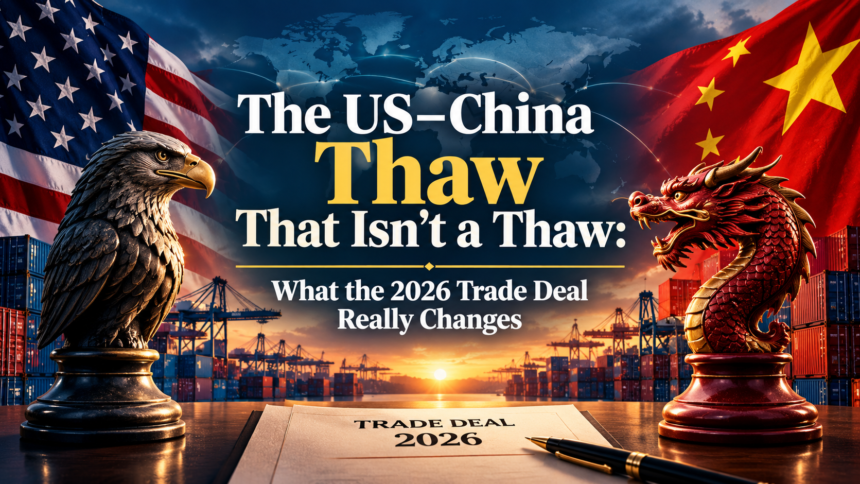
The US–China Thaw That Isn’t a Thaw: What the 2026 Trade Deal Really Changes
The high-stakes summit between US President Donald Trump and Chinese President Xi Jinping yielded an agreement that headlines initially celebrated as a breakthrough. Built around a reciprocal framework offering more favorable tariff treatment for roughly $30 billion in non-sensitive goods in each direction, China’s commitment to import at least 10 million metric tons of American coal annually starting in 2027, and the creation of a bilateral dialogue on “super intelligence” and emerging technology, the understanding offers an immediate buffer for global markets. However, framing this consensus as a fundamental economic de-escalation misinterprets its structural purpose. Rather than a permanent peace, the arrangement represents a calculated tactical stabilization a pause that allows both Washington and Beijing to manage acute domestic economic pressures while leaving the core architecture of strategic competition untouched.
The mechanics of the $30 billion tariff framework reveal its tightly circumscribed nature. By restricting tariff reductions exclusively to non-sensitive commercial sectors such as select agricultural outputs, basic consumer goods, and non-critical industrial inputs, both administrations deliberately protected their strategic economic sectors. For Washington, securing Chinese agricultural purchases and coal export commitments provides political relief to vital domestic constituencies. For Beijing, easing tariff barriers on low-tech manufacturing helps absorb industrial overcapacity and stabilizes employment without forcing structural economic concessions. Similarly, the establishment of the bilateral “super intelligence” dialogue creates a necessary communication channel to mitigate operational risks and prevent unintended escalation, but it does not signal technological convergence.
Beneath this transactional agreement, the fundamental drivers of US–China rivalry remain fully active and unresolved. Critical supply-chain bottlenecks, most notably rare earth elements, critical minerals, and advanced semiconductor fabrication continue to dictate national security planning in both capitals. Washington’s comprehensive export controls on cutting-edge microchips, lithography equipment, and artificial intelligence hardware remain unchanged, underscoring the American imperative to retain technological supremacy. In response, Beijing continues to pour state capital into domestic chip self-sufficiency while leveraging its near-monopoly on rare earth refining as strategic counter-leverage. The existential status of Taiwan, security dynamics in the South China Sea, and mutual accusations of cyber espionage were notably excluded from the economic consensus, highlighting that geopolitical friction points operate independently of tactical trade arrangements.
For multinational corporations and third-party nations, the temporary nature of this trade truce reinforces the necessity of “friend-shoring” and supply-chain diversification. Businesses recognize that while low-value trade flows may enjoy temporary regulatory stability, dual-use technologies and advanced manufacturing face permanent bifurcations. Across Southeast Asia, Europe, and Latin America, corporate entities are expanding the “China Plus One” strategy, establishing secondary production hubs in countries like Vietnam, India, and Mexico to insulate operations against sudden policy shifts in Washington or Beijing. Rather than reversing decoupling, the 2026 framework codifies a dual-track global economy where non-sensitive trade operates under market principles, while strategic technologies are governed by strict national security imperatives.
This evolving landscape presents complex challenges and strategic opportunities for developing economies, particularly those structurally tied to both superpowers. Nations like Pakistan find themselves managing a delicate balancing act. Islamabad relies heavily on Western financial markets, US export destinations, and international financial institution support, while simultaneously being anchored to Beijing through the China–Pakistan Economic Corridor (CPEC) and deep strategic ties. The temporary stabilization between Washington and Beijing reduces immediate pressures on third-party states to make stark, mutually exclusive choices. However, the ongoing division in global technology ecosystems forces developing nations to navigate conflicting standards in telecommunications, digital infrastructure, and artificial intelligence, risking market fragmentation and rising integration costs.
Ultimately, the 2026 trade understanding demonstrates that managing a strategic rivalry is not the same as ending it. By lowering the temperature on non-sensitive commerce and establishing high-level communication channels, Washington and Beijing have created a functional operational boundary. Yet this framework does not alter the trajectory of systemic competition. As technology, economic independence, and military capability remain intertwined with national power, the US–China relationship will continue to be defined by controlled confrontation where brief tactical agreements provide stability, but strategic rivalry remains the permanent state of international relations.
Author
I am an independent researcher with a passion for exploring global affairs through the lens of critical thinking and evidence-based analysis. My writing examines contemporary political, economic, and strategic issues, with the aim of presenting balanced perspectives that inform, engage, and encourage meaningful discourse.