
Rimsha Saleem
An evidence-based assessment of how extreme ecological shocks act as threat of multipliers, worsening resource competition, internal migration, and state fragility.
Climate Security Is No Longer a Future Problem: From El Niño to Conflict and Displacement
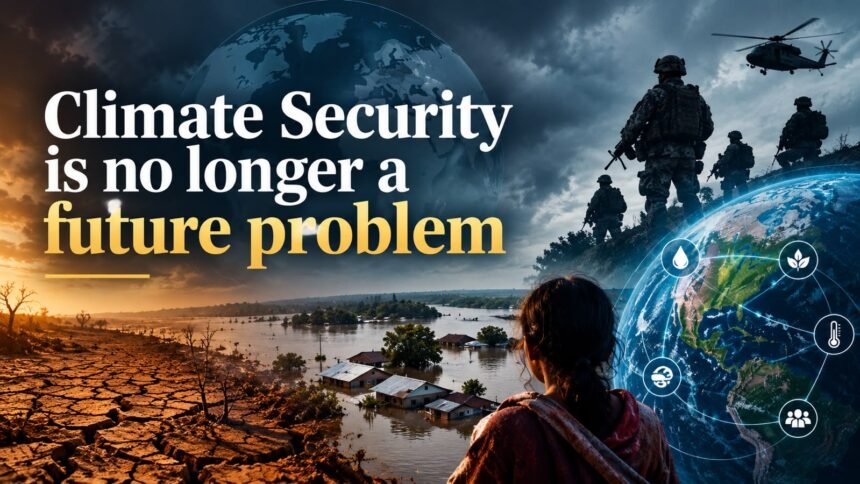
The conceptualization of climate change as a distant environmental threat belongs to a bygone era of security planning. In 2026, ecological disruption operates as an immediate structural driver of geopolitical instability, socioeconomic dislocation, and state fragility. The current El Niño episode vividly illustrates this reality: prolonged drought conditions across Southeast Asia have catalyzed a severe wildfire crisis in Indonesia, destroying fragile peatland ecosystems, generating toxic regional haze, and inflicting heavy economic damage. Beyond Southeast Asia, compound climate shocks are destabilizing vulnerable regions across Africa, the Middle East, and South Asia. Recognizing this trajectory, European defense officials and UN institutions have formally elevated climate security links on the global diplomatic agenda, reflecting a growing consensus that ecological disruption directly affects international peace, border stability, and national defense strategies.
To analyze this phenomenon accurately, international relations experts distinguish between crude environmental determinism and evidence-based security risk assessments. Climate change rarely serves as a direct, linear cause of armed conflict—saying climate stress simply “causes war” oversimplifies complex social and political dynamics. Instead, rigorous research from the Intergovernmental Panel on Climate Change (IPCC), the United Nations Environment Programme (UNEP), and defense research institutions demonstrates that climate shocks act as potent threat multipliers. Severe environmental stress interacts with pre-existing governance deficits, ethnic friction, poverty, and economic inequality, amplifying localized grievances. When extreme weather events destroy agricultural yields, degrade freshwater resources, or force rural communities off their land, state institutions face immense pressure. Where governance is weak, resource competition can quickly escalate into localized violence, non-state armed group recruitment, or mass internal displacement.
This structural interaction explains why climate security has moved from environmental forums directly into defense ministries and the United Nations Security Council. Defense planners no longer view extreme weather merely as a humanitarian concern requiring disaster relief, but as a catalyst for strategic instability. In the Horn of Africa and the Sahel, prolonged droughts alternating with severe flooding have disrupted pastoral trade routes, driving inter-communal conflict over arable land and water. In the Middle East, severe water scarcity compounds political friction along transboundary river basins, undermining agricultural livelihoods and accelerating rural-to-urban migration. When states lack the financial reserves or administrative capacity to buffer these shocks, the resulting socio-economic instability creates power vacuums that extremist organizations and criminal networks routinely exploit.
For South Asia, and Pakistan in particular, climate security constitutes an existential domestic and national security challenge. Pakistan occupies a precarious position at the intersection of glacial melt in the Himalayas, volatile monsoon patterns, intense heatwaves, and structural water stress. The country’s agricultural sector—the bedrock of its economy and primary employer of its rural workforce—remains highly sensitive to shifts in seasonal precipitation and temperature variations. Extreme weather events disrupt crop cycles, diminish yields of essential staples, and heighten national food insecurity. Furthermore, transboundary water dynamics with neighboring states complicate long-term resource management, making internal water allocation between provinces a persistent political friction point.
The human security consequences for Pakistan manifest most visibly through climate-induced displacement and urban pressure. As degraded land and water scarcity reduce agricultural viability in rural districts, millions of citizens migrate toward major urban centers like Karachi, Lahore, and Faisalabad. This rapid, unplanned urbanization places severe strain on municipal infrastructure, healthcare systems, housing markets, and sanitation networks. When local governments struggle to provide basic public services to expanding urban populations, socio-economic frustration rises, increasing the risk of urban instability and civil unrest. Concurrently, external climate shocks across the broader region—such as extreme weather and economic contraction in neighboring states—risk generating broader cross-border migration pressures that complicate regional security management.
Addressing the reality of climate security requires moving beyond reactive emergency assistance toward integrated risk management. International institutions and national governments must incorporate climate adaptation directly into foreign policy, defense planning, and macroeconomic policy. Building national resilience demands substantial investments in climate-smart agriculture, modern water storage and distribution infrastructure, early warning systems, and social safety nets designed to cushion vulnerable populations against environmental shocks. For middle powers like Pakistan, securing international climate finance and regional resource-sharing frameworks is not merely an environmental goal—it is a fundamental imperative for preserving internal stability, economic sovereignty, and national security in an era of ecological volatility.
Author
I am an independent researcher with a passion for exploring global affairs through the lens of critical thinking and evidence-based analysis. My writing examines contemporary political, economic, and strategic issues, with the aim of presenting balanced perspectives that inform, engage, and encourage meaningful discourse.