
Rimsha saleem
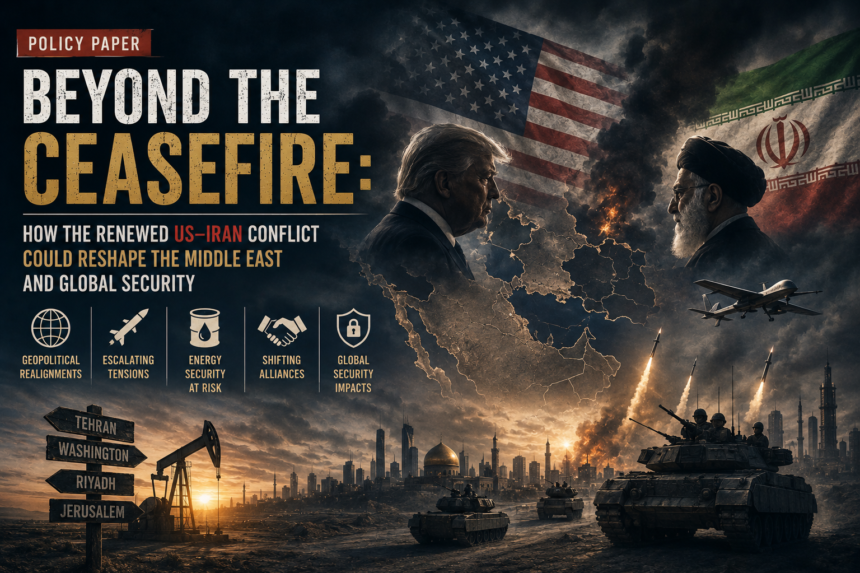
The collapse of the US–Iran ceasefire threatens global energy markets, shifts geopolitical alliances, and forces regional powers to brace for renewed instability.
The fragile architecture of West Asian security suffered a catastrophic fracture this week with the formal collapse of the short-lived US–Iran ceasefire. Formalized under the Islamabad Memorandum on June 17, 2026, the temporary pause in hostilities was intended to build a bridge toward a permanent settlement and secure the vital arteries of maritime commerce. Instead, the sudden breakdown on July 8 following renewed kinetic strikes in the Strait of Hormuz signals a transition from diplomatic theater to a volatile, unpredictable phase of regional friction. Rather than a localized skirmish, this collapse marks a systemic realignment where localized friction points interact directly with great power competition, creating severe ripples through global energy architecture and Middle Eastern security.
The unraveling of the ceasefire stems from an irreconcilable gap between Washington’s demands for structural concessions and Tehran’s regional security redlines. The diplomatic framework required an immediate, verifiable halt to proxy operations, strict nuclear constraints, and the unhindered opening of the Strait of Hormuz in exchange for conditional, phased sanctions of relief. However, the internal political dynamics on both sides doomed the arrangement from its inception. Washington’s insistence on a comprehensive regional retreat collided with Tehran’s domestic imperative to project strength and project its asymmetric deterrent. The immediate catalyst for the collapse unclaimed drone strikes targeting critical maritime assets and subsequent reciprocal naval engagements illustrates that without structural enforcement mechanisms, tactical incidents will invariably override diplomatic intent.
For the primary stakeholders, the resumption of conflict forces a rapid reassessment of strategic calculations. The United States finds itself anchored to a costly posture of forward deterrence, caught between a political desire to draw down West Asian commitments and the geopolitical reality of securing global maritime chokepoints. Israel views the collapse as confirmation that diplomatic containment is unviable, likely accelerating its operational planning for preemptive strikes against hardened Iranian nuclear and military infrastructure. Conversely, the Gulf monarchies face a complex security environment. While states like Saudi Arabia and the United Arab Emirates share a structural interest in weakening Iranian regional influence, they are intensely aware of their own vulnerability to retaliatory drone and missile strikes targeting energy infrastructure, forcing them to balance public alignment with Washington against quiet, de-escalatory channels with Tehran.
On the broader geopolitical chessboard, Moscow and Beijing view the renewed conflict through the lens of strategic competition with the West. For Russia, an active, low-boil conflict in the Middle East serves as a valuable systemic distraction, pulling American military assets, intelligence resources, and political capital away from the European theater. Beijing presents a more complex, dual-faceted calculus. As a massive consumer of Persian Gulf crude, China is highly vulnerable to energy supply shocks and rising maritime insurance premiums. However, Beijing also recognizes that Washington’s deep entanglement in a Middle Eastern security crisis limits its capacity to execute its strategic pivot to the Indo-Pacific, creating tactical room for maneuver in East Asia while cementing China’s role as a vital diplomatic mediator and economic lifeline for an isolated Iran.
The immediate economic shockwave travels directly through the Strait of Hormuz, the world’s most critical maritime chokepoint. The return of kinetic friction to these waters has immediately sent Brent crude prices back toward conflict highs, reversing the brief stabilization achieved during the June truce. For a global economy already navigating structural vulnerabilities, the real danger lies in a prolonged closure or a sustained high-risk premium on shipping. The resulting surge in energy costs acts as a direct driver of global inflation, complicating monetary policy across Europe and North America while threatening to trigger severe balance-of-payments crises in energy-importing, emerging market economies.
For Pakistan, the collapse of the ceasefire presents a acute, high-stakes foreign policy dilemma. Having actively facilitated the Islamabad Talks, Islamabad now faces the immediate collapse of its diplomatic investment and the return of an unstable, volatile conflict along its western border. Pakistan must navigate this environment by maintaining strict neutrality, resisting pressure to align with any external coalition, and reinforcing border security to prevent regional instability from spilling into its territory. Simultaneously, Islamabad must urgently secure alternative energy supply lines and strengthen its economic partnerships with Gulf nations to insulate its fragile domestic economy from the looming dual shocks of high inflation and soaring global energy prices.
Navigating this volatile environment requires a shift away from maximalist demands toward structured crisis management. International policy must prioritize the establishment of direct, hardened military-to-military de-escalation hotlines between the United States, its regional allies, and Iran to prevent tactical miscalculations from triggering an unintended regional escalation. Concurrently, a multilateral maritime security framework, backed by neutral international actors and regional states, must be explored to insulate commercial shipping from wider political conflict. Ultimately, a sustainable regional order cannot be built on temporary pauses in violence or demands for unconditional surrender; it requires a realistic, institutionalized security framework that acknowledges the baseline defensive anxieties of all regional actors while establishing clear, enforceable redlines for asymmetric behavior.
I am an independent researcher with a passion for exploring global affairs through the lens of critical thinking and evidence-based analysis. My writing examines contemporary political, economic, and strategic issues, with the aim of presenting balanced perspectives that inform, engage, and encourage meaningful discourse.