
Why is Pakistan suddenly facing coordinated pressure from Japan, Singapore, and India? The answer lies in CPEC, the Strait of Malacca, and the U.S. Indo-Pacific containment strategy against China
There is a pattern being created, and Pakistan needs to consider it clearly before it is too late. Within the span of a few weeks, Japan’s Prime Minister issued a joint statement explicitly naming Pakistan in the context of cross-border terrorism, something Japan deliberately avoided after the Pahalgam incident last year.
A former senior Singaporean diplomat, Bilahari Kausikan, delivered publicly disrespectful remarks about Pakistan’s political and military leadership. Meanwhile, Indian media has been running a persistent campaign, with 90 percent of its podcasters and commentators targeting Pakistan on everything from the Indus Waters Treaty to military intentions. None of this is a coincidence. None of this is organic. This is a coordinated information and diplomatic environment being constructed around Pakistan.
To understand why, we have to start looking at where U.S. strategic anxiety is actually concentrated. The United States has spent much part of this decade repositioning its global focus away from the Middle East and toward the Indo-Pacific. Its 2026 National Defence Strategy prioritises a homeland-first posture, emphasises the importance of deterring China in the Indo-Pacific, and reframes alliance management with a focus on stricter burden-sharing and conditional support. It clearly shows two primary areas of interest, the Western Hemisphere and the Indo-Pacific. The U.S. wants Europe and the Middle East to manage their own affairs.
The Iran conflict appears to have accelerated that withdrawal. Because the U.S. is done being the Middle East’s policeman. It wants its resources and its alliances pointed east. That eastward turn has one primary object, which is China. And China has one primary vulnerability, which is the Strait of Malacca.
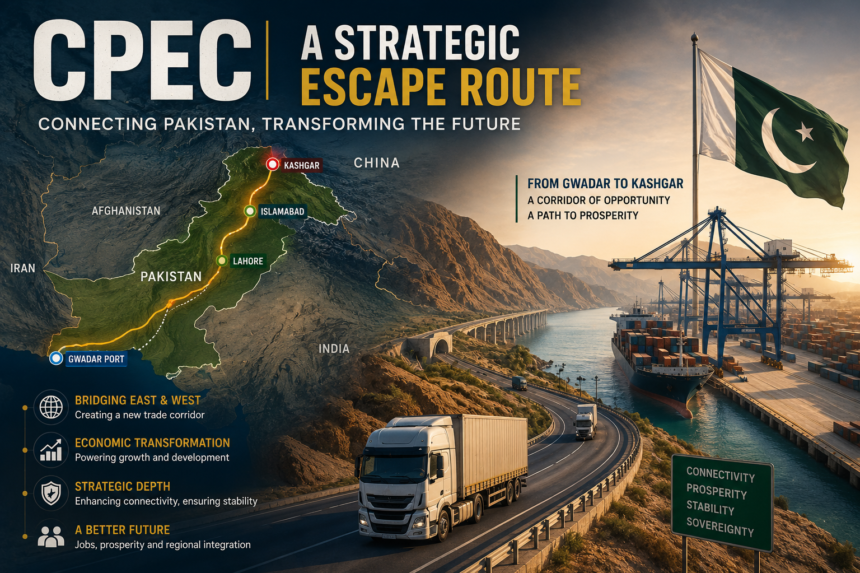
At its narrowest point, the Malacca Strait is just 3 kilometres wide. China’s maritime trade: 80% of oil and 62% of liquefied natural gas pass through this single chokepoint. Therefore, this is the commercial bloodstream of the world’s second largest economy. The Belt and Road Initiative (BRI), and particularly the China-Pakistan Economic Corridor (CPEC), was initiated to reduce that vulnerability. A route from Xinjiang to Gwadar gives China a way to move goods and energy without passing through a chokepoint that a hostile navy could complicate in the blink of an eye.
That is why CPEC is not, from the U.S. perspective, a developmental project. It is a strategic escape route. And escape routes, in great power competition, must be blocked.
Pakistan has proved its mettle in recent military performance against India, using Chinese weapons and Chinese technology, removed whatever ambiguity remained about where Pakistan stands in this contest. The message received in the U.S. and India was simple and loud that Pakistan is not merely a diplomatic partner of China. It is an operational one. That changes the calculation entirely.
This is the strand that connects Japan’s statement, Singapore’s remarks, and India’s media campaign into a single coherent picture. None of these actors needed a phone call from the U.S. directing them to target Pakistan. The strategic environment America has constructed, the Quad, the Indo-Pacific framework, and India’s elevation to a central pillar create their own gravity.
Smaller states usually align their foreign policy objectives to fit the existing regional and global security order. Instead of challenging the dominant powers, they often align with them to protect their own interests. For instance, Japan has strengthened its ties with India as part of its broader strategy to secure its position in the Indo-Pacific. Similarly, Singapore follows a more cautious approach by maintaining balanced relations while adapting to the prevailing security environment. Besides, India is shaping the regional narrative, and the U.S. is providing the larger strategic framework through its alliances and partnerships.
Within this evolving order, Pakistan has not realised that it has gradually shifted from being viewed as a secondary regional issue to a more visible strategic concern in a wider geopolitical competition that it neither created nor formally chose to join.
The author, Maimona Saleem, is a senior researcher at CDS and a PhD scholar in Peace and Conflict Studies. Her research focuses on terrorism and extremism. Her work also focuses on peace-based approaches to economic development, growth, and regional cooperation. She also writes on geopolitics, regional security, and global power dynamics