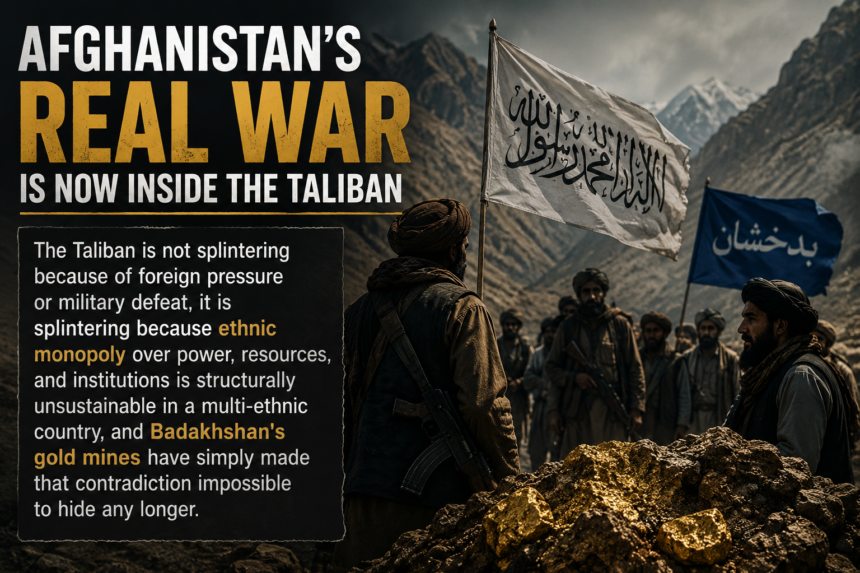

The Taliban is not splintering because of foreign pressure or military defeat; it is splintering because ethnic monopoly over power, resources, and institutions is structurally unsustainable in a multi-ethnic country, and Badakhshan’s gold mines have simply made that contradiction impossible to hide any longer.
Since 2021, when the Taliban took control of Afghanistan, the group has been fighting a war it did not expect, not against foreign troops or resistance fighters, but against itself. The signs are everywhere. In Badakhshan, a senior Taliban commander named Juma Khan Fateh has refused to hand over his weapons and his men.
The Taliban sent a delegation to negotiate. The talks failed. Now military helicopters are flying over Nusay District. Groups of intelligence personnel are moving from Kabul toward Darwaz. Local commanders are being dismissed one by one. The message from the Taliban’s central leadership is clear: obey or be removed.
But Juma Khan Fateh is not backing down either. He has told his fighters to stay alert but not to fire first. He believes, according to sources, that the Taliban leadership in Kandahar already knows the situation across Badakhshan is dangerously tense. He may be right.
The root of this particular dispute is gold. Badakhshan and neighbouring Takhar lie on some of Afghanistan’s richest mineral deposits. For generations, local families made their living from small-scale gold mining. The previous government largely left them alone. The Taliban have not.
Over the past year, mining sites have become flashpoints, and deadly clashes between residents, mining companies, and Taliban forces have become routine. The Taliban’s central leadership wants control of those mines. Local commanders who have spent years building relationships and authority in those same valleys are not willing to simply step aside.
This is not just one dispute in one province. It is a pattern that is repeating itself across Afghanistan. In Zabul, Juma Khan Fateh was removed as deputy governor after he openly stated he commanded ten thousand fighters, a show of strength that the Kandahari leadership perceived as a direct challenge.
In Faryab, the arrest of Uzbek commander Makhdoom Alam Rabbani triggered public protests. In Badghis, Tajik commander Qari Wakil was arrested while trying to mediate a separate conflict. In the defence ministry, more than four thousand military personnel, the majority from Badakhshan, Kapisa, Parwan, and Takhar, have been quietly dismissed. Badakhshan alone lost over a thousand officers.
The picture that emerges from these individual events is not complicated. The Taliban is systematically removing anyone who is not from the right tribe, the right province, and the right inner circle. Out of 1,185 senior government positions, roughly ninety percent are held by Pashtuns, even though Pashtuns make up less than half of Afghanistan’s population. Tajiks, who are the second-largest ethnic group in the country, hold just over five percent of senior posts. Uzbeks hold two and a half percent. Hazaras, a community that has already suffered enormously under Taliban rule, hold less than one percent.
The Taliban, when it returned to power in 2021, promised an inclusive government that would represent all Afghans. The numbers make clear that this was never true. The cabinet of 49 members contains two Tajiks, two Uzbeks, two Baloch, and one Nuristani. No women. No Hazaras in any meaningful capacity. Mawlawi Mahdi Mujahid was the only Hazara commander in the Taliban’s military leadership. He raised his voice against ethnic discrimination. He was captured and executed in Herat province. That was the Taliban’s answer.
Even figures who were loyal Taliban members for years have not been spared. Former deputy intelligence chief Salahuddin Salar was dismissed after he accused Taliban leaders of ethnic favouritism and resource monopoly. Tajik Army Chief Qari Fasihuddin Fitrat technically still holds his title, but the officers loyal to him have been methodically removed from the defence ministry. The title remains. The power has been taken away.
Therefore, what is happening in Afghanistan today is not simply a governance failure. It is the deliberate construction of a mono-ethnic state inside a multi-ethnic country. The Taliban is not governing Afghanistan. It is occupying it and the communities it is occupying are beginning to push back.
The gold mines of Badakhshan are not just an economic issue. They are the point where ethnic exclusion meets material deprivation. When a Kandahari commander arrives to take control of a mine that has fed local families for decades, and the local commander who protected those families is arrested or killed, the people watching do not see a government enforcing the law. They see a tribe taking what does not belong to it.
This is the instability that no military helicopter can resolve. They cannot fly over a grievance. They cannot disarm a community’s memory of how it has been treated. The Taliban’s leadership in Kandahar may believe that removing enough commanders, collecting enough weapons, and sending enough convoys will bring order to Badakhshan. History suggests otherwise. Regions that are governed by exclusion and extraction do not become stable. They become fuel.
Afghanistan’s crisis is no longer primarily about ideology or foreign intervention. It is about whether a government that represents only one part of its population can hold together a country that belongs to all of them. Based on everything happening right now in Badakhshan, Faryab, Badghis, Takhar, and Zabul, the answer is becoming harder and harder to avoid.
It cannot.
The author, Maimona Saleem, is a senior researcher at CDS and a PhD scholar in Peace and Conflict Studies. Her research focuses on terrorism and extremism. Her work also focuses on peace-based approaches to economic development, growth, and regional cooperation. She also writes on geopolitics, regional security, and global power dynamics