
By Brig (R) Asif Haroon Raja
The Objectives of the JAAC
The Joint Awami Action Committee (JAAC) sought to insert far-reaching legal and constitutional changes under the cover of demands for basic rights. This raised concerns within the establishment and government circles. The State is not always oppressive, nor is it always a victim. The issues that initially alarmed the establishment and government are now being examined and discussed more openly.
Under the banner of public rights, twelve public demands were initially accepted. However, JAAC’s demands expanded to thirty-eight. Thirty-six were accepted, while two were rejected. These two demands remain unacceptable under any circumstances. If JAAC does not withdraw these demands, they cannot be accommodated, regardless of how events unfold.
The insistence on these demands led to a crackdown on protesters despite Pakistan’s sensitive geopolitical circumstances. The two of JAAC’s demands effectively align with India’s interests and run contrary to Pakistan’s position.
Pakistan’s Foreign Policy
Since 1947, Pakistan’s foreign policy has consistently placed the Kashmir cause at its core. From the United Nations to international seminars, Pakistan has continuously advocated this cause.
Issue of 12 Reserved Seats
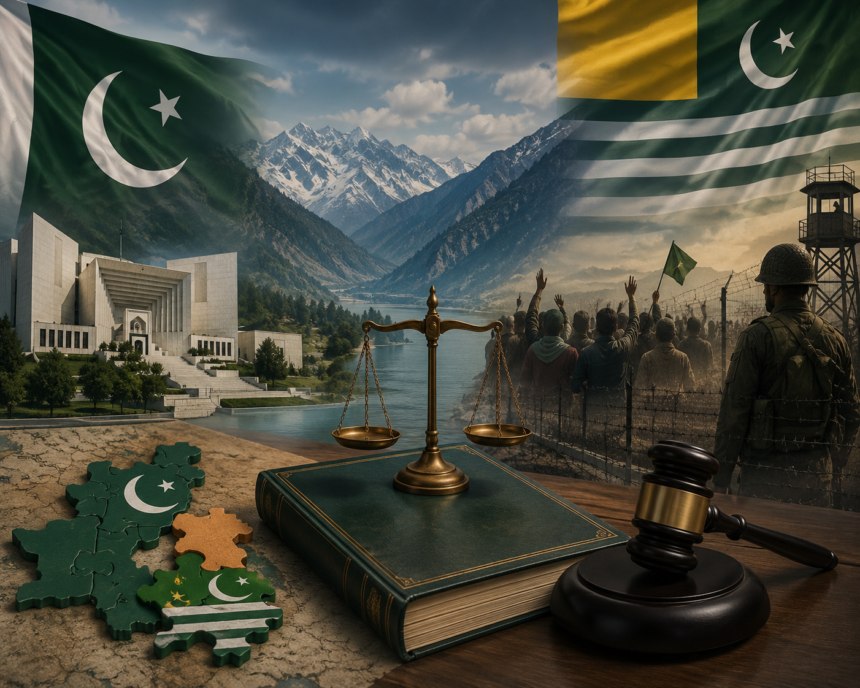
The JAAC seeks the abolition of the twelve reserved seats for Kashmiri refugees, which would effectively bury the Kashmir cause permanently. These twelve refugee seats are integral to Pakistan’s advocacy of Kashmir’s right to self-determination.
Their removal would represent a victory for India, which has long sought to portray the Kashmir dispute as settled. The JAAC wants amendments to constitutional provisions and election laws governing the oath of office in Azad Jammu and Kashmir.
Under the existing constitutional framework, the President, Prime Minister, and members of the Legislative Assembly are required to pledge loyalty to the cause of Jammu and Kashmir’s accession to Pakistan and affirm their belief in the ideology of Pakistan, the state’s accession to Pakistan, and Pakistan’s sovereignty and territorial integrity.
The JAAC seeks to remove this oath of allegiance. This would allow individuals to continue benefiting from federal funding, subsidies, development projects, and government employment without being required to pledge loyalty to Pakistan.
Both of these proposed changes would, knowingly or unknowingly, benefit India while harming Pakistan, and Pakistan cannot afford such consequences. The supporters of PTI are backing the protests for this reason alone. The former Prime Minister Imran Khan had compromised the Kashmir cause.
The JAAC is misleading ordinary people, much like banned organizations do, by using the language of rights to pursue different objectives. Pakistan’s political parties, military and civilian establishment, and government are united in opposing these demands. No major political party has endorsed them. The State action is often driven by underlying security and political concerns rather than arbitrary repression.
In the past, the demonstrators damaged public property but were handled leniently. This time, however, the State’s response has been much tougher because of JAAC’s unlawful demands.
So-called “Rights” Claimed by JAAC
“Whose rights?”
The rights belong to the refugees who migrated from Jammu to Pakistan, leaving behind ancestral homes, properties, and family graves in the name of Pakistan and Azad Kashmir.
The rights belong to those fighters who helped establish Azad Kashmir and to those who sacrificed their lives in the struggle.
The rights belong to the people of Indian-administered Kashmir, who bury their martyrs wrapped in Pakistani flags and who continue to support Pakistan despite enduring hardships.
The rights belong to those who joined the Kashmir jihad during the 1990s and whose families never even received their bodies for burial, leaving parents and relatives to grieve indefinitely.
The rights belong to those who contributed to the economic development of Azad Kashmir, purchased land for infrastructure projects, and provided financial opportunities that enabled many Kashmiris to prosper and settle abroad, particularly in the United Kingdom.
The rights belong to the taxpayers of Pakistan, who subsidize electricity and flour prices in Azad Kashmir while paying significantly higher prices themselves.
The rights belong to Pakistan’s armed forces, who protect the region and make sacrifices while serving on the country’s borders. Finally, the rights belong to those in Indian-administered Kashmir who continue to express support for Pakistan.
The rights are built through love, mutual respect, and relationships—not through violence, intimidation, bullets, or abusive language. The JAAC and its leaders damaged the bond between Pakistan and Kashmir, fostering divisions between different Kashmiri communities, and betrayed the sacrifices made for the Kashmir cause.
Brigadier (Retd) Asif Haroon Raja, SI (M), is a war veteran. He is Command and Staff Course and War Course qualified, holds an MSc in War Studies, and served as Defence Attaché in Egypt and Sudan, as well as Dean of the Corps of Military Attachés in Cairo. He is a defence, security, and geopolitical analyst, columnist, featured columnist of IntelDrop magazine, Washington, author of five books, former Chairman of Thinkers Forum Pakistan, Patron-in-Chief of Centre for Development Studies Think Tank, Director of Meesakh Research Centre; he regularly appears on media platforms.