
Asif Haroon Raja
Those who, on May 9, were calling upon people to “come out of their homes and reach the places where the Captain had instructed them to go” appeared to know exactly where they were expected to assemble.
This raises an obvious question: if the events of May 9 were entirely spontaneous, how were specific locations identified and communicated in advance?
On the evening of May 9, some supporters were reportedly celebrating what they regarded as a historic breakthrough, claiming that military personnel and their families had been targeted and that the “myth” surrounding the armed forces had been broken.
The expectation behind this strategy appeared to be that large numbers of people would come out of their homes, join the protests, attack military installations, force a political change and turn Pakistan into another Sri Lanka.
Change of Narrative and the Questions Raised
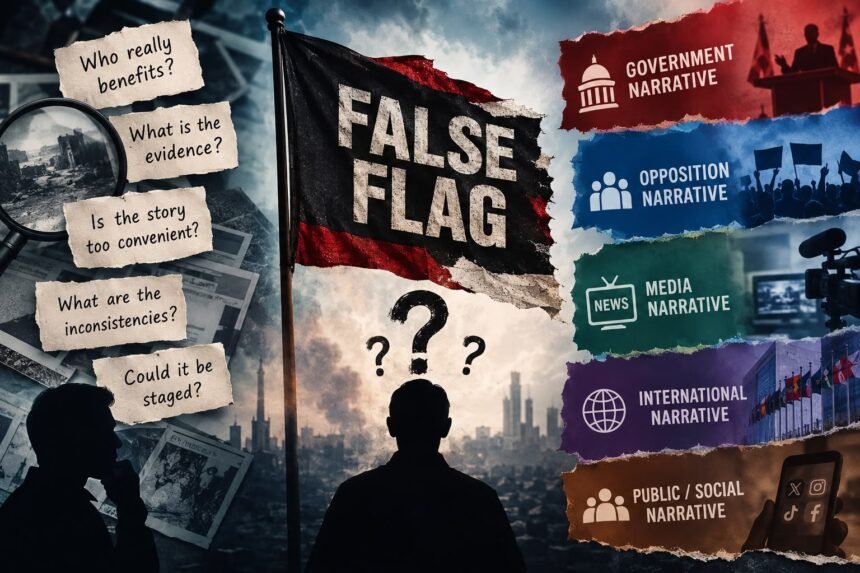
When this anticipated uprising failed to materialise and the state regained control of the situation, a dramatically different narrative began to emerge: that May 9 itself had been a false-flag operation.
This claim, however, raises a number of fundamental questions.
If May 9 was indeed a false-flag operation, then what was the role of PTI leaders and workers who were openly mobilising supporters and directing them
towards specific locations?
If May 9 was a false-flag operation, then was Murad Saeed an Army pawn when he was loudly calling upon people on May 9 to come out of their homes and reach all those places where the Captain had instructed them to go?
Were the PTI district presidents also pawns in this alleged false-flag operation when they brought groups of 200 to 500 people and attacked defence installations?
Was Yasmin Rashid also an Army pawn?
What about women such as Sanam Javed and Alia Hamza, who were seen breaking things, throwing their dupattas aside and challenging others? Which political party did they belong to?
If the attacks were orchestrated by elements seeking to discredit PTI, why were large groups of PTI supporters seen at sensitive locations, including military installations?
Why were groups reportedly numbering in the hundreds present at GHQ, the Corps Commander’s House and other military-related sites?
How did the PTI workers visible in the videos reach those locations? Who brought these attackers out of their homes and took them to those 200 locations — Army personnel or PTI leaders?
Similarly, what explains the presence of prominent PTI figures and activists at various locations?
Were all those individuals merely unwitting participants in a false-flag operation? If so, who mobilised them, who transported or directed them, and who coordinated their movements?
The videos and other visual evidence from May 9 contain substantial material showing identifiable individuals participating in, encouraging or observing the disturbances.
These questions cannot simply be dismissed by changing the narrative after the event.
Contradictory Narratives
One of the most striking features of the political debate surrounding May 9 has been the repeated change in narratives.
At one stage, the events were portrayed by some participants and supporters as a spontaneous expression of public anger and a historic political uprising.
Subsequently, when the movement failed to achieve its anticipated objectives, a counter-narrative emerged portraying the entire episode as a state-engineered false-flag operation.
Both narratives cannot simultaneously be true.
If the events were genuinely spontaneous, responsibility must be examined on the basis of the actions of those who participated in or encouraged them.
If, on the other hand, the entire episode was a carefully orchestrated false-flag operation, then those advancing this argument should provide credible answers to some basic questions:
*Who planned the operation?
*Who identified the targets?
*Who mobilised the crowds?
*Who communicated the locations?
*Who coordinated the participants?
*Who enabled them to reach sensitive military installations?
*Why were so many identifiable political activists present?
*And why did prominent political figures publicly react to the events in real time?
These are legitimate questions in any serious investigation.
The Jerusalem Post Controversy
Another contentious aspect of the political discourse concerns reporting and commentary by The Jerusalem Post regarding Imran Khan.
People used to ask why Imran Khan was called a “Jewish agent,” but now, it is claimed, The Jerusalem Post itself has provided confirmation of this allegation.
The fact that Israel’s major newspaper, The Jerusalem Post, has spoken in support of Imran Khan and called for his release is presented as clear evidence that Khan is actually an “asset” of the Zionist lobby, for whose protection Israel is now deeply concerned about.
Those who used to call Khan “the leader of the Ummah” should lower their heads in shame after seeing this post by The Jerusalem Post, which reveals whose favourite their leader actually is.
Supporters and opponents of Khan have interpreted such coverage in sharply different ways. Critics have argued that favourable coverage by an Israeli newspaper should at least prompt questions about Israel’s strategic interests and its broader assessment of Pakistan’s political landscape.
At a time when Field Marshal Asim Munir is bringing Iran and the Muslim world together, Israel’s support for Khan is portrayed as proof that it wants to create instability and discord in Pakistan.
Pakistan must remain alert to attempts by any foreign power to influence its internal political affairs.
A Larger Question of National Security
The real issue is not whether one political party or another can win the argument over May 9 through competing narratives. The larger question is whether political differences in Pakistan can ever justify attacks on military installations, public property or symbols of the state.
Political parties are an essential component of democracy. Peaceful protest, criticism of the government and political mobilisation are legitimate democratic activities.
But violence against state institutions crosses a fundamentally different line.
Likewise, allegations of a false-flag operation should not be accepted merely because they are politically convenient. They should be tested against evidence, video material, communications, eyewitness accounts and independent investigation.
Pakistan has suffered enormously from political polarisation, terrorism and institutional confrontation. Continuing to rewrite the events of May 9 according to political convenience will only deepen the country’s divisions.
The Need for Truth and Accountability
The country needs neither political revenge nor political impunity. It needs truth, justice and accountability.
Those who planned, incited, facilitated or participated in violence should be held accountable through due process, irrespective of their political affiliation.
At the same time, anyone who may have unlawfully used the events for political manipulation should also be investigated.
The May 9 episode should therefore not be reduced to a battle of slogans — “revolution” on one side and “false flag” on the other.
Pakistan deserves the truth. Only a transparent, impartial and evidence-based investigation can establish what actually happened, who organised it, who participated in it, and whether any individuals or institutions attempted to exploit the crisis for their own purposes.
Until such questions are conclusively answered, changing narratives will continue to deepen mistrust rather than resolve it.
The Obstructive Role of the Higher Judiciary:
The role of sections of the higher judiciary in the aftermath of 9 May also warrants serious scrutiny.
Instead of enabling a swift and transparent judicial process to determine responsibility, repeated interventions, prolonged hearings, stays and procedural delays in several cases contributed to an inordinate delay in bringing the alleged planners, instigators and perpetrators to account.
This prolonged judicial uncertainty provided
the political leadership accused of masterminding or facilitating the unrest of an opportunity to obscure the original acts of violence, shift the narrative, portray the perpetrators as victims, and smokescreen their own responsibility behind competing political narratives.
While the independence of the judiciary must be respected and every accused person is entitled to due process and a fair trial, justice delayed in a matter as grave as 9 May inevitably weakens public confidence in accountability and allows politically motivated narratives to gain traction.
In effect, the delay enabled those facing serious allegations to shift the debate from the destruction of state and military installations to questions of victimhood, political persecution and human-rights violations, thereby attempting to smokescreen their own alleged culpability.
Judicial independence and due process are indispensable pillars of a constitutional order, but they cannot become instruments—whether intentionally or inadvertently—for frustrating timely accountability.
In a matter as grave as 9 May, justice must not only be fair and evidence-based; it must also be sufficiently expeditious to prevent political narratives from overwhelming the facts and allowing the architects of violence to escape accountability through the passage of time.
A credible and expeditious judicial process, based strictly on evidence and law, would have served both justice and the country better.
About the Author
Brigadier (Retd) Asif Haroon Raja, SI (M) is a war veteran. He is Command and Staff Course and War Course qualified, holds an MSc in War Studies, and served as Defence Attaché in Egypt and Sudan, as well as Dean of the Corps of Military Attachés in Cairo. He commanded the largest brigade in Kashmir.
He is a defence, security, and geopolitical analyst, columnist, featured columnist of IntelDrop magazine Washington, author of five books, former Chairman of Thinkers Forum Pakistan, Patron-in-Chief of Centre for Development Studies Think Tank, Director of Meesakh Research Centre; he regularly appears on media platforms.