
(By: Nuzhat Nazar)
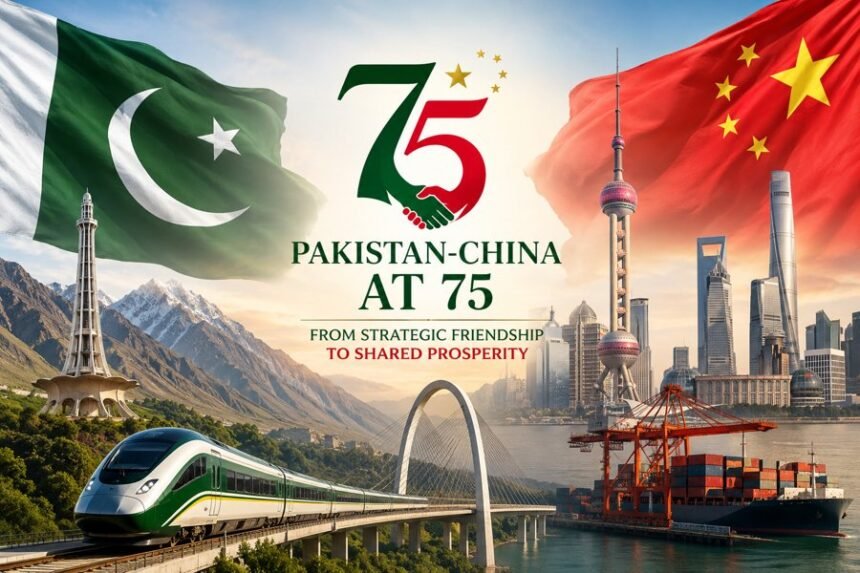
As Pakistan and China mark 75 years of diplomatic relations on May 21, 2026, the relationship stands at an important moment of renewal. Its strength is already well established. What matters now is how this trusted partnership can help Pakistan enter a new phase of economic resilience, industrial growth, technological learning and regional connectivity.
Few bilateral relationships in Pakistan’s foreign policy have shown the same continuity. Pakistan-China ties have survived wars, sanctions, political transitions, regional instability and major changes in the global order. Unlike many relationships that expand during moments of need and narrow when circumstances change, Pakistan-China relations have remained steady. This continuity is the real value of the partnership. It gives Pakistan a reliable strategic anchor at a time when global politics is increasingly uncertain.
The relationship did not begin with CPEC. Long before CPEC, the Karakoram Highway had already turned geography into strategy by connecting Pakistan with China through one of the world’s most difficult mountain routes. It was more than a road. It was a symbol of trust, engineering cooperation and long-term vision. CPEC later expanded that same logic into energy, transmission, transport, Gwadar, industrial cooperation and social-sector development.
CPEC’s first phase made a visible contribution to Pakistan’s infrastructure base. It helped address energy shortages, added transmission capacity, improved road connectivity and supported port-related development in Gwadar. These were essential investments for an economy that had long been constrained by power deficits and weak logistics. The next phase can build on this foundation by shifting from infrastructure creation to productivity creation.
This is where CPEC 2.0 becomes important. The upgraded framework around growth, livelihood, innovation, green development and openness gives both countries an opportunity to move beyond roads and power plants towards industry, agriculture, technology, climate resilience and human development. This is a positive shift. It places people, jobs and long-term economic capacity at the centre of the partnership.
Special Economic Zones can become one of the most important engines of this next phase. Rashakai, Allama Iqbal Industrial City, Dhabeji and Bostan offer Pakistan the chance to attract investment, support manufacturing, create jobs and increase exports. With better utilities, skilled labour, clear regulation and stable policies, these zones can help Pakistan move towards a more production-based economy. China’s industrial experience and Pakistan’s young workforce can complement each other if execution remains disciplined.
Trade is another area with major potential. China is Pakistan’s largest trading partner, and this gives Pakistani businesses access to one of the world’s biggest consumer markets. The current trade imbalance should be seen not only as a challenge but as an opportunity. Pakistan can expand exports in rice, seafood, meat, textiles, leather, surgical instruments, sports goods, IT services, minerals and processed agricultural products. With better quality control, branding, certification and market research, Pakistani firms can enter Chinese supply chains and benefit from China’s vast demand.
Minerals diplomacy is also emerging as a promising new pillar. Pakistan’s copper, gold, chromite, antimony, rare earth potential and broader mineral base have gained strategic relevance as the world competes for resources linked to clean energy, electric vehicles, semiconductors, batteries and defence technologies. This gives Pakistan a major opening to build value-added industries rather than only exporting raw materials.
China can be a central partner in this transition. Its experience in mining, processing, refining, infrastructure and industrial parks can help Pakistan develop minerals as part of a national industrial strategy. Pakistan can also engage the United States, Gulf countries and European investors, but China must remain closely consulted because it is already Pakistan’s long-term infrastructure and industrial partner. The best approach is not exclusivity, but transparent diversification with strategic trust.
Gwadar also carries great promise. It is often viewed through a strategic lens because of its location near the Arabian Sea and the Gulf. But for Pakistan, its most meaningful success will come through local development. Gwadar can become a hub for fisheries, warehousing, logistics, vocational training, tourism, trade and maritime services. The port, airport and free zone can create opportunities for Balochistan if development is linked with local employment, water, electricity and community participation. A prosperous Gwadar would strengthen both CPEC and Pakistan’s internal economic integration.
Security remains essential, but it should be seen as part of a broader development framework. The safety of Chinese citizens and projects is a national priority because these projects are linked to Pakistan’s economic future. Stronger security, better policing, intelligence coordination, local engagement and community ownership can create the confidence required for long-term investment. A secure corridor can also become a socially accepted and economically productive corridor.
The regional dimension adds further value. Pakistan and China share an interest in stability in Afghanistan and wider regional connectivity. In the long term, Pakistan can become a bridge between China, Central Asia, the Arabian Sea and the Middle East. This would require better border management, customs reforms, banking channels, transport links and political stability. If achieved, Pakistan’s geography can become a source of economic strength rather than strategic pressure.
The relationship also has an important human dimension. Pakistani students in China, vocational training programmes, language learning, media exchanges, technical education and professional networks can build the social base of the partnership. If Pakistan wants to benefit fully from Chinese technology, industry and markets, it needs more China-literate engineers, entrepreneurs, translators, logistics experts, trade specialists and policy professionals.
At 75, Pakistan-China relations have already proven their durability. The partnership is strategic, not need-based. It has provided Pakistan with diplomatic support, defence cooperation, infrastructure development and economic opportunity. The next 25 years can make this relationship even more meaningful if both countries focus on measurable outcomes: higher exports, functional industrial zones, mineral value addition, agricultural cooperation, digital skills, climate resilience, secure corridors and a commercially active Gwadar.
Pakistan should continue diversifying its partnerships with the United States, Gulf countries, Europe and others. But it must also recognise the unique continuity of its relationship with China. China is not simply a partner of convenience. It is Pakistan’s long-term strategic anchor. The best tribute to 75 years of friendship will be a stronger Pakistani economy, deeper industrial capacity and shared prosperity built through disciplined execution and strategic trust.