
Pakistan’s Role During the Afghan Jihad in the 1980s
During the Soviet invasion and occupation of Afghanistan from December 1979 to February 1989, an estimated 1.8 million Afghans, including nearly 300,000 children, lost their lives.
In stark contrast, Pakistan opened its doors to more than five million Afghan refugees over several decades. It not only provided them with shelter and security, but also extended education, healthcare, employment opportunities, and humanitarian support.
Many refugees developed deep social and economic ties with Pakistan, and numerous families departed with visible emotion when repatriation eventually began.
Apart from providing extensive humanitarian assistance, Pakistan played a pivotal role in supporting the Afghan resistance and was instrumental in compelling Soviet forces to withdraw from Afghanistan.
Ironically, Afghanistan’s present rulers are now forging defence ties with the very country whose military intervention inflicted immense suffering on the Afghan people.
At the same time, they are widely accused in Pakistan of failing to curb the activities of anti-Pakistan militant groups operating from Afghan soil.
Despite repeated concerns raised by Islamabad, they have not publicly distanced themselves from these groups nor taken sufficiently visible action to dismantle their infrastructure.
Pakistan also complains that hostile external actors, particularly India and Israel, seek to exploit Afghan territory to destabilise Pakistan through terrorism and subversion.
Against this backdrop, many Pakistanis ask a fundamental question: What explains this apparent shift in Afghanistan’s attitude toward a country that hosted millions of its people for decades and extended extraordinary humanitarian support in their hour of need?
Afghan Taliban Rule in Afghanistan
When the first Afghan Taliban government, led by Mullah Mohammad Omar, assumed power in October 1996 and ruled Afghanistan until November 2001, India was among the countries most hostile to the regime because of its Islamist ideology.
During that period, New Delhi extended political and material support to the anti-Taliban Northern Alliance.
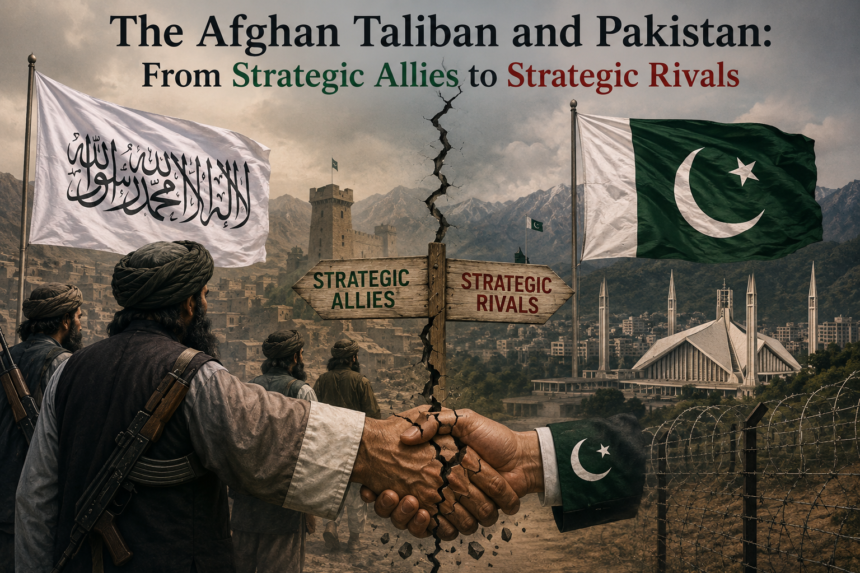
Ironically, Pakistan and Afghanistan enjoyed their warmest relations during the first Taliban regime under Mullah Omar (1996–2001). For the first time in decades, Pakistan’s western frontier remained peaceful and secure.
The Deterioration of Pakistan–Afghanistan Relations
Following the U.S.-led intervention in late 2001 and the establishment of a Western-backed government in Kabul under Hamid Karzai, India emerged as one of its closest strategic partners.
Pakistan has evidence to support its claim that India used its diplomatic missions and intelligence network in Afghanistan and in Iran to support covert operations against Pakistan and the Afghan Taliban, who had regrouped in the former FATA and parts of Balochistan.
India also remained a steadfast supporter of the successive Northern Alliance-dominated governments in Kabul. The US played a duplicitous role by pretending to be a friend of Pakistan, but in reality, it wanted to destabilize, denuclearize, and balkanise Pakistan through covert operations.
Throughout the twenty-year war on terror, the US blamed Pakistan for the instability in Afghanistan. When the US-led Western forces had to exit from Afghanistan in August 2021, it carried a grudge that it couldn’t achieve any of its political and military objectives in the region, and once again blamed Pakistan for its failure.
The Breakdown of Pakistan–Afghanistan Relations in the Post-2021 Era
Ironically, the same India that had for years denounced the Taliban as terrorists fundamentally recalibrated its Afghanistan policy after the Islamic Emirate of Afghanistan (IEA), led by Haibatullah Akhundzada, returned to power in August 2021.
New Delhi initiated diplomatic engagement with the new rulers, and relations between the two sides have steadily expanded into a strategic partnership.
The Afghan Taliban interim regime has failed to meet many of the expectations associated with the Doha Agreement signed in February 2020. It has neither established an inclusive and broadly representative government nor adequately safeguarded the rights of women.
Most importantly, it has been repeatedly accused of failing to honour its commitment to prevent Afghan territory from being used by terrorist groups to threaten other countries, particularly by not harbouring terrorist groups and taking effective action against cross-border terrorism emanating from Afghan soil.
The interim regime has failed to prevent Afghan territory from being used by anti-Pakistan militant groups. Despite Pakistan’s extensive political, diplomatic, humanitarian, and military support for the Afghan Taliban over the past four decades, Kabul has ignored Pakistan’s security concerns, rejected repeated offers of enhanced bilateral cooperation, and has been unwilling or unable to curb cross-border terrorist activities.
Pakistan further believes that the Kabul authorities have drawn closer not only to India but also to Israel, and that these alignments have intensified the proxy conflict being waged against Pakistan in Khyber Pakhtunkhwa and Balochistan.
Terrorist violence has risen sharply since late 2024, with the period from 2025 to mid-2026 proving particularly deadly.
At the same time, longstanding disputes over the Durand Line remain unresolved, and sections of the Afghan political establishment continue to reject the border as an international boundary.
Afghanistan: A Hub of Terrorism
The world, including the UN, has now acknowledged that Afghanistan has become a sanctuary for numerous militant organisations, including Al-Qaeda, IS-Khorasan, the Islamic Movement of Uzbekistan (IMU), the East Turkestan Islamic Movement (ETIM), the Tehrik-e-Taliban Pakistan (TTP), and the Balochistan Liberation Army (BLA). Russia confirmed that there are 23 terrorist groups based in Afghanistan.
Based on concrete evidence collected over a period of time, Pakistan does not doubt in its mind that some of these organisations receive external financial and logistical assistance from hostile foreign actors. These allegations are disputed by the countries concerned.
The Taliban authorities are reportedly permitting militant organisations to recruit, indoctrinate, and train terrorists and suicide bombers responsible for attacks against civilians and security forces.
Such attacks have frequently targeted mosques, madrassas, funeral gatherings, marketplaces, and other public places.
Pakistan further alleges that militant groups operating from Afghan territory have employed increasingly sophisticated tactics, including drone-assisted attacks against civilian targets.
Finally, it is widely believed in Pakistan that the Taliban leadership has failed to honour commitments made to neighbouring countries and key benefactors, including Pakistan, Saudi Arabia, and Qatar.
From Islamabad’s perspective, it is particularly disheartening that a movement whose leaders and supporters found refuge in Pakistan for decades—where they lived, worked, educated their children, established businesses, acquired property, and benefited from medical and humanitarian assistance—is now perceived as allowing Afghan territory to be used for militant operations against Pakistan.
Afghan Taliban – TTP Bondage
The Afghan Taliban maintain particularly close ties with the TTP under Noor Wali Mehsud. Despite repeated diplomatic engagement, border management measures, and military pressure by Pakistan, the Taliban leadership has remained reluctant to take decisive action against the group.
Strengths of TTP
The TTP is widely believed to enjoy support from influential factions within the Taliban movement as well as assistance from external actors.
This patronage has strengthened its operational capabilities and enabled it to recruit disaffected former Taliban fighters as well as ex-members of the former Afghan National Security Forces.
Access to abandoned U.S.-supplied military equipment has further enhanced its capabilities.
Internal dynamics within the Taliban leadership also remain significant. Any shift in the TTP’s allegiance towards the Haqqani Network under Sirajuddin Haqqani could alter the balance of power between the Kandahar-based leadership and the Haqqani faction.
Regardless of these internal rivalries, the TTP has acquired sufficient leverage to pressure elements within the ruling establishment to facilitate cross-border operations against Pakistan.
IEA Criticised for its Flawed Policies
While presenting itself as the Islamic Emirate of Afghanistan (IEA) and claiming to govern strictly in accordance with Islamic principles, the Taliban government has faced widespread international criticism over its policies towards women and girls.
Restrictions on female education, employment, and public participation have drawn condemnation from Muslim scholars, human rights organisations, and much of the international community.
Critics also argue that several of the regime’s policies are inconsistent with the traditional Pashtun code of Pashtunwali.
Afghanistan’s Internal Challenges
Afghanistan continues to suffer from severe economic hardship, widespread poverty, food insecurity, chronic unemployment, and diplomatic isolation.
These hardships have reportedly forced many families into desperate coping mechanisms, including early and forced marriages involving underage girls. There are reports of fathers selling their daughters for the sake of the survival of their families.
IEA is increasingly held responsible by the Afghan people for the country’s worsening political, economic, humanitarian, and security crises. Critics attribute these challenges to weak governance, ineffective state institutions, and a lack of administrative responsibility.
Amid growing public frustration over deteriorating economic hardship, political exclusion, and poor governance, internal divisions within the Taliban have reportedly deepened, resulting in an increasingly visible power struggle among the Kandahar, Kabul, and Haqqani factions.
Simultaneously, armed resistance has gained momentum in Northern Afghanistan, where the National Resistance Front (NRF) and the Afghanistan Freedom Front (AFF) have intensified their operations, particularly in Panjshir, Baghlan, Takhar, Badakhshan, and Kunduz.
While the Taliban continues to claim nationwide control, resistance groups assert that they are expanding their operational reach and are steadily challenging Taliban authority in several northern districts.
Under the leadership of Ahmad Massoud, the NRF has reportedly stepped up military pressure on the Taliban through a series of coordinated attacks.
Reports from Kabul indicate that several powerful explosions occurred in the capital today, with ammunition and fuel depots said to be among the reported targets, although the circumstances surrounding the blasts and responsibility for them have yet to be independently verified.
How to Wipe out the Scourge of Terrorism?
If the scourge of terrorism is to be eradicated, Pakistan’s proactive and offensive counterterrorism strategy must not remain a temporary response but should evolve into a permanent feature of the country’s national security policy.
Whenever terrorists inflict casualties upon Pakistan, the response must be swift, overwhelming, and directed at dismantling their infrastructure, leadership, training camps, and support networks.
Terrorism has been deliberately imposed upon Pakistan; therefore, it must be confronted with the resolve and determination required in wartime. The emotionally appealing slogans of Muslim Ummah, Islamic brotherhood, and neighbourly goodwill have their place in normal interstate relations.
However, in today’s harsh geopolitical environment, the foremost duty of every state is to safeguard its sovereignty, territorial integrity, and the lives of its citizens. The protection of vital national interests must remain the state’s highest priority.
Whether a Pashtun from Khyber Pakhtunkhwa, a Punjabi from Punjab, a Sindhi from Sindh, a Baloch from Balochistan, a Muhajir, a Hazara, a Gilgiti, or a Kashmiri, every Pakistani has an equal right to live in peace and security. Our mothers did not give birth to their sons and daughters so that they should fall victim to ruthless terrorists operating from across the border.
Whoever the terrorists may be, and wherever they may be based, they must be relentlessly pursued and their operational networks dismantled. Those who plan, finance, facilitate, train, or execute acts of terrorism must understand that they will find no sanctuary and no impunity. Every attack on innocent civilians must invite an effective and decisive response against those responsible.
Only when terrorist organisations and their handlers are convinced that the costs of aggression far outweigh any perceived gains will they think repeatedly before attempting another cowardly attack.
For decades, Pakistan invested enormous political, economic, humanitarian, and diplomatic capital in supporting Afghanistan, hoping to build enduring bonds of friendship based on shared history, faith, and culture.
Many Pakistanis believe that these sacrifices have not been reciprocated. Instead, they argue that the authorities in Kabul have ignored Pakistan’s legitimate security concerns while simultaneously cultivating closer ties with countries viewed in Pakistan as strategic adversaries.
As a consequence, trust between the two neighbours has reached one of its lowest points. If this trajectory continues, repeated appeals based solely on the ideals of Muslim brotherhood and shared Islamic values are unlikely, by themselves, to alter the strategic calculations of those in Kabul.
Durable peace can only emerge when mutual respect, reciprocal security commitments, and an unequivocal rejection of terrorism become the foundation of Pakistan-Afghanistan relations.
The author, Brigadier (Retd) Asif Haroon Raja, SI (M) is a war veteran. He is Command and Staff Course and War Course qualified, holds an MSc in War Studies, and served as Defence Attaché in Egypt and Sudan, as well as Dean of the Corps of Military Attachés in Cairo. He is a defence, security, and geopolitical analyst, columnist, featured columnist of IntelDrop magazine, Washington, author of five books, former Chairman of Thinkers Forum Pakistan, Patron-in-Chief of Centre for Development Studies Think Tank, Director of Meesakh Research Centre; he regularly appears on media platforms.