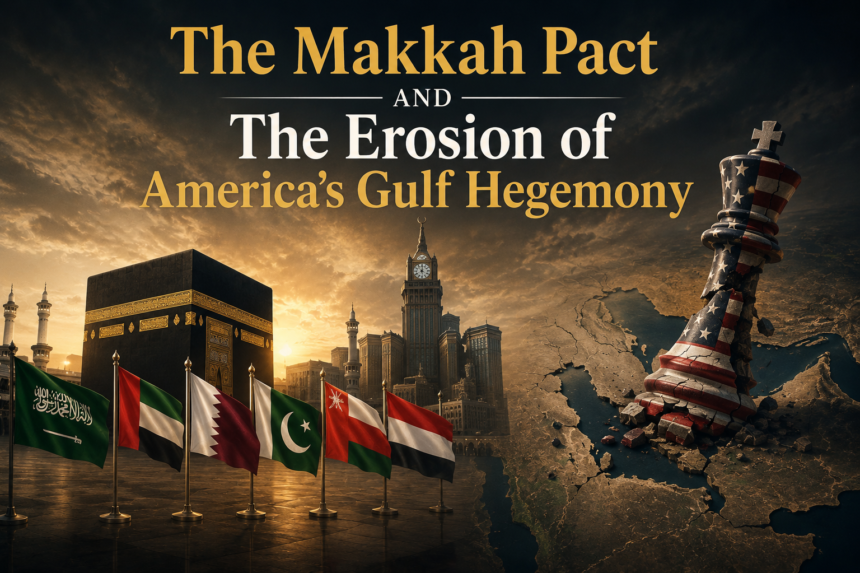

The Makkah Joint Defence Agreement is a potentially historic shift in Gulf security: from an order dominated by American power since Britain’s withdrawal east of Suez, the 1980 Carter Doctrine and the 1990–91 Gulf War, towards one increasingly shaped by regional powers themselves.
The change is gradual, not abrupt. The 2019 Saudi oil attacks, China-brokered Saudi-Iran rapprochement in 2023, and now Pakistan-Saudi-Türkiye defence cooperation suggest that Washington is not disappearing, but its position as the indispensable organiser of Gulf security is steadily being challenged by growing regional strategic autonomy.
Nuzhat Nazar
Great powers are rarely replaced in a single dramatic moment. Their influence erodes gradually, often while their military bases remain, their alliances continue and their diplomats insist that the old order is intact.
The real change begins when other states stop assuming that one power must always sit at the centre.
That is why the Makkah Joint Defence Agreement between Pakistan, Saudi Arabia and Türkiye deserves to be read as more than another defence pact. It may represent one of the clearest signs yet that the Gulf is moving away from an American-managed security order towards a more regionally driven system.
A recent analysis by Council on Foreign Relations senior fellow Steven A. Cook argues that the agreement reflects the decline of the U.S.-led Middle Eastern order. The argument is provocative, but the historical trajectory gives it weight.
For decades, Washington was not simply another security partner in the Gulf. It was the indispensable one.
After Britain announced its withdrawal from major military commitments east of Suez in the late 1960s, the United States increasingly assumed the role of the dominant external power in the region. That role became explicit after the Iranian Revolution and the Soviet invasion of Afghanistan in 1979.
In January 1980, President Jimmy Carter declared that any attempt by an outside power to gain control of the Persian Gulf would be regarded as an assault on vital American interests and could be resisted by military force. The Carter Doctrine effectively placed Gulf security within the framework of American strategic power.
The 1990 Iraqi invasion of Kuwait demonstrated that dominance at its peak. When Saddam Hussein’s forces crossed into Kuwait, it was the United States that assembled and led the international coalition that ultimately expelled them.
But hegemony is not measured only by aircraft carriers, bases or troop numbers. It is also measured by whether other states believe they have viable alternatives.
That is where the story begins to change.
The September 2019 attacks on Saudi Aramco’s Abqaiq and Khurais facilities became a psychological turning point. The attacks, claimed by Yemen’s Houthis but disputed in their origin and attribution, exposed the vulnerability of some of the world’s most important energy infrastructure despite the extensive Western security presence in the Gulf.
The lesson for Riyadh was not necessarily that America had disappeared. It was that American presence did not automatically mean American intervention.
Four years later came another striking development. In 2023, Saudi Arabia and Iran restored diplomatic relations through negotiations brokered not by Washington, but by Beijing.
That was more than a diplomatic photo opportunity. It demonstrated that China could perform a consequential political role in a region long considered part of America’s strategic domain.
Then came defence diversification.
Pakistan and Saudi Arabia formalised their long-standing security relationship through the Strategic Mutual Defence Agreement in 2025. In 2026, Türkiye entered the equation through the Makkah framework.
Seen separately, each event can be explained away.
Seen together, they point towards something larger.
Diplomatic mediation is diversifying. Defence partnerships are diversifying. Arms relationships are diversifying. Regional states are increasingly building security arrangements directly with one another.
This is not yet the disappearance of American power. It is the erosion of American indispensability.
And history offers an intriguing comparison.
In the 1950s, Pakistan and Türkiye were both part of the Baghdad Pact, later known as CENTO, an alliance structure created within the wider Western strategy of containing Soviet influence. The architecture may have included regional states, but its strategic logic was heavily shaped by Western priorities.
Seven decades later, Pakistan and Türkiye are again appearing together in an emerging regional security structure.
The difference is significant.
This time, the framework was not conceived in Washington or London.
It is being developed by regional powers themselves.
Pakistan brings conventional military experience, counterterrorism expertise and decades of security engagement with Gulf states. Türkiye contributes NATO experience, an increasingly sophisticated defence industry and growing capabilities in drones, missiles and electronic warfare. Saudi Arabia provides financial weight, geography and immense political influence across the Arab and Islamic worlds.
These are not identical capabilities. They are complementary ones.
That is precisely why the agreement has strategic potential.
But calling it a “Muslim NATO” would still be premature. NATO became formidable not simply because it contained a collective-defence clause, but because it developed integrated command structures, interoperability, intelligence mechanisms, logistics, exercises and decades of institutional habit.
The same test applies to Makkah.
Its future significance will depend on what happens after the signatures: joint planning, intelligence sharing, military exercises, interoperability, maritime coordination, cyber cooperation, technology transfer and eventually joint defence production.
Another important question is whether the framework expands.
If additional countries eventually participate, Makkah could evolve from a trilateral agreement into the nucleus of a broader regional security system. That would represent something more profound than another alliance.
It would indicate that states historically dependent on external guarantees are beginning to assume greater responsibility for their own strategic environment.
This does not necessarily make the arrangement anti-American.
Saudi Arabia can strengthen defence ties with Pakistan and Türkiye while maintaining its relationship with Washington. Türkiye can remain in NATO while pursuing greater strategic autonomy. Pakistan can deepen Gulf security cooperation without joining a confrontation against another bloc.
The emerging international system is increasingly built around overlapping partnerships rather than rigid Cold War-style camps.
That is why saying that America has already been “replaced” would go too far.
But saying that it is gradually being replaced as the sole organising centre of Gulf security is becoming increasingly difficult to dismiss.
The United States still possesses enormous military and diplomatic power in the Middle East. Yet power and hegemony are not the same thing.
A hegemon dominates not simply because it is strong, but because others believe the system cannot function without it.
The Makkah agreement suggests that this assumption is beginning to weaken.
History may eventually remember this period not as the moment America left the Gulf, but as the period in which the Gulf began learning how to organise itself without waiting for America.
And that may prove to be the more consequential transformation.