
Part Three
Asif Haroon Raja
Emerging Fault Lines in India–US Relations
Pakistan’s nuclear programme, its growing strategic relationship with China and the China–Pakistan Economic Corridor (CPEC) have long been viewed with concern in Washington, New Delhi and Tel Aviv.
These considerations contributed to the gradual emergence of a closer US–India strategic relationship in the post-Cold War period, with India increasingly viewed in Washington as a potential counterweight to China.
Since then, India has sought to derive strategic benefits from relations with competing global powers.
During the Cold War, it maintained close defence and political ties with the Soviet Union while formally pursuing non-alignment.
After the Cold War, it progressively developed a strategic partnership with the United States and strengthened its relationship with Israel.
In recognition of India’s growing role as a counterweight to China and an important security partner in the Indo-Pacific, Washington has supported India’s emergence as the strongest military and economic power in South Asia.
This strategic space has also enabled India to maintain significant defence and energy relations with Russia despite Western sanctions, while simultaneously expanding its engagement with BRICS and the Shanghai Cooperation Organisation.
India has also continued, at various times, to purchase Iranian oil despite the US sanctions regime.
Such divergences illustrate the limits of strategic alignment: India seeks the benefits of partnership with Washington while retaining considerable autonomy in pursuing its relations with Moscow, Tehran and Beijing.
The evolving relationship, however, has not been free of friction. Trade disputes involving tariffs, market access, digital taxation and intellectual-property issues have periodically strained bilateral relations.
Trade and Tariffs
Trade tensions between Washington and New Delhi are likely to persist irrespective of which administration is in power in the United States.
India’s protectionist policies, tariff structures, market-access restrictions and differences over digital taxation have remained sources of contention.
The imposition of US tariffs on Indian imports has demonstrated that strategic partnership does not necessarily eliminate economic disagreements.
Human Rights and Democracy
Sections of the US Congress, American media and civil society have periodically criticised India over religious freedom, minority rights and the health of democratic institutions.
Such criticism has occasionally generated diplomatic friction and illustrates another potential fault line in the otherwise expanding US–India strategic partnership.
India’s Foreign Policy
India’s foreign policy is increasingly based on multi-alignment rather than traditional non-alignment.
It seeks simultaneously to:
*Maintain a strategic partnership with the United States.
*Preserve its longstanding defence and political relationship with Russia.
*Avoid open conflict with China while competing with it strategically.
*Expand its influence across the Indo-Pacific, the Middle East, Africa and the Global South.
This balancing strategy has served India’s national interests reasonably well.
However, as strategic rivalry among the United States, China and Russia intensifies, sustaining such a delicate equilibrium will become progressively more difficult.
Proxy Warfare: A Preferred Instrument
Against this strategic backdrop, Pakistan contends that India has increasingly relied on proxy warfare and information warfare as relatively low-cost instruments for exerting pressure on Pakistan, weakening its security forces and undermining its international credibility.
Pakistan has further alleged that India has sought to exploit Afghanistan as a platform for cross-border terrorism and that Israel has provided strategic and technological support to India’s broader efforts against Pakistan.
The central concern for Pakistan, however, is that the use of proxies and non-state actors creates a form of conflict in which responsibility can be denied, while the target state continues to bear the security and economic costs.
Pakistan’s Perspective on India’s Allegations
Pakistan has consistently accused India of interfering in its internal affairs and of supporting proxy warfare, particularly in Khyber Pakhtunkhwa and Balochistan and, more recently, in relation to developments in Azad Jammu and Kashmir (AJK).
Pakistani officials have maintained that evidence supporting these allegations has been presented to international forums and friendly countries and have repeatedly called for impartial international investigations.
India, in turn, has accused Pakistan of supporting cross-border terrorism, particularly in Indian-administered Jammu and Kashmir. Pakistan rejects these allegations and maintains that India has failed to substantiate them with credible evidence.
These competing narratives have become a persistent source of tension between the two nuclear-armed neighbours.
Against this backdrop, sections of the Indian political establishment and media have at times alleged that Pakistan sought to exploit or influence student protests and political unrest within India.
Pakistan has denied such involvement, arguing that these demonstrations stemmed primarily from domestic grievances concerning education, governance, unemployment and other socioeconomic issues.
Trust Deficit
The exchange of allegations illustrates the profound trust deficit between the two countries. Instead of addressing each other’s concerns through institutional dialogue, both sides have frequently resorted to reciprocal accusations, further complicating efforts to improve bilateral relations.
This cycle of blame has reinforced hostility, diverted attention from underlying domestic grievances and reduced the prospects for meaningful confidence-building measures between the two neighbours.
Difference in Approaches
The major reason for the persistent lack of trust and enduring hostility between the two arch-rivals lies in the fundamental divergence in their strategic outlooks.
India, driven by a hegemonic and expansionist mindset, has repeatedly pursued an assertive regional posture, whereas Pakistan has consistently advocated peaceful coexistence and maintains no territorial claims or expansionist ambitions against any of its neighbours.
Suspension of the Indus Waters Treaty
The Indian decision in April 2025 to place the Indus Waters Treaty in abeyance represented one of the most serious developments in India–Pakistan relations in decades.
Pakistan regards the Treaty as a binding international agreement that cannot be unilaterally suspended, whereas India has argued that changed security circumstances justify a fundamental reassessment of its implementation.
The dispute has subsequently entered legal and diplomatic channels, with Pakistan maintaining that India’s position is incompatible with the Treaty and applicable international law.
From a strategic perspective, the weaponisation of water carries significant risks.
First, it could permanently undermine one of the world’s most important and enduring transboundary water-sharing arrangements.
Second, it risks internationalising the dispute by attracting greater attention from other states and international institutions.
Third, it could intensify Pakistan’s perception of an existential threat, given the country’s dependence on the Indus river system for agriculture, food security and power generation.
Fourth, it could further reduce the already limited space for bilateral dialogue.
If the dispute escalates without a negotiated framework, water could become a long-term source of instability between the two nuclear-armed neighbours.
Pakistan–US Relations
Washington continues to recognise Pakistan’s strategic importance because of its geographical location, counterterrorism role, nuclear capability and close relations with the Gulf States.
Pakistan’s increasingly visible role in regional diplomacy and mediation has also enhanced its international profile.
Islamabad now seeks to project itself not merely as a security state but as a peacemaker, stabiliser and net contributor to regional security.
Both Pakistan and the United States have expressed interest in overcoming longstanding reservations and developing a more constructive relationship based on mutual interests, respect and strategic pragmatism.
Such a shift would inevitably ruffle the feathers of the policy makers in New Delhi and Tel Aviv and ring alarm bells.
The Makkah Accord—the strategic defence understanding between Pakistan and Saudi Arabia, with Turkiye also associated with the emerging security framework—has introduced another significant dimension into the regional strategic equation. It has alarmed Israel and India, while Iran is monitoring the emergence of Islamic NATO prudently.
China and Russia’s positive response to the emerging framework has further increased its geopolitical significance and could contribute to the evolution of a broader security architecture involving major Muslim and Eurasian powers.
Future of India–Pakistan Relations
*In the near term, India–Pakistan relations are likely to remain tense.
*The principal obstacles include:
*The unresolved Jammu and Kashmir dispute.
*Allegations of cross-border terrorism and proxy warfare.
*The dispute over the Indus Waters Treaty.
*India’s aspiration for regional primacy and its vision of Akhand Bharat.
*Military competition and conventional deterrence.
*China’s expanding strategic role in South Asia.
*Deep political mistrust between the two countries.
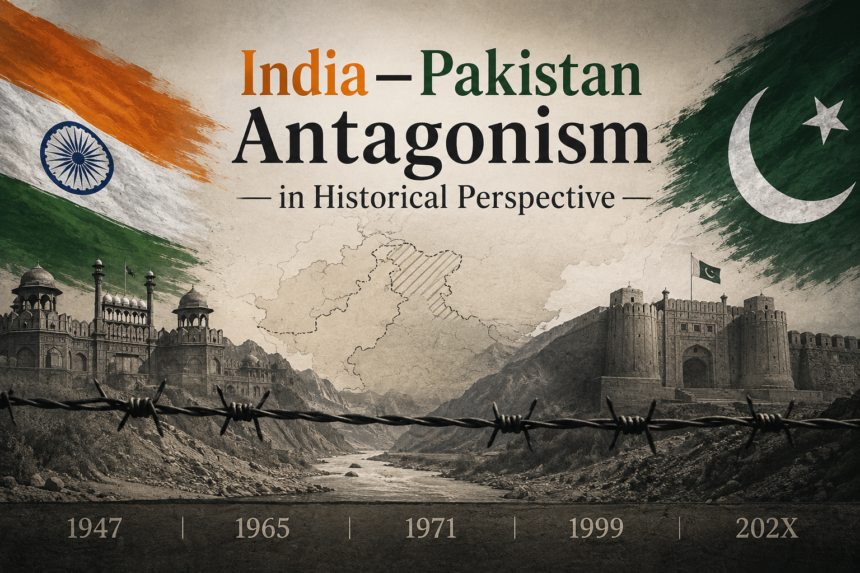
Nevertheless, both countries are nuclear powers. Their history demonstrates that periods of acute confrontation have often been followed by renewed diplomatic engagement.
Strategic realities, economic considerations and international pressure have repeatedly encouraged both governments to avoid uncontrolled escalation.
The principal challenge, therefore, is not the absence of mechanisms for peace but the absence of sufficient political trust and sustained political will to use them.
Overall and Concluding Assessment
India appears to be entering a more complex strategic phase than at any time in the past decade.
The BJP government retains considerable political strength, but India’s room for manoeuvre is being tested by converging domestic, economic, security and diplomatic pressures.
Managing relations simultaneously with Pakistan, China, Russia and the United States while maintaining its influence across the Global South will require increasingly sophisticated statecraft.
For Pakistan, the immediate priorities should remain economic strengthening, neutralising hostile Western front, internal security, diplomatic engagement, strategic stability and the mobilisation of international support for its legal and political positions, including those concerning Jammu and Kashmir and the Indus Waters Treaty.
The suspension of the Indus Waters Treaty has added a new and potentially dangerous dimension to India–Pakistan relations by introducing water security into an already volatile strategic equation.
Unless both countries revive meaningful diplomatic engagement and establish credible mechanisms for crisis management, mutual distrust is likely to deepen.
Future crises could consequently escalate more rapidly and unpredictably than those of the past.
Yet perpetual confrontation is neither inevitable nor sustainable.
The long-term interests of India and Pakistan—and indeed of the entire South Asian region—lie not in military coercion, proxy warfare, information confrontation or reciprocal accusations, but in responsible statecraft, sustained dialogue, respect for international commitments and the gradual restoration of strategic trust.
The history of the past eight decades demonstrates that neither country can change its geography, eliminate the other, or secure lasting peace through coercion alone.
The choice before India and Pakistan is therefore not between victory and defeat, but between perpetual antagonism and a managed peace founded on mutual security and coexistence.
Concluded
About the Author
Brigadier (Retd) Asif Haroon Raja, SI (M) is a war veteran. He is Command and Staff Course and War Course qualified, holds an MSc in War Studies, and served as Defence Attaché in Egypt and Sudan, as well as Dean of the Corps of Military Attachés in Cairo.
He is a defence, security, and geopolitical analyst, columnist, featured columnist of IntelDrop magazine Washington, author of five books, former Chairman of Thinkers Forum Pakistan, Patron-in-Chief of Centre for Development Studies Think Tank, Director of Meesakh Research Centre; he regularly appears on media platforms.