

Nuzhat Nazar
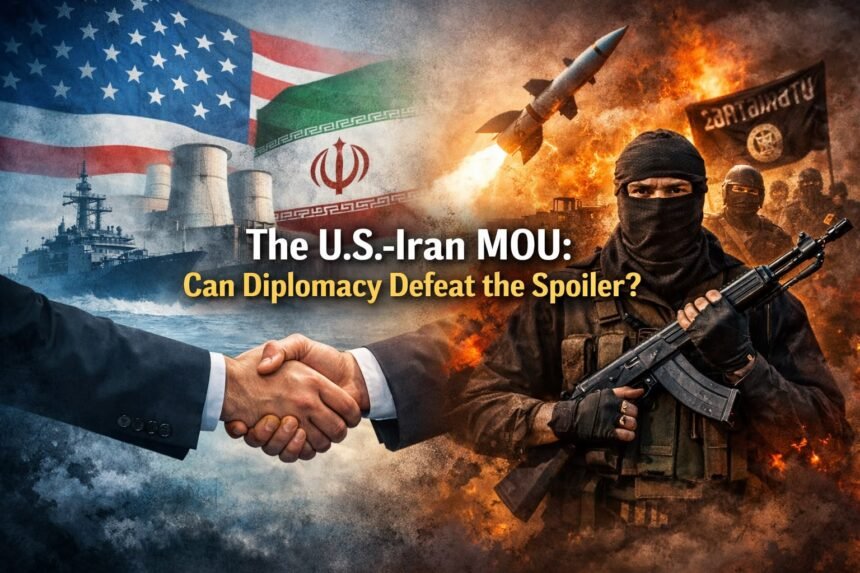
History rarely gives diplomacy a quiet moment. Just when negotiators believe they have opened the door to peace, events on the ground threaten to slam it shut. The recently announced 14-point Memorandum of Understanding (MoU) between the United States and Iran is no exception. It has generated cautious optimism across the region, but it has also entered the most dangerous phase of any peace process – the period between a political understanding and a legally binding agreement.
That distinction matters.
Unlike a treaty, an MoU is not legally enforceable. It is a political commitment, a framework that outlines shared intentions and builds confidence for future negotiations. It can open the door to peace, but it cannot guarantee it. Its success depends entirely on whether the parties can preserve enough trust to transform political intent into a comprehensive agreement.
The reported understanding covers de-escalation, maritime security, confidence-building measures, a pathway towards resolving the nuclear issue, sanctions relief and reducing regional tensions. In simple terms, Washington and Tehran appear to have recognised an uncomfortable reality: another regional war would benefit neither side.
For the United States, diplomacy offers a chance to avoid yet another costly military entanglement while focusing on broader strategic priorities. For Iran, it offers the possibility of economic relief and greater regional stability. Neither country appears interested in a prolonged conflict that could engulf the Middle East and send shockwaves through the global economy.
But diplomacy has now reached its most fragile stage.
If history teaches us anything, it is that peace initiatives rarely collapse because diplomats stop talking. They collapse because someone decides that conflict serves their interests better than compromise.
The closest parallel is the 2015 Joint Comprehensive Plan of Action (JCPOA). As Washington negotiated with Tehran, Israel strongly opposed the agreement, arguing that it merely delayed rather than eliminated Iran’s nuclear ambitions. Political lobbying, diplomatic pressure and covert operations became part of a wider effort to prevent the agreement from reshaping the regional balance.
History offers similar lessons elsewhere. The Oslo peace process, the Camp David negotiations and even the Suez Crisis all remind us that diplomatic breakthroughs are often tested not in conference rooms but on battlefields. Agreements rarely fail because negotiators cannot find common ground. They fail because military and political realities overtake diplomacy before it has a chance to mature.
That risk is once again becoming evident.
Despite the diplomatic momentum created by the US-Iran MoU, Israeli military operations in Lebanon have continued. With much of the international community calling for restraint, diplomacy and de-escalation, Israel increasingly risks positioning itself as the principal spoiler of an emerging regional peace process. Every military escalation erodes confidence, hardens negotiating positions and reduces the chances of transforming the MoU into a comprehensive and legally binding agreement. Diplomacy cannot flourish when the battlefield dictates the political agenda.
Lebanon has therefore become far more than another flashpoint. It is now the first real test of whether the political understanding between Washington and Tehran can survive events on the ground. The question is no longer whether the two sides can sign a document, they already have! The real challenge is whether they can protect the diplomatic process long enough to negotiate a lasting settlement.
While missiles have dominated headlines, Pakistan has quietly chosen a different path.
From the outset of the crisis, Islamabad consistently advocated restraint, dialogue and diplomacy. Through engagement with regional capitals and international stakeholders, Pakistan supported efforts to prevent the conflict from expanding into a wider regional war. Its message has remained consistent: lasting peace cannot be achieved through military escalation alone.
Pakistan’s position is rooted not only in principle but also in practical realities. Another major conflict in the Middle East would disrupt energy supplies, threaten maritime trade routes, fuel inflation and place additional strain on an already fragile global economy. For countries like Pakistan, regional stability is not an abstract diplomatic objective; it is an economic and strategic necessity.
More importantly, Pakistan’s diplomacy reflects a broader truth about today’s international system. The era when conflicts were resolved solely through military superiority is gradually giving way to one where dialogue, mediation and regional diplomacy are becoming increasingly important. Middle powers are no longer passive observers. They are emerging as facilitators of dialogue in an increasingly fragmented world.
This is no longer just a story about Washington and Tehran. It is a story about a changing Middle East and an even faster-changing world.
For decades after the Cold War, the United States largely shaped the regional order through overwhelming military and political influence. Today, that landscape looks very different. Washington is seeking to reduce prolonged military commitments while focusing on strategic competition elsewhere. Gulf states are prioritising economic transformation over endless confrontation. China and Russia continue expanding their influence across the region. Regional powers are pursuing increasingly independent foreign policies.
The US-Iran MoU should therefore be viewed not merely as a bilateral understanding but as an attempt to redefine how regional crises are managed. It reflects a growing recognition that perpetual military confrontation has failed to deliver lasting security. The alternative being tested is diplomacy — slow, imperfect and often frustrating but still preferable to another cycle of war.
Whether this effort succeeds will depend less on the fourteen points contained in the MoU than on whether diplomacy is given the time and political space to work. If restraint prevails, the memorandum could evolve into a comprehensive and legally binding agreement, laying the foundations for a more stable regional security architecture. If military escalation continues to dominate events, the opportunity may disappear before negotiations are even completed.
The real value of the US-Iran MoU lies not in the document itself but in the possibility it creates. Peace in the Middle East has never failed because agreements were impossible; it has too often failed because they were never given the chance to succeed.
The coming weeks will determine whether this MoU becomes the first chapter of a new regional order or simply another reminder that in the Middle East, diplomacy must first survive the spoilers before it can deliver peace.

