
Part Three
By Asif Haroon Raja
The Real Problem
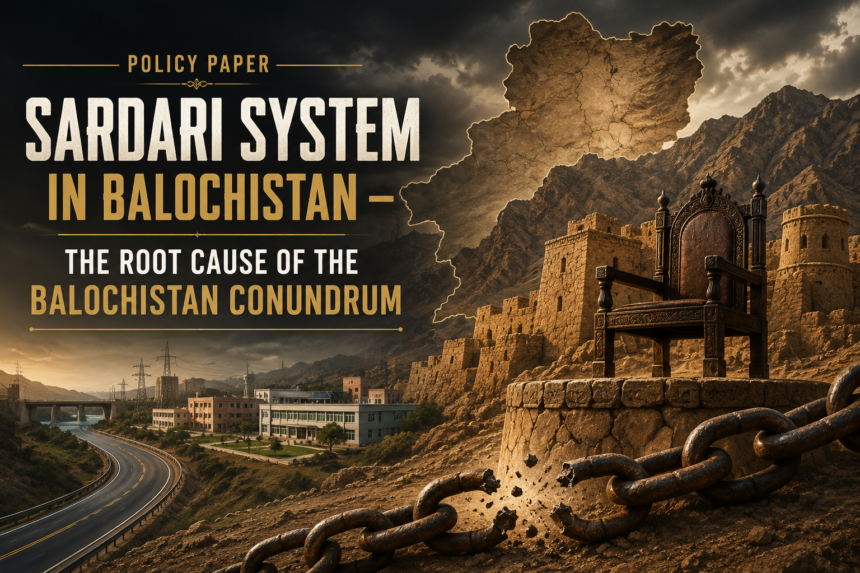
The central argument of this series is that the principal challenge confronting Balochistan is not merely militancy or terrorism, but the continued dominance of the Sardari system. A similar, though less pronounced, feudal structure also exists in parts of Sindh.
For decades, political power, land ownership, and economic resources have remained concentrated in the hands of a small number of influential tribal chiefs and feudal families, while a large segment of the population continues to live in poverty with limited access to quality education, healthcare, employment, and justice.
This concentration of power has enabled tribal elites to preserve their influence through private militias, informal taxation, patronage networks, and control over local resources.
Despite substantial public expenditure, many districts continue to lag behind national averages in literacy, healthcare, and other indicators of human development.
Successive attempts to introduce meaningful land reforms, regulate mineral royalties, or strengthen civilian institutions have achieved only limited success because of the political influence exercised by powerful tribal interests.
Whenever the authority or financial interests of influential tribal leaders have been challenged, confrontation with the State has often followed.
While tribal leaders have benefited from government offices, privileges, and financial allocations, many have simultaneously projected themselves as champions of Baloch grievances after leaving office.
An Assessment of the Balochistan Issue
Balochistan covers approximately 347,000 square kilometres, making it Pakistan’s largest province by area. Its vast distances, rugged terrain, sparse population, and porous international borders present extraordinary administrative and security challenges.
The province’s socio-economic problems are genuine and require sustained attention. However, these challenges cannot be attributed solely to the federation. Internal governance, tribal politics, weak institutions, corruption, and poor implementation of development programmes have also played significant roles.
Some analysts have suggested that administrative restructuring could improve governance by bringing the government closer to the people. They point to India’s reorganisation of Punjab in 1966, which created smaller administrative units and improved governance.
Similar proposals have occasionally been advanced for Balochistan, including the creation of additional administrative units based on geography, language, or administrative convenience.
Such proposals, however, remain politically sensitive and would require broad national consensus. Moreover, without reforms of the institutions such as the bureaucracy, judiciary, police, FBR, education and electoral reform, creation of additional provinces or administrative units wouldn’t resolve the problem.
The fundamental issue is the equitable distribution of opportunities, resources, and political representation. Unless ordinary citizens become meaningful stakeholders in the province’s development, cycles of poverty, alienation, and unrest are likely to persist.
The Role of the Sardars
Successive civilian and military governments share responsibility for relying excessively on influential tribal chiefs rather than strengthening democratic institutions at the grassroots level.
For decades, many Sardars remained indispensable political allies of successive governments. In return, they retained their traditional authority, while reforms affecting land ownership, local governance, education, and resource distribution received inadequate attention.
The Sardari elite accumulated considerable wealth through royalties, government allocations, commercial ventures, and political influence, while many tribal communities remained deprived of basic facilities.
Political patronage enabled influential families to consolidate their economic and political dominance across generations.
Another criticism frequently advanced is that while ordinary tribesmen bore the burden of prolonged insurgencies, many tribal leaders themselves remained outside the conflict or settled abroad, where several continue to reside.
The Emerging Challenge
One significant development in recent years has been the emergence of an educated Baloch youth determined to question traditional tribal authority.
This represents perhaps the most significant political and social change in the province in decades.
Rather than effectively engaging this new generation through education, employment, entrepreneurship, and political inclusion, state institutions often failed to develop a comprehensive strategy to harness their potential.
Consequently, various political movements and hostile foreign intelligence agencies have sought to influence sections of the youth for their own strategic objectives.
Shady organisations such as the Baloch Yakjehti Committee (BYC) posing itself as a peaceful rights movement, serve as political platforms that indirectly advance narratives benefiting proscribed militant organisations. BYC is the political face of BLA.
At the same time, militant organisations have increasingly recruited young men and women through ideological indoctrination, exploitation of local grievances, and promises of financial incentives.
Poverty, unemployment, and inadequate educational opportunities have made vulnerable sections of society more susceptible to recruitment.
Governance Challenges
Governance remains another major concern. Corruption, weak institutions, political instability, criminal networks, smuggling, and narcotics trafficking have collectively undermined effective administration in many parts of the province.
Although the 18th Constitutional Amendment substantially enhanced provincial autonomy in 2010, many of the grievances relating to governance, service delivery, and development persist.
This suggests that greater autonomy alone cannot resolve structural problems without corresponding improvements in accountability and institutional capacity.
Another longstanding administrative anomaly is the division of Balochistan into ‘A’ Areas and ‘B’ Areas. In many ‘B’ Areas, law enforcement has traditionally depended on the Levies rather than the regular police, limiting the uniform application of state authority.
The recruitment of Levies from the tribes of interior Balochistan remains largely subject to the approval of the respective tribal Sardars, reflecting the enduring influence of the tribal system over local administration.
This arrangement has long been criticised for reinforcing the Sardars’ authority and limiting merit-based recruitment.
A substantial portion—reportedly up to two-thirds—of the Levies’ pay, allowances, and medical benefits is appropriated by the Sardars, leaving the personnel with only a fraction of their entitled remuneration.
Many analysts believe that integrating policing and strengthening civilian administration would improve governance throughout the province.
The Way Forward
The future of Balochistan depends upon empowering its people rather than perpetuating traditional power structures.
The state should pursue comprehensive reforms aimed at strengthening education, healthcare, local government, judicial access, employment generation, industrialisation, mineral development, and transparent distribution of royalties.
Simultaneously, political authority must increasingly shift from hereditary tribal influence to democratic institutions accountable to the people.
The educated youth of Balochistan represent the province’s greatest asset. By investing in their education, skills, entrepreneurship, and political participation, Pakistan can transform Balochistan from a region associated with conflict into one driven by opportunity and prosperity.
The time has come for the State — from parliament to local administration — to take a historic decision to dismantle feudal strangle hold.
The time has come for Parliament, provincial institutions, and civil society to work together to gradually reform outdated feudal structures while preserving Balochistan’s rich tribal traditions and cultural identity.
- Sustainable peace will ultimately depend not only upon security measures but upon justice, inclusive development, accountable governance, and equal opportunities for every citizen.
Concluded
About the Author
Brigadier (Retd) Asif Haroon Raja, SI (M) is a war veteran. He is Command and Staff Course and War Course qualified, holds an MSc in War Studies, and served as Defence Attaché in Egypt and Sudan, as well as Dean of the Corps of Military Attachés in Cairo.
He is a defence, security, and geopolitical analyst, columnist, featured columnist of IntelDrop magazine Washington, author of five books, former Chairman of Thinkers Forum Pakistan, Patron-in-Chief of Centre for Development Studies Think Tank, Director of Meesakh Research Centre; he regularly appears on media platforms.