
CDSCDSCDS
Font ResizerAa
  • Home
  • ArticlesNew
  • Events
  • Media Coverage
  • Gallery
  • About
    • Who We are
    • Board of Directors
  • Contact
Reading: China-Pakistan Five-Point Initiative
Share
CDSCDS
Font ResizerAa
  • Home
  • ArticlesNew
  • Events
  • Media Coverage
  • Gallery
  • About
    • Who We are
    • Board of Directors
  • Contact
Follow US
Designed & Developed by Odesigning – Creative Web Experts.
Articles

China-Pakistan Five-Point Initiative

Maimona Saleem
Last updated: April 18, 2026 12:38 pm
Maimona Saleem
Share
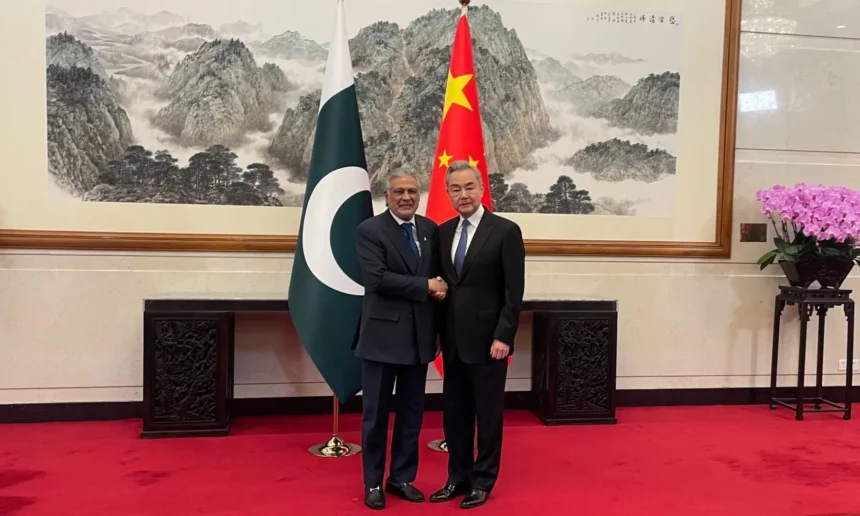
Deputy Prime Minister and Foreign Minister Ishaq Dar meets China’s FM Wang Yi in Beijing, China on March 31. Photo via X/@CGTNOfficial
SHARE

China-Pakistan Five-Point Initiative, a diplomatic framework for restoring peace in the Gulf and the Middle East

Amid escalating tensions in the Gulf and Middle East, China and Pakistan have jointly proposed a five-point initiative aimed at restoring peace, stability, and adherence to international norms. Member of the Political Bureau of the Communist Party of China (CPC) Central Committee and the Minister of Foreign Affairs of the People’s Republic of China H.E. Mr. Wang Yi and Deputy Prime Minister/Foreign Minister of the Islamic Republic of Pakistan, Senator Mohammad Ishaq Dar met in Beijing on 31 March 2026 to review the situation in the Gulf and Middle East Region. The initiative reflected a shared commitment to diplomatic engagement and multilateral cooperation in a rapidly deteriorating regional security environment.

The two sides proposed the following measures:

Both countries emphasize the necessity of halting ongoing violence to prevent further escalation across the region. Recognizing the severe humanitarian consequences of continued conflict, the proposed measure underscored the importance of ensuring unhindered access to humanitarian assistance for affected populations.

 China and Pakistan strongly advocated for the prompt initiation of peace talks, reiterating that dialogue and diplomacy remain the only sustainable means of conflict resolution. The initiative stressed the importance of respecting the sovereignty, territorial integrity, and political independence of regional states, including Iran and Gulf countries. It called upon all parties to commit to peaceful negotiations while refraining from the use or threat of force during the process.

Besides, a key pillar of the framework was the protection of civilians and non-military infrastructure. The initiative urged all actors involved in the conflict to adhere strictly to International Humanitarian Law (IHL) to safeguard civilian lives. It specifically highlighted the need to avoid targeting critical infrastructure such as energy facilities, desalination plants, power grids, and peaceful nuclear installations, which are vital for civilian survival and regional stability.

The strategic significance of the Strait of Hormuz was also an important part of the proposed measures. As one of the world’s most crucial maritime routes for energy and trade, its security is vital for global economic stability. China and Pakistan called for the protection of ships and crew operating in the area and advocated for the swift restoration of safe, uninterrupted maritime passage.

Finally, the initiative emphasized the primacy of the United Nations and its Charter. Both countries reaffirmed their commitment to true multilateralism and called for collective international efforts to establish a comprehensive peace framework. Such a framework, grounded in international law, was seen as essential for achieving long-term peace and stability in the region.

The China-Pakistan five-point initiative represented a pragmatic and timely diplomatic effort to address one of the most volatile geopolitical crises of recent times. By prioritizing de-escalation, dialogue, humanitarian protection, and multilateral cooperation, the proposal measures are a structured pathway toward sustainable peace. However, whether regional and global actors will align with this framework remains to be seen, but it irrefutably reinforces the growing role of China and Pakistan as promoters of diplomatic conflict resolution in an increasingly fragmented international order.
Subscribe to Our Newsletter
Subscribe to our newsletter to get our newest articles instantly!
[mc4wp_form]

Sign Up For Daily Newsletter

Be keep up! Get the latest breaking news delivered straight to your inbox.
By signing up, you agree to our Terms of Use and acknowledge the data practices in our Privacy Policy. You may unsubscribe at any time.
Share This Article
Email Copy Link Print
Previous Article Wickedness of India Backfires
Next Article Between Mediation and Reality: Pakistan’s Emerging Role in the Iran-US-Israel Crisis

Recent Articles

War for Space: How History May Judge the US-Israel Doctrine in the Middle East
June 1, 2026
China-Pakistan New Broad Consensus 2026: Response to the Region’s Growing Appetite for Stability Not Just Diplomacy
May 31, 2026
The New Great Game: Middle East Realignment & Pakistan A Strategic Pivot
May 31, 2026
Pakistan, China and the Search for an Off-Ramp in the Iran-US War
May 31, 2026
Beyond CPEC: How Prime Minister Shehbaz Sharif’s China Visit Signals a New Strategic Era in Pakistan-China Relations
May 30, 2026
Show More

Popular Articles

China-Pakistan Economic Corridor: Assessing the Transformation of Vision into Reality with a Focus on Regional Connectivity, Innovation, and Security in Balochistan
June 23, 2025
Insights from CISS Seminar on “Pakistan’s Energy Crisis: Role of Nuclear Power”
October 12, 2025
China-Pakistan Economic Corridor: Assessing the Transformation of Vision into Reality with a Focus on Regional Connectivity, Innovation, and Security in Balochistan
October 12, 2025
China-Pakistan Economic Corridor: Assessing the Transformation of Vision into Reality with a Focus on Regional Connectivity, Innovation, and Security in Balochistan
June 23, 2025
The Centre for Development and Stability (CDS) Organized a Seminar in Quetta, where Tribal elders, Local Youth Representatives, and Notable Figures of Balochistan Affirmed their Unwavering Support for the Smooth Implementation of CPEC
June 23, 2025
Show More
CDS

CDS Events

About CDS

The Centre for Development Studies (CDS) is a non-governmental organization dedicated to youth engagement, national dialogue, and policy development.

Explore

  • Research Articles
  • Events
  • Gallery
  • Media Coverage
  • Insight

Recent Media Coverage

Omani Majlis-e-Shura Delegation Paid a Visit to Pakistan Monument and Heritage Museum- Coverage by ARY News

Omani Majlis-e-Shura Delegation Paid a Visit to Pakistan Monument and Heritage Museum- Media Coverage by Such TV

Omani Parliamentary Delegation Visits Murree

Pride for Pakistan: Dr. Irfan Ashraf Honored with Outstanding Participant Award at CIPCC 2025

Stay updated

  • Facebook
  • Instagram
  • Youtube
  • About
  • Privacy Policy
  • Terms & Conditions

© 2025 CDS. All rights reserved. 

Welcome Back!

Sign in to your account

Username or Email Address
Password

Lost your password?