
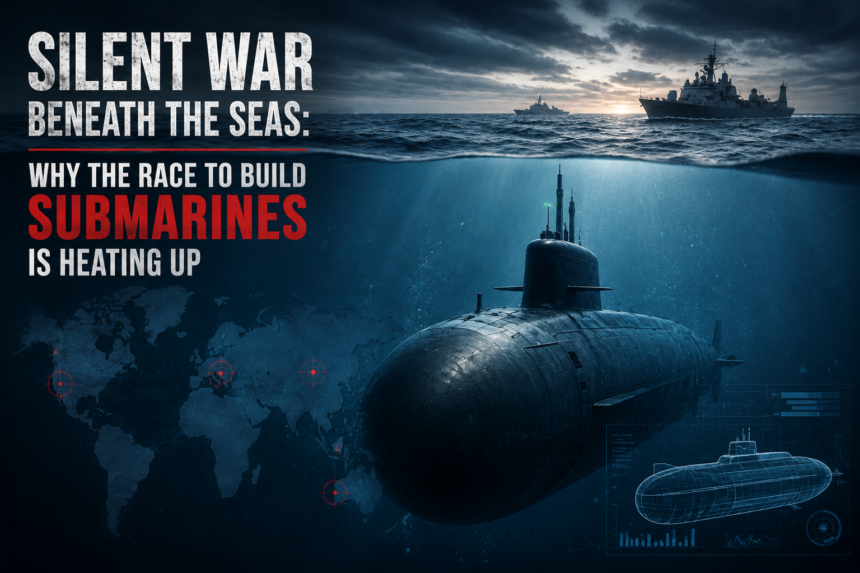

underwater warfare and the global race to develop advanced submarine capabilities are becoming central to modern military competition. It emphasizes that submarines, underwater technologies, and the protection of critical maritime infrastructure are reshaping global power dynamics, making maritime dominance, technological innovation, and strategic deterrence essential for national security. For Pakistan, the article highlights the need to strengthen maritime awareness and naval capabilities to safeguard its strategic and economic interests in the Indian Ocean.
Talha Arif
The Hidden Theater of Warfare That Will Shape Global Power Dynamics
As news headlines fill up with the stories of missile strikes, drone warfare, and political turmoil, there is yet another competition taking place in the hidden theater of military operations—under the oceans of the world. Below the waves, there are nuclear submarines on silent patrols, reconnaissance ships keeping watch on crucial shipping lanes, and competing navies playing the cat-and-mouse game of espionage. The “silent war” is quickly becoming one of the defining military competitions of the 21st century.
Submarines have long outgrown their function of being merely naval platforms. Nowadays, they serve a much broader range of purposes: from a tool of deterrence to a reconnaissance platform and covert means of power projection. As geopolitical rivalry is escalating in the Indo-Pacific region, the Arctic, and the Atlantic, the subsea competition becomes increasingly complex and risky.
Why Are Submarines Relevant Now More Than Ever?
Unlike aircraft carriers or warships, submarines are designed to work in stealth. Stealth rather than any other form of weapon gives submarines an edge over their rivals. Modern submarines can stay under water for months; they may conduct reconnaissance missions close to enemy shores, use special operation forces, launch guided missiles, or deliver nuclear weapons which can change the balance of power on Earth.
Therefore, submarines are some of the most durable military assets that any nation can have at its disposal. For nuclear nations, strategic missile submarines (SSBNs) offer a safe way of delivering retaliatory strikes if the nation faces a terrible strike from its rival. It is this feature of submarines that provides the basis for nuclear deterrence and strategic stability.
The US-China Underwater Contest
There is no better example of a submarine rivalry than Indo-Pacific region. The United States still has one of the most developed submarine fleets which features advanced stealth capabilities, long-range missiles, and sonar systems. The American attack submarines patrol the Pacific Ocean and support freedom of navigation.
Nevertheless, China is steadily developing its submarine fleet. In recent years, Beijing has made extensive investments in nuclear submarines, conventional submarines, and submarine intelligence networks. What does China hope to achieve with such rapid development? It seeks to restrict the movements of potential enemies near its coast and extend its maritime influence in the Pacific and Indian oceans.
The underwater race has turned out to be a critical part of the strategic competition between Washington and Beijing. In case of a conflict involving Taiwan or the South China Sea, the underwater competition will commence long before surface combat operations start.
Underwater Advantage of Russia
Russia still holds onto the position of being one of the leaders in submarines despite economic issues. Russia’s navy focuses on submarines with a nuclear engine that can launch cruise and ballistic missiles. Additionally, Russia has been working on technologies related to underwater deep diving, underwater intelligence, and torpedoes to create threats for NATO navies.
The Arctic has become a special field for activities of Russian submarines. Due to climate change, new maritime passages and resource access are becoming available, and thus military tensions in the region increase. Russia has developed good infrastructure in the Arctic, while NATO has started its buildup there.
The Race for Technologies for Submarines
The contemporary race of submarines is not limited to just submarines anymore. Nations are developing technologies that might revolutionize the concept of undersea warfare
Artificial intelligence is also enhancing the sonar processing and navigational capabilities of military assets. Autonomous underwater vehicles (AUVs) are carrying out surveillance activities and mine hunting without the risk of endangering their human operators. The use of quantum sensors can be effective in submarine detection and can undermine the stealth capabilities that have worked for decades. Underwater sensor systems and communication networks have also become an integral part of maritime intelligence.
It is not only about the number of submarines built by one nation—what matters more is who will control the underwater intelligence.
Critical Infrastructure: A New Target for Strategists
Contemporary economies rely greatly on underwater infrastructure. Over 95 percent of global internet traffic passes via undersea fiber-optic cables that run along the ocean bottom.
Recent cases of cable damage have revealed the vulnerability of such structures during times of political and diplomatic strain. Disruption of the infrastructure below water could bring economic, financial, and military repercussions without the launch of a single missile.
Defense of this infrastructure has become as crucial as defense of a country’s own borders.
The AUKUS Factor
AUKUS, which stands for the security alliance between Australia, the UK, and the US, is one of the most defining innovations in the field of naval warfare in recent years. The deal includes plans of Australia to get nuclear-powered submarines, alongside increased collaboration in advanced technologies, from artificial intelligence to cyber technologies to quantum technologies.
Supporters view the deal as strengthening deterrence and contributing to regional stability, while critics believe that it might fuel the naval arms race even further in the Indo-Pacific region.
Implications for Pakistan
Pakistan also needs to take note of the situation happening below the surface of water. In terms of competition and rivalry, the Indian Ocean is becoming an important strategic region, and Pakistan needs to build up its maritime awareness, its anti-submarine warfare capability, its naval surveillance, and its protection of critical sea lines of communication related to Pakistan’s trade and energy security.
It might not make sense for Pakistan to try to match other countries quantitatively in terms of naval strength, but Pakistan could use some select investments in technology and partnerships with some international allies to improve its deterrence capacity.
Conclusion
Wars taking place in the air and on the land tend to attract more attention, but arguably one of the most important strategic competitions in the world is taking place under the ocean.
The subaqueous struggle that takes place below the waves is more than just a matter of submarines—it is one of deterrence, intelligence, technological development, and the ownership of some of the most important bodies of water in the world. Countries that have mastery of the underwater realm will have the upper hand in any future fight, while those that fail to do so will find themselves lagging behind in an age when the next big battle starts not with a bang but with a whisper