
Realism in Action: Why China and Russia Are Keeping Their Distance from the US–Iran Conflict
Hamza Rahim
Among the many theoretical approaches to International Relations (IR), Realism has consistently remained the most dominant framework for explaining state behaviour during international crises. From the Cold War to the ongoing US–Iran confrontation, realism continues to provide the most convincing explanation of why states act the way they do. Contrary to liberal expectations of collective security or idealist notions of moral responsibility, realism argues that states are primarily driven by national interest, survival, power, and strategic calculations rather than ideology, emotions, or ethical considerations.
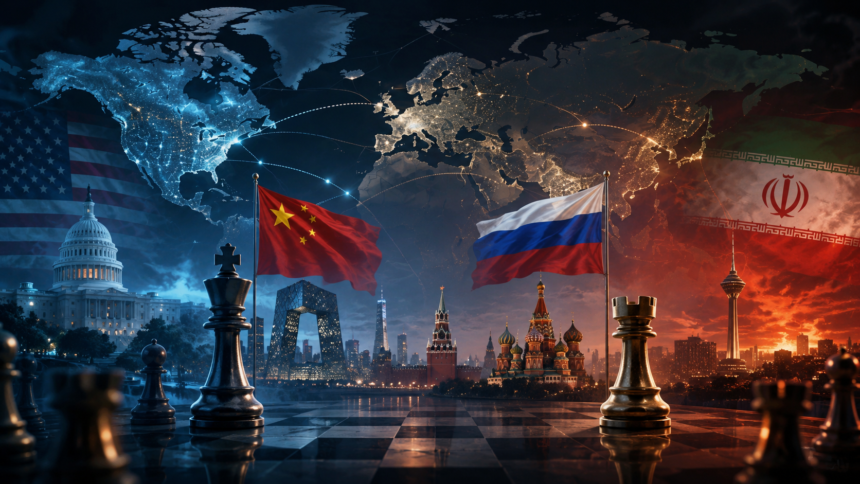
The ongoing US–Iran conflict presents yet another compelling case where realist assumptions are clearly visible. Historically, both China and Russia have maintained close political, economic, and strategic relations with Iran. Even today, both countries describe Iran as an important regional partner and have repeatedly criticized unilateral sanctions and military coercion. Nevertheless, despite these longstanding ties, neither Beijing nor Moscow has offered Iran the kind of open military or political support that many observers expected from major powers.
This apparent restraint has generated numerous questions. Why are Iran’s closest strategic partners unwilling to stand firmly beside Tehran at a time of crisis? The answer lies not in weakened bilateral relations but in the enduring logic of classical and structural realism. According to Hans Morgenthau, states pursue power and national interest above all else, while Kenneth Waltz’s neorealism argues that the anarchic international system compels states to prioritize their own security and strategic survival over ideological commitments or alliances.
Unlike public perception, international politics is rarely driven by considerations of justice, morality, or the distinction between the oppressor and the oppressed. Instead, foreign policy decisions are made through the lens of raison d’état, where national interest remains supreme. Every state, regardless of its power status, operates under certain strategic compulsions that shape its external behaviour.
China’s cautious approach is primarily rooted in these compulsions. Economically, Beijing depends heavily on stable energy imports from the Middle East and uninterrupted global trade routes. Any prolonged regional conflict threatens both its energy security and the smooth functioning of the Belt and Road Initiative. Militarily, China seeks to avoid direct confrontation with the United States, preferring to concentrate its strategic resources on the Indo-Pacific, where competition with Washington remains its foremost priority. Diplomatically, Beijing seeks to portray itself as a responsible global stakeholder capable of facilitating dialogue rather than escalating conflict. At the international level, China continues to advocate peaceful dispute resolution and adherence to international law, thereby preserving both regional stability and its global legitimacy.
Russia’s calculations are equally pragmatic. Moscow’s economy remains closely linked to energy exports, making it vulnerable to prolonged regional instability and additional economic sanctions. Militarily, Russia is already managing multiple security commitments and has little incentive to open another costly strategic front. Diplomatically, the Kremlin seeks to preserve its influence across the Middle East without becoming excessively entangled in the US–Iran confrontation. It must simultaneously maintain workable relations with Iran, Israel, the Gulf monarchies, and other regional actors. Such strategic balancing reflects a careful exercise in balance-of-power politics, another core concept of realist thought.
Consequently, both China and Russia find themselves constrained by a combination of economic interdependence, military commitments, diplomatic calculations, and geopolitical realities. Their reluctance to openly support Iran should therefore be interpreted as an exercise in strategic prudence rather than abandonment. Both continue to advocate dialogue, mediation, and de-escalation because regional stability ultimately serves their own national interests. This position is entirely consistent with realist expectations.
On the other hand, regional powers such as Pakistan, Egypt, and Türkiye have actively encouraged diplomatic engagement and conflict resolution. Yet their mediation efforts are also shaped by national and strategic interests. This should not be viewed as hypocrisy but rather as a reflection of the realist understanding that diplomacy itself is often an instrument for advancing state interests. By positioning themselves as mediators, these countries seek not only regional stability but also enhanced diplomatic influence, international credibility, and strategic relevance.
The repeated uncertainty surrounding ceasefire initiatives has further complicated the crisis. President Donald Trump has, on several occasions, appeared to retreat from proposed ceasefire understandings, making it difficult to achieve a durable and formally documented agreement. More importantly, the absence of a credible major-power guarantor has significantly reduced the prospects for a lasting settlement. History demonstrates that durable ceasefire agreements and peace arrangements are generally sustained when backed by influential great powers capable of providing security guarantees and enforcing compliance. Smaller or weaker states rarely possess the political leverage or strategic capacity to perform such a role effectively.
The reluctance of both China and Russia to assume the role of guarantor underscores another important principle of realism: great powers intervene only when the expected strategic benefits outweigh the potential costs. In the current crisis, both countries appear to believe that direct involvement would expose them to greater geopolitical and economic risks than strategic gains.
The trajectory of the conflict remains highly uncertain. Given the unpredictability surrounding President Trump’s approach, it is difficult to forecast either the timing of the conflict’s conclusion or the prospects for a consensual political settlement. Equally uncertain is the future of Iran’s relations with China and Russia once the crisis subsides.
Will Tehran interpret Beijing’s and Moscow’s restraint as a rational consequence of structural constraints and continue strengthening these partnerships? Or will it conclude that these relationships are fundamentally transactional, prompting Iran to diversify its strategic partnerships in the future? The answer to this question will shape not only Iran’s foreign policy but also the evolving geopolitical architecture of the Middle East.
Ultimately, the US–Iran confrontation once again reinforces a timeless lesson of International Relations: states have permanent interests, not permanent friends. As Lord Palmerston famously observed, nations do not possess eternal allies or perpetual enemies; they possess only enduring national interests. More than a century later, realism continues to explain international politics with remarkable clarity. In an anarchic international system, power, security, and national interest remain the principal determinants of state behaviour, while morality and sentiment occupy only a secondary place.
Author is a student of International Relations with a strong interest in international politics, Diplomacy, and International law.