
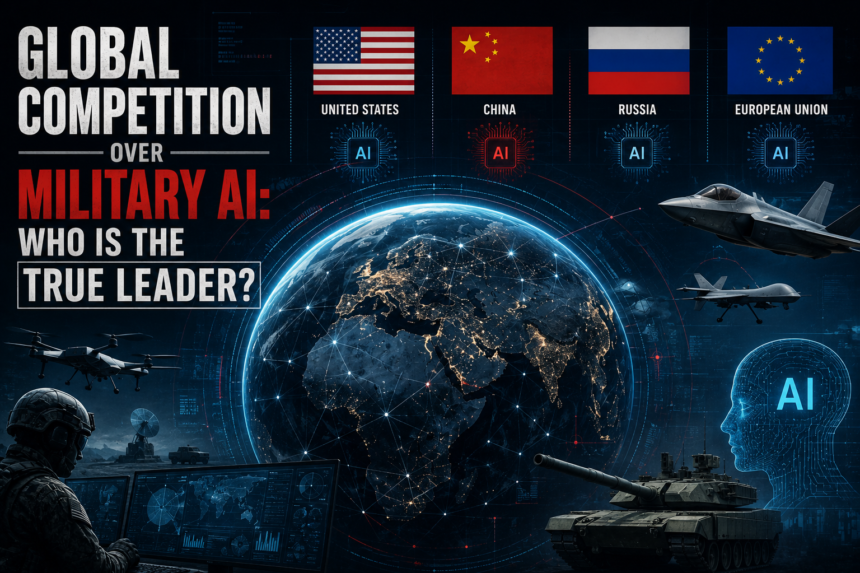

Global Competition over Military AI: Who Is the True Leader?
Talha Arif
Artificial Intelligence (AI) is actively changing the nature of war. Despite the fact that nuclear weapons, combat airplanes, and navies remain the basis of military might, the key strategic rivalry of the twenty-first century will be focused around algorithms, unmanned machines, and data supremacy. The competition for military artificial intelligence is no longer about building smart machines; it is about establishing strategic domination in an age when the quality and timeliness of decision-making will decide who wins the battle even before the first shot is fired.
What separates AI from other technologies that triggered military revolutions in the past is the fact that it is poised to transform all aspects of warfare at once. Starting from intelligence and cyberwarfare, logistics, surveillance, missile defence systems, and ending with autonomous weapons, AI is gradually becoming the core of military technology of the future.
The United States continues to take the lead in military AI technologies. First of all, the country has not only unmatched defense spending but also the ability to marry technological innovations of companies working in this sphere with the experience of its army. The ecosystem consisting of Silicon Valley, top universities, and defense agencies constantly produces evolving AI-based intelligence, autonomous drones, cyber-defence, and decision-support technologies.
Instead of replacing soldiers, the main goal of the United States is to improve commanders’ decision-making capabilities through these innovations. This human-centered approach allows AI to enhance military effectiveness while keeping humans in control of critical decisions
Nevertheless, the biggest challenge comes from China. Artificial intelligence is viewed by Beijing as a key element of its national strategy and is integrated into military modernization plans. Thanks to the policy of military-civil fusion, technological innovations produced by commercial enterprises are immediately adopted for military use.
Chinese investments in autonomous drones, smart command centers, satellite monitoring, and AI-supported electronic warfare continue to grow. In spite of the current technological advantage of the United States, China is steadily closing the gap through sustained investment and long-term planning.
At the same time, Russia has shown that even under conditions of economic strain, innovation remains possible. The war in Ukraine has led to a spike in Russian capabilities in drone warfare, electronic warfare, and AI-assisted combat. Despite sanctions restricting access to advanced semiconductors and supercomputers, Russia has proved highly resourceful in applying technological advances to the military
The conflict has also demonstrated that modern warfare relies more on software, autonomous systems, and rapid innovation than simply on numbers. Adaptability has become just as important as conventional military strength.
When it comes to smaller states, Israel can be singled out as one of the world leaders in operational military AI. The country’s military has successfully employed AI in missile defense, intelligence gathering, border surveillance, and precision strikes. Close cooperation between the army, defense industry, and IT companies enables the rapid implementation of new technologies.
Among the many achievements of the AI revolution, one of the most significant is the development of autonomous and semi-autonomous drone warfare. Recent conflicts have shown that even relatively inexpensive drones can destroy million-dollar military installations with exceptional accuracy.
In the future, AI-controlled drone swarms will be able to overcome sophisticated air defence systems, forcing militaries around the world to rethink doctrines that have existed for decades. Future wars are expected to feature networks of autonomous vehicles operating in the air, at sea, and on land alongside human soldiers.
Artificial intelligence is also transforming the cyber domain. AI-controlled software can perform intrusion detection, malware analysis, vulnerability assessment, and cyber defence much faster than any human operator. At the same time, hostile actors can use AI to automate cyberattacks, spread disinformation, and manipulate digital environments.
Moreover, competition in the development and production of advanced semiconductors has become another critical aspect of the AI arms race. Since AI requires enormous computing power, advanced microchips have become a strategic resource comparable to oil in the twentieth century. Nations capable of producing cutting-edge semiconductors enjoy a significant advantage in developing next-generation military technologies.
Although AI offers enormous military potential, it also raises important ethical and legal concerns. Questions regarding accountability, human supervision, AI bias, and compliance with international humanitarian law remain unresolved. While many governments insist that humans must retain ultimate authority over the use of lethal force, technological progress is advancing much faster than international regulation.
The military AI revolution presents both challenges and opportunities for middle powers such as Pakistan. Competing with superpowers in terms of defense spending may not be realistic, but meaningful progress can still be achieved through investment in AI research, cybersecurity, autonomous surveillance, robotics, and human resource development.
Strategic collaboration among academic institutions, the private sector, and international technology partners will be essential for strengthening national security and building long-term technological capabilities.
However, who is winning the international race for military AI? At present, the United States maintains the overall lead due to its technological ecosystem, operational experience, and extensive alliance network. China is rapidly catching up through massive state investment and industrial expansion, while Israel continues to set standards in operational innovation and Russia demonstrates a remarkable ability to adapt.
Ultimately, the true winner will not be the country that develops the most advanced algorithm, but the one that successfully integrates artificial intelligence into its military doctrine, industry, strategy, and governance. The wars of the future will not belong solely to the strongest or best-equipped armies, but to those capable of transforming information into knowledge, knowledge into action, and technological superiority into lasting strategic advantage. In the age of artificial intelligence, military power will be measured not only by weapons, but also by the ability to think faster than the enemy.