
By: Nuzhat Nazar
For much of the post Cold War era, the United States did not have to choose between economic strength and global military dominance. It could sustain both, and for a time, it did so effectively. Today, that balance is becoming harder to maintain. Not because America is in decline, but because the cost of doing both is rising faster than the benefits.
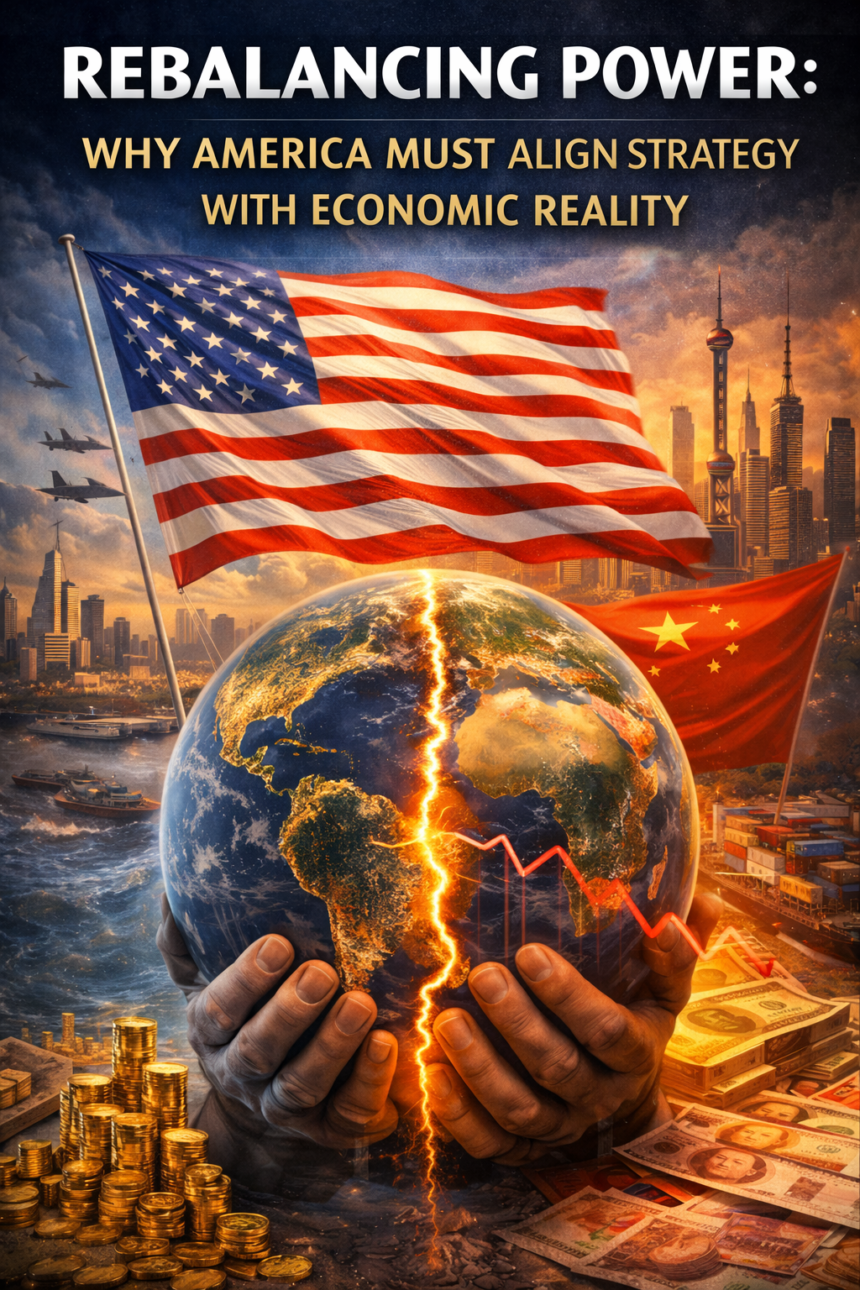
The United States remains the world’s largest economy, with nominal GDP estimated at around $30.5 trillion in 2026, well ahead of China’s roughly $19.5 trillion. But the picture changes when viewed more structurally. On a purchasing power basis, China’s economy is already larger, reflecting its scale as a manufacturing and production hub. That does not mean China is wealthier per person. The United States still leads decisively in per capita income, financial depth, and innovation. But it does mean the global economic balance is no longer as one sided as it once was. The real question now is not who is bigger, but who is allocating resources more effectively under pressure.
That question becomes sharper when set against America’s fiscal outlook. U.S. public debt has crossed 100 percent of GDP and is expected to keep rising in the coming years. Annual deficits are approaching $2 trillion, and interest payments are growing faster than almost any other category of spending. In fact, they are projected to rival and in some scenarios exceed defense spending within the next decade. This is a significant shift. The United States is no longer borrowing mainly to invest or stabilize its economy in times of crisis. It is increasingly borrowing to sustain its existing commitments, including its global security posture.
Military spending is central to this discussion. The United States spends close to $1 trillion annually on defense, more than any other country by a wide margin. While alliances help share operational responsibilities, the broader costs of leadership, financial, logistical, and strategic, still fall largely on Washington. At one level, this level of spending is still manageable for an economy of America’s size. But in a high interest rate environment, the issue is not just whether the United States can afford it. It is whether this is the most effective use of its resources at a time when long term competitiveness depends on investment in technology, infrastructure, energy, and industrial capacity.
These pressures are not theoretical. They are already visible in how geopolitical tensions feed back into economic realities. The current U.S. Iran dynamic is a case in point. The Strait of Hormuz carries around one fifth of global oil supply, making even limited disruption globally significant. In such a setting, even calibrated military signaling can push up energy prices, disrupt shipping, and add to inflationary pressure worldwide. For the United States, this creates a difficult loop. External tensions raise economic costs at home, complicating monetary policy and further tightening fiscal space.
It is often argued, correctly, that U.S. military power underpins the global system from which its economy benefits. Secure trade routes, stable alliances, and confidence in the dollar are all, in part, supported by American power projection. But this model works only when the cost of maintaining that system remains proportionate to its benefits. As debt rises and interest payments grow, that balance is shifting. The issue is no longer whether military strength supports economic leadership. It clearly does. The question is whether the current scale and distribution of commitments remain efficient.
None of this calls for American retrenchment or withdrawal. The United States continues to hold extraordinary advantages. It has deep capital markets, world leading innovation, a dominant currency, and a global network of partners. But these strengths need to be reinforced, not assumed. That requires a more deliberate alignment between strategy and economic capacity.
A more sustainable approach would begin with recognizing economic strength itself as a core element of national security. This means sustained investment in industrial capabilities, technological leadership, and energy resilience. It also means shifting from a model of constant physical presence to one of strategic leverage, working more through alliances, burden sharing, and targeted engagement rather than open ended commitments. Finally, it requires greater cost discipline in military decision making, with clearer recognition of the broader economic consequences of prolonged deployments or regional escalations.
As competition with China intensifies and regional crises become more frequent, the margin for inefficient choices is shrinking. The United States still has the capacity to lead. But leadership today depends as much on economic sustainability as it does on military reach.
The question, ultimately, is no longer how far American power can extend. It is how long it can be sustained and whether it is being used in ways that strengthen, rather than strain, the economic foundations on which it depends.