
Strategic Fractures, Global Governance, and the Imperative for a Multi-Tiered Conflict Resolution Framework
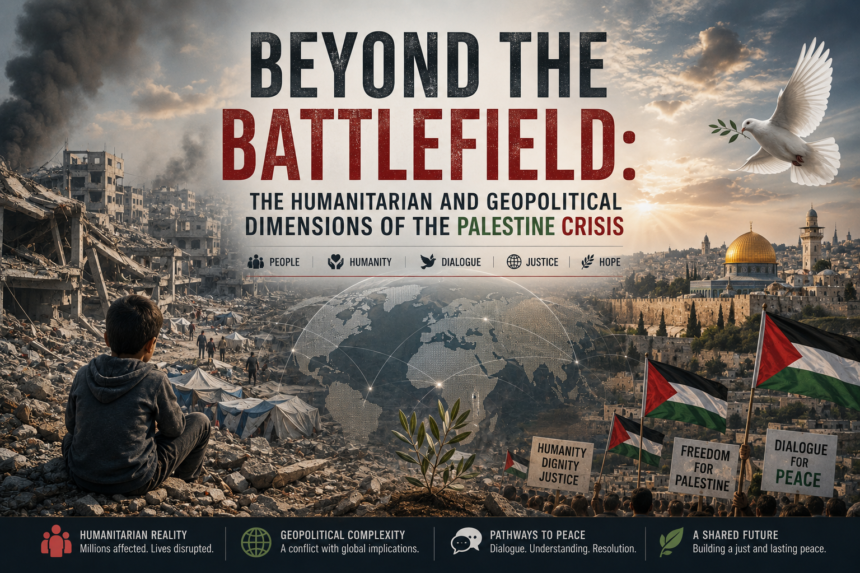
The ongoing crisis in Palestine has broken past the confines of a localized territorial dispute, standing today as a bleeding wound on the collective human conscience and a profound destabilizer of the global order. At its core, this conflict is a human tragedy written in shattered lives, flattened neighborhoods, and a relentless cycle of grief. For the people enduring it, the crisis is defined by an agonizing daily reality: mothers searching for food amid gray rubble, children waking to the trauma of explosions, and entire families displaced repeatedly with nowhere safe to turn. Yet, this profound suffering does not happen in a vacuum. Its shockwaves ripple outward, challenging the moral legitimacy of international law and rewriting the rules of Middle Eastern geopolitics. Today, the crisis sits at a critical intersection where an unfolding humanitarian catastrophe meets a paralyzed global governance system. The persistent failure to secure a just political settlement does more than perpetuate civilian heartbreak it actively deepens great-power rivalries, strains regional security architectures, and exposes a dangerous deadlock within the world’s highest security institutions.
The roots of this modern catastrophe trace back through a historical continuum of displacement and unfulfilled sovereignty, beginning with the 1948 mass displacement, or Nakba. Decades of subsequent military administration, territorial fragmentation, and the ongoing expansion of settlements have systematically dismantled the foundations of a viable, contiguous Palestinian state. Past diplomatic frameworks, most notably the 1993 Oslo Accords, failed to secure a permanent path to independent statehood, leaving the most painful and sensitive core issues including the final status of Jerusalem, permanent borders, and the right of return for millions of refugees perpetually unaddressed. These unresolved historic injustices are not passive memories; they are active, burning drivers of the current crisis. The total absence of a credible political horizon has normalized an unstable status quo, where systemic disenfranchisement continuously undermines moderate political voices and fuels periodic, devastating explosions of violence.
On the ground, the sheer scale of destruction has pushed Palestinian society to the brink of total collapse, leaving scars that will take generations to heal. Beyond the staggering loss of innocent civilian lives, the conflict has engineered an existential emergency. Modern hospital networks have been systematically crippled, leaving the sick and wounded to be treated on cold floors without basic medical supplies. Widespread food insecurity, a near-total lack of clean drinking water, and the decimation of civilian utility grids have transformed survival into a daily struggle. Furthermore, the flattening of schools, universities, and civic institutions systematically robs the youth of their future. The psychological trauma infusing this predominantly young demographic who navigate their formative years under a suffocating weight of fear, bereavement, and confinement guarantees that the human cost of this warfare will endure for decades. True human security cannot be achieved through transactional, short-term aid drops; it demands legally protected, permanent humanitarian corridors that treat human dignity as a non-negotiable priority.
The execution of intense military operations in densely populated civilian areas has pushed international humanitarian law (IHL) and global governance bodies into a profound crisis of legitimacy. Core legal tenets meant to protect the innocent during wartime. Specificallythe principles of distinction, proportionality, and precaution are being aggressively bypassed or reinterpreted, deeply wounding the global conscience. This erosion of normative consensus has reduced the United Nations Security Council and international judicial bodies to arenas for diplomatic gridlock rather than instruments of accountability and protection. The repetitive use of the veto power and the open defiance of provisional legal directives highlight a dangerous trend toward exceptionalism in global statecraft. When the international community proves unable to protect vulnerable populations or enforce legal accountability, the foundational credibility of the post-World War II rules-based order is compromised, signaling to other revisionist actors worldwide that international mandates can be safely ignored.
Geopolitically, the Palestine conflict acts as a volatile catalyst, connecting regional proxy networks and threatening wide-scale instability across the Middle East. The long-standing confrontation between Israel and Iran, once confined to asymmetric gray-zone skirmishes, now repeatedly threatens to spill over into a direct, conventional regional war. Simultaneously, non-state armed groups across the Levant and the Arabian Peninsula exploit the plight of Palestinians to legitimize their own operations, directly disrupting international trade routes and maritime security in critical chokepoints like the Red Sea. In response, Arab states find themselves navigating an incredibly delicate domestic landscape, forced to balance deeply felt public grief and solidarity with the Palestinian cause against pragmatic, long-term bilateral security alignments and economic modernization goals. This regional interconnectivity proves that the conflict can no longer be geographically isolated; its escalatory dynamics possess a distinct transnational reach capable of destabilizing global energy markets and maritime commerce.
The highly divided international response to the crisis both reflects and accelerates the ongoing fragmentation of the global geopolitical landscape into a multipolar order. The United States continues to provide its traditional military guarantees and diplomatic insulation for Israel, though this posture faces mounting domestic scrutiny particularly among younger generations and complicates Washington’s strategic outreach to the Global South. Conversely, China and Russia have strategically filled the diplomatic vacuum to expand their influence across the Middle East, advocating for the immediate enforcement of UN resolutions and positioning themselves as alternative, empathetic arbiters aligned with global public opinion. Meanwhile, the European Union remains intensely divided internally, struggling to reconcile its normative commitment to human rights with its strategic ties to the transatlantic alliance. This major-power polarization ensures that the Palestine issue is deeply intertwined with broader systemic competition, turning a regional tragedy into a chess piece for global geopolitical maneuvering.
For Pakistan and the wider Muslim world, the Palestine issue is not a distant geopolitical calculation; it is a core pillar of foreign policy identity and ethical solidarity. Islamabad has historically maintained a principled stance advocating for a two-state solution based on pre-1967 borders, with a contiguous, independent Palestinian state keeping Al-Quds al-Sharif as its capital. This unwavering position is sustained by intense domestic public sentiment, a profound emotional connection to the holy sites, and a historical commitment to anti-colonial self-determination. Modern Pakistani diplomacy, however, must skillfully manage this ideological stance alongside complex strategic realities, including maintaining critical economic relationships with Western trading partners and navigating the shifting normalization dynamics within the Gulf Cooperation Council (GCC). For the Global South as a whole, the crisis serves as a litmus test for international equity, demanding a foreign policy approach that successfully synthesizes moral solidarity with sophisticated, multi-channel statecraft.
To transition from perpetual crisis management to an authentic, durable peace process, the international community must move past political posturing and implement a coordinated, multi-tiered policy framework focused on human dignity and structural reform. First, global actors must institutionalize unrestricted, monitored humanitarian access by creating permanent, independently monitored supply routes free from military or political interference to repair deep infrastructure deficits and alleviate human suffering. Second, multilateral mediation needs immediate revitalization, transitioning from exclusive, single-state diplomatic monopolies toward an expanded international consortium that integrates emerging global and regional powers to ensure balanced, credible negotiation dynamics. Third, verifiable confidence-building measures must be enforced, beginning with an immediate pause on settlement expansion, land confiscation, and demographic shifts, to re-establish a plausible political horizon. Fourth, global accountability mechanisms must be consistently supported through impartial international judicial bodies to rebuild the eroded credibility of global legal norms. Finally, a coordinated, multilateral economic recovery plan must be funded to rebuild local institutional capacity, foster economic autonomy, and generate sustainable youth employment. Ultimately, the Palestine crisis cannot be resolved through military dominance or temporary humanitarian palliatives. Lasting stability demands a comprehensive strategy that addresses immediate human vulnerabilities while courageously confronting the underlying political drivers of structural disenfranchisement. Neglecting either dimension guarantees the perpetual radicalization of the strategic environment and the continuation of immense human grief. For global policymakers, this conflict is no longer a peripheral ethical concern; it is a profound systemic and moral challenge. Securing a balanced, final, and just resolution is therefore essential not only for the restoration of human dignity and security in the Levant, but also for preserving the fragile framework of international law and global security