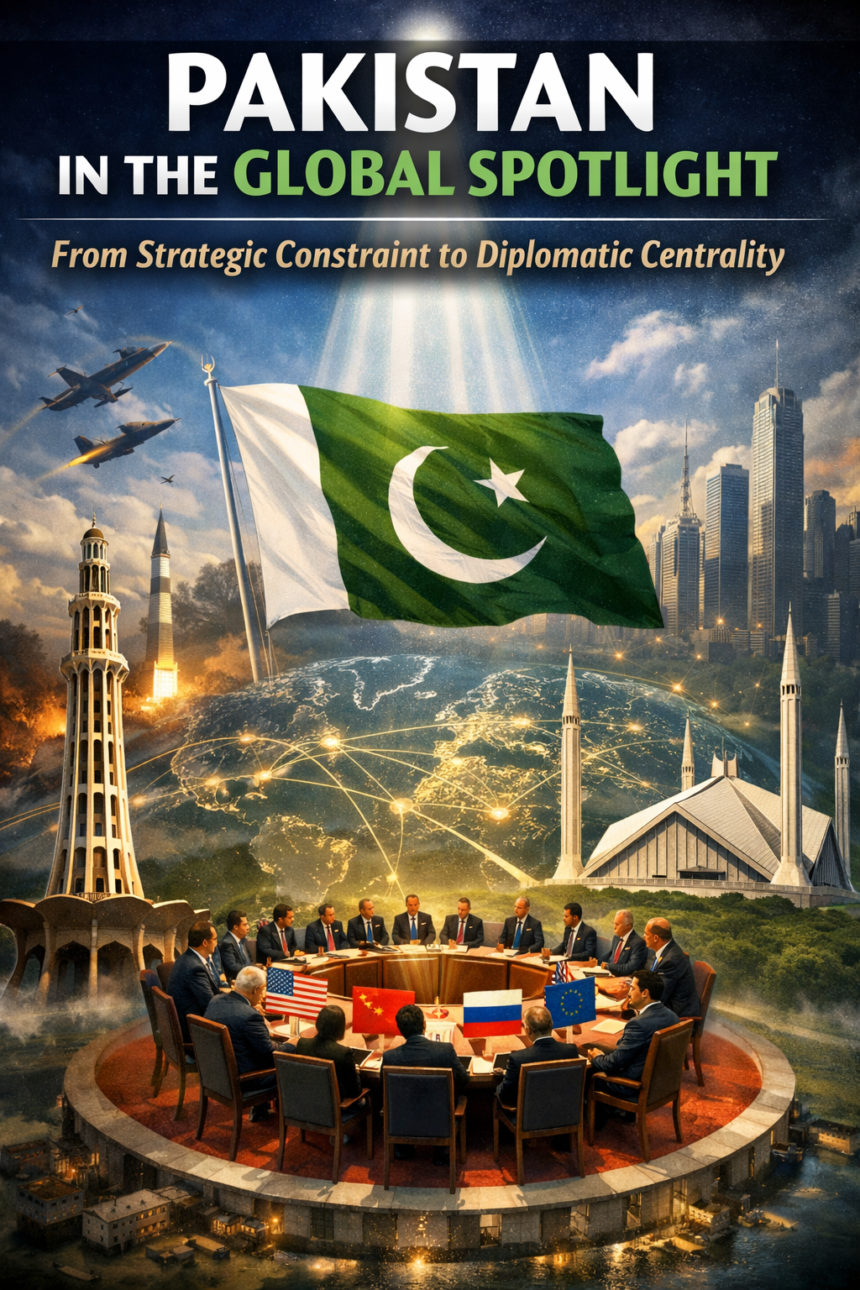

Pakistan has, once again, stepped into the global spotlight—this time not as a peripheral actor, but as a pivotal intermediary in one of the most volatile geopolitical confrontations of the present era.
Under the leadership of Field Marshal Asim Munir, Pakistan’s military establishment has emerged as a key interlocutor between Washington and Tehran.
Within a remarkably short span, Islamabad achieved what many had deemed impossible: it helped broker a two-week ceasefire at a critical moment when Donald Trump’s deadline of 7 April was about to expire.
This was followed by the hosting of 21 hours of direct, face-to-face negotiations between two adversaries whose hostility spans over four decades.
This diplomatic breakthrough marked a significant strategic win for Pakistan.
During the six-week conflict, which inflicted considerable destruction on both sides, Pakistan played a crucial role in containing regional escalation.
It successfully worked to calm tensions between Iran and key Arab states, thereby frustrating attempts—particularly by Benjamin Netanyahu—to widen the conflict by provoking intra-regional confrontation.
Yet, as is often the case in complex diplomacy, progress proved fragile.
Optimism quickly gave way to disappointment when U.S. Vice President JD Vance abruptly called off the Islamabad talks over two unresolved issues: nuclear enrichment and the status of the Strait of Hormuz.
Undeterred, Pakistan recalibrated and relaunched its diplomatic offensive, engaging key stakeholders including Gulf States, Türkiye, Egypt, Iran, and the United States.
Escalation, Setbacks, and Renewed Openings
Efforts toward de-escalation were repeatedly undermined. Israel, acting as a spoiler, struck Lebanon—flaring up the emotions of the Iranians.
At Pakistan’s urging, President Trump intervened, securing a 10-day ceasefire in Lebanon on 16 April. Shortly thereafter, Iran announced the reopening of the Strait of Hormuz.
However, internal divisions within Iran—particularly between the government and the Islamic Revolutionary Guard Corps (IRGC)—led to renewed tensions.
The Strait was again closed when the United States refused to lift its naval blockade imposed after the inconclusive Islamabad talks of 22 April. Washington maintained that the blockade would remain until a final agreement was reached.
Trump’s Rhetoric and Strategic Signaling
President Trump adopted an increasingly hardline stance, warning that if a deal was not reached, key Iranian infrastructure—including power plants and bridges—could be targeted.
He confirmed that American representatives would arrive in Islamabad for further diplomatic engagement, expressing confidence that both sides were nearing an “extremely reasonable deal.”
At the same time, he accused Iran of violating ceasefire arrangements in the Strait of Hormuz, warning that failure to respond positively could further escalate the situation.
He also pointed to increased maritime deployments, with vessels arriving in U.S. States such as Texas, Alaska, and Louisiana—signaling preparation for multiple contingencies.
Despite the rhetoric, Trump appears to be relying heavily on Pakistan’s military leadership as a trusted diplomatic channel—reportedly even expressing willingness to visit Islamabad if key conditions are met, including zero uranium enrichment, transfer of nuclear stockpiles, and unconditional reopening of Hormuz.
Iran’s Position: Firm but Calculated
Iran, for its part, has adopted a firm stance. Iranian sources have made it clear that as long as the naval blockade remains in place, Tehran will not participate in negotiations.
No final decision has yet been made regarding the dispatch of an Iranian delegation to Islamabad.
This position reflects a broader strategic calculus: Iran seeks sanctions relief and the lifting of blockades as prerequisites for meaningful engagement. Without these, the diplomatic process remains uncertain and fragile.
Pakistan’s Diplomatic Edge and India’s Relative Absence
Pakistan’s proactive diplomacy during this crisis has been widely acknowledged. Through sustained engagement with both Washington and Tehran, Islamabad positioned itself as an indispensable mediator.
In contrast, Narendra Modi’s diplomatic approach appeared limited, largely confined to discussions on oil supplies and economic concerns.
Analysts and segments of the Indian opposition have criticized New Delhi’s foreign policy as ineffective in the face of a rapidly evolving regional crisis.
Global recognition of Pakistan’s role has come from multiple quarters. The world leaders including Donald Trump and Iranian President Masoud Pezeshkian have acknowledged Islamabad’s constructive efforts, while also appreciating the leadership of Prime Minister Shehbaz Sharif and Field Marshal Asim Munir.
Possible American Concessions
Reports indicate that the United States is considering significant concessions to secure a deal. These include the potential release of $6 billion in frozen Iranian assets as part of an initial agreement—possibly increasing over time.
According to policy discussions, a broader framework under consideration may involve a $20 billion “cash-for-uranium” arrangement:
Iran would relinquish its stockpile of enriched uranium.
Portions of highly enriched uranium would be transferred abroad or diluted under international supervision.
Iran would retain limited nuclear capabilities for civilian purposes, such as medical isotope production, with all facilities declared and monitored.
If realized, such a deal could have far-reaching implications for regional stability, global energy markets, and international security.
Islamabad Talks 2.0: A Defining Moment
Following the inconclusive first round, a second round of negotiations—“Islamabad Talks 2.0”—is set to commence. A high-level U.S. delegation, likely including figures such as Steve Witkoff and Jared Kushner, is expected to participate.
Vice President JD Vance’s absence is reportedly due to security protocols, which prevent both the U.S. President and Vice President from being abroad simultaneously—fueling speculation that Trump himself may visit Pakistan if a breakthrough is achieved.
This round represents a critical opportunity to revive the diplomatic process and prevent further escalation.
A New Strategic Bloc in the Making
Parallel to these developments, a significant shift is underway in regional security architecture. The Pakistan–Saudi Arabia Mutual Strategic Defence Pact signed in September 2025 reflects declining confidence among Gulf states in the U.S. security umbrella.
Together with Qatar and Türkiye, this emerging alignment represents a powerful combination of financial resources, military capability, and diplomatic influence.
Such a bloc has the potential to reshape energy markets, trade corridors, and global institutions.
A collective defence framework would go beyond symbolic cooperation—it would ensure coordinated, multi-domain responses to aggression, reflecting a deeper level of strategic integration.
Changing Global Dynamics: The End of Illusions
Perhaps the most striking development is the shift in global power dynamics.
President Trump’s blunt assertion—“our alliances were never free; they were transactional”—has shattered long-held assumptions about the Western security order.
His message to European allies was stark: either purchase energy security or secure it independently. With nearly 20% of the world’s oil passing through the Strait of Hormuz—approximately 17 to 18 million barrels per day—this statement carries profound implications.
For countries like the United Kingdom, France, and Germany—long reliant on U.S. security guarantees—this represents a strategic shock. Decades of alignment, from Iraq to Afghanistan, have culminated in a moment of stark recalibration.
At its core, this reflects the evolution of the “America First” doctrine. Having achieved relative energy independence through shale production, the United States appears less willing to underwrite global security at its own expense.
This shift also aligns with the economics of power. The United States remains the world’s largest arms exporter, with defence sales exceeding $300 billion in 2024. The politics of threat perception continues to underpin this model.
Conclusion: A Moment of Reckoning
For Pakistan and the wider Muslim world, this is a moment of strategic awakening.
The illusion of permanent alliances has faded. The era of dependency is giving way to an era of self-reliance and regional cooperation.
The Strait of Hormuz is no longer just an energy corridor—it is a theatre of power, where new actors are poised to redefine the rules.
Pakistan’s recent diplomatic success demonstrates its potential to act as a stabilizing force. Yet, the durability of this role will depend on its ability to overcome internal vulnerabilities and sustain strategic coherence.
The world is entering an era where no power will provide security for free, no alliance will be unconditional, and no nation can afford complacency.
The real question is not whether the global order is changing—it already has. The question is: who is prepared to navigate the new order, and who will be left behind?
About the Author
Brigadier (Retd) Asif Haroon Raja is a war veteran who fought in the Battle of Hilli in former East Pakistan and recovered the body of Major Akram Shaheed, NH. He is Command and Staff Course and War Course qualified, holds an MSc in War Studies, and served as Defence Attaché in Egypt and Sudan, as well as Dean of the Corps of Military Attachés in Cairo.
He served as the Pakistan Army’s spokesperson in 1992 and later as Honorary Colonel of the battalion he commanded for eight years.
He is a defence, security, and geopolitical analyst, international columnist, author of five books, former Chairman of Thinkers Forum Pakistan, Patron-in-Chief of CDS Think Tank, Director of Meesakh Research Centre, and regularly appears on national and international media platforms.