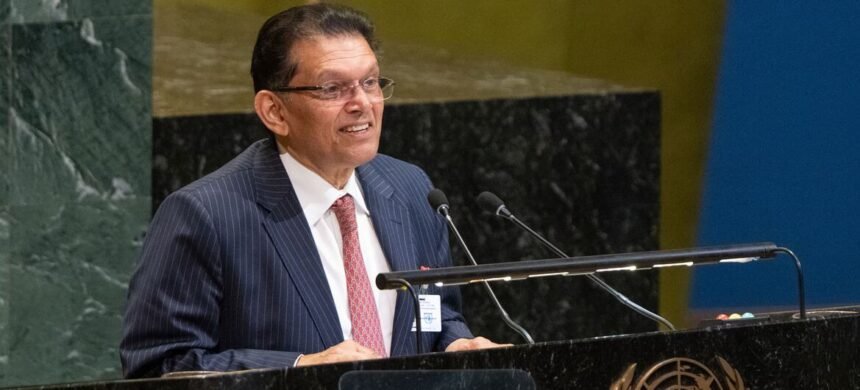

On June 2, 2026, Khalilur Rahman, Bangladesh’s Foreign Minister, was elected as the President of the 81st session of the United Nations General Assembly (UNGA). He took charge at one of the most turbulent moments in history.
Khalilur Rahman, a career diplomat who joined Bangladesh’s foreign service in 1979, secured the UNGA presidency in a secret ballot by defeating Cyprus’s Ambassador Andreas Kakouris with 99 out of 190 valid votes. He will assume office when the 81st UNGA session opens on September 8, 2026.
Rahman is no stranger to the UN system. He previously served as spokesperson for the Least Developed Countries (LDCs), special adviser to the United Nations Conference on Trade and Development (UNCTAD), and first secretary at Bangladesh’s Permanent Mission to the UN between 1986 and 1991.
Most recently, he served as national security adviser and high representative on the Rohingya issue under Nobel laureate Muhammad Yunus’s interim government, before becoming Foreign Minister in February 2026 after the Bangladesh Nationalist Party’s election victory.
Why does this presidency matter more than usual?
Rahman’s term will coincide with the most consequential event on the UN calendar, which is the selection of a new Secretary-General to replace António Guterres, whose term expires at the end of 2026. This gives the UNGA president unusual weight in shaping the process. Combined with growing US disengagement, such as withdrawal from the World Health Organisation (WHO), the Human Rights Council (HRC), and dropped UN funding, the presidency is no longer a ceremonial role. As outgoing President Annalena Baerbock stated, “defending the UN Charter has become a daily necessity.”
The presidency rotates among the UN’s five regional groups. The 81st session falls to the Asia-Pacific group, which made Rahman’s election part of a structured rotation rather than an open contest. Yet the closeness of the vote, just eight ballots separating him from Cyprus, signals that even within this system, geopolitical fault lines run deep. For Bangladesh, a democratic transition after the ouster of Prime Minister Sheikh Hasina in 2024, the election carries symbolic weight because a country still finding its role on the world stage now holds the world’s most inclusive diplomatic forum.
“The UN will commence its ninth decade at a time when trust in our organisation is being tested on multiple fronts.“
— Khalilur Rahman, accepting the UNGA presidency