
Asif Haroon Raja
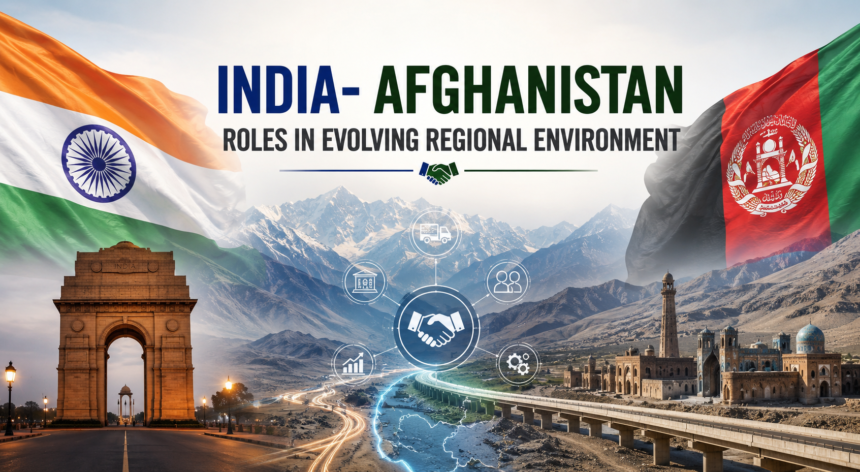
India’s role in the evolving regional environment is likely to remain shaped by three interconnected objectives:
containing Pakistan strategically.
Preserving its partnership with the United States,
Projecting itself as the principal regional power in South Asia and the Indian Ocean region.
India’s Likely Strategic Calculus
India has closely aligned itself with the US-led strategic architecture aimed at containing China, particularly through the Indo-Pacific framework.
For New Delhi, any weakening of the US position complicates its long-term strategic ambitions.
India has attempted to balance relations with multiple poles simultaneously — maintaining ties with the US, preserving defence relations with Russia, and avoiding a complete rupture with Iran because of connectivity and energy interests linked to Chabahar and Central Asia.
The US–Iran conflict exposed vulnerabilities in maritime energy routes and trade corridors. India, being heavily dependent on imported energy, remains deeply concerned about instability in the Strait of Hormuz.
India also recognises that a strengthened Iran–China–Pakistan convergence could alter the regional balance in ways unfavourable to New Delhi.
India’s long-term strategic approach has centered on diplomatically isolating and strategically encircling Pakistan, while seeking to keep it politically fragmented and economically weakened. Wait for the right opportunity to launch Cold Start Doctrine.
Internally, the Indian leadership may seek to maintain nationalist momentum through muscular rhetoric and calibrated military posturing, particularly when domestic political pressures intensify.
Will India Launch “Sindhoor-2”?
If “Sindhoor-2” refers to a possible future military operation or coercive strategy against Pakistan, several factors would shape India’s decision-making:
India is unlikely to initiate a full-scale conventional war unless it believes escalation can be tightly controlled. Both countries are nuclear powers, and escalation risks remain extremely high.
However, India may continue pursuing limited-spectrum options below the threshold of major war:
Cross-border covert operations.
Intelligence-led sabotage.
Cyber warfare.
Information and media warfare.
Diplomatic isolation campaigns.
Water terrorism.
Limited stand-off strikes under a “new normal” doctrine.
Much would depend on:
The internal political climate in India.
The state of India-US relations.
China’s regional posture.
Pakistan’s internal stability.
The military balance along the Line of Control and broader western front.
India would also carefully study the lessons of recent conflicts, particularly the increasing vulnerability of expensive conventional military assets to drones, missiles, cyber disruption, and electronic warfare.
Any major Indian military adventure would become considerably riskier if regional tensions simultaneously involve China, Iran, or instability in the Indian Ocean.
The India-Israel Nexus Fails to Digest Pakistan’s Strategic Successes — Empty Threats Will Achieve Nothing
Over the past year, Pakistan’s historic military and diplomatic achievements have fundamentally transformed the country’s international image, enabling Pakistan to emerge on the global stage as a confident and unconquerable power.
During the May 2025 war, the Pakistan Armed Forces successfully thwarted the aggressive assault of India (Operation Sindhoor), five times its size.
Pakistan armed forces taught the aggressive Hindu leadership a bitter and unprecedented lesson, one that has written a dark chapter for India and a golden chapter for Pakistan in history.
A swift, thunderous, and brilliantly executed retaliatory air campaign crushed the arrogance of an enemy intoxicated with power and completely paralyzed its military forces, leaving them with no option but to plead for a ceasefire.
The credit for this magnificent victory has been attributed to the leadership of Chief of Defence Forces, Field Marshal Syed Asim Munir, under whose command the armed forces demonstrated exceptional resolve and professionalism.
During the crisis, the entire nation stood united behind its military leadership like a wall of steel.
Pakistan’s strategic neutrality and diplomatic weight also enabled it to play a steadfast and mediatory role in the complex Middle Eastern crisis, ultimately persuading the warring parties to agree to a ceasefire that saved countless lives from destruction. Pakistan’s diplomacy is widely acknowledged and appreciated across the world.
Pakistan’s sustained diplomacy led by Field Marshal Asim Munir and PM Shahbaz Sharif has finally borne fruit.
The Much-awaited Peace Deal
The mutually agreed upon peace deal between the US and Iran is about to be signed. Reportedly, it includes ending hostilities (including in Lebanon), releasing billions in frozen Iranian funds, easing the U.S. naval presence around Hormuz, and pulling U.S. forces farther from Iran.
Both sides would then get 30 days — extendable by mutual agreement — to finalize a nuclear deal, while Iran and Oman negotiate transit and control arrangements for the Strait of Hormuz. (Source: Al Jazeera).
A political settlement will be a major diplomatic triumph for Pakistan, the credit for which goes to CDF Asim Munir. He made the impossible possible.
Frustrated Spoilers
These two major successes — military superiority and diplomatic prestige — have become difficult for hostile States, particularly India and Israel, to digest.
The extent of this frustration can be gauged from the recent statements of the Israeli Prime Minister, who attempted to falsely accuse Pakistan of creating divisions between the United States and Israel, despite the fact that the American public knows very well who stabbed them in the back.
Consumed by frustration and desperation, the Indian Army Chief General Upendra Dwivedi dared to threaten to alter Pakistan’s geography and history. (Inspired by Trump’s theatrics). The provocative statement made by him deserves the strongest possible condemnation.
These hollow boasts stem from a defeated mindset, especially at a time when even the RSS Secretary General and Ex-Indian army chief are speaking of negotiations with Pakistan.
ISPR has issued a strong response to the remarks made by the Indian army chief.
The response came after he remarked that Pakistan should decide whether it wanted to remain “part of geography and history,” comments that sparked widespread debate across the region.
In an official statement released from Rawalpindi, ISPR said Pakistan is already “a country of consequence at the global level, a declared nuc|ear power, and an indelible part of South Asia’s geography and history.”
The statement criticized what it described as a “hubristic, jingoistic and myopic mindset” in India, warning that threatening a sovereign nuc|ear state with elimination from geography reflected “madness and warmongering.”
ISPR further stated that any future attempt to target Pakistan could trigger consequences “neither geographically confined nor strategically or politically palatable for India.”
Pakistani officials also accused India of regional destabilization, disinformation campaigns, and aggressive posturing, while emphasizing peaceful coexistence and strategic restraint.
The President of PESS and ex-Senator Lt Gen Retd Abdul Qayyum held both India and Israel responsible for using Afghan territory to fuel terrorism and insurgency inside Pakistan.
He said , the Pakistan Armed Forces, backed by the unwavering support of 240 million citizens, including six million veterans, are fully determined to inflict a crushing defeat upon these mercenaries who survive on foreign weapons, funding, and resources.
He and the other like-minded patriotic notables in Pakistan stated that any attempt to contaminate Pakistan’s peace, stability, and economic environment — particularly in our western border provinces — will be crushed with an iron hand.
Lessons and Realities
Amid the ever-increasing wave of terrorist violence in Baluchistan, several important lessons and realities have emerged:
Following Pakistan’s decision to tighten border controls with the TTA and impose punitive measures against them, the TTA strengthened its nexus with the BLA, PTM, and TTP. These groups now appear to be operating on a common anti-Pakistan agenda.
The TTA seeks revenge against Pakistan and is attempting to obstruct Pakistan’s strategic and economic connectivity with the Central Asian Republics through Iran.
For this purpose, it is exploiting the capabilities of the BLA and TTP to maximum advantage. Their external backers, particularly India and Israel, are providing political, financial, and intelligence support.
Simultaneously, anti-army and anti-Pakistan propaganda and subversion campaigns are rapidly gaining momentum through both conventional and digital platforms, aimed at weakening national cohesion and public confidence in state institutions.
The BLA appears to have received unprecedented external patronage, significantly enhancing its operational capacity, access to sophisticated weaponry, and propaganda outreach.
India, Israel, and certain regional actors are widely perceived to have strategic interests in the natural wealth and geostrategic location of Baluchistan. Proxy militant groups are being used to destabilize Pakistan and undermine its economic and strategic projects.
These external actors have no genuine sympathy for the BLA or other anti-Pakistan elements. Rather, such groups are being used merely as instruments to serve broader geopolitical and strategic objectives.
The tactics of sabotage, psychological warfare, and internal destabilization bear striking similarities to the methods employed by India in former East Pakistan prior to the events of 1971.
Terrorism from Afghanistan
Allama Iqbal described Afghanistan as the heart of Asia, and there is no doubt that Pakistan holds deep sympathies for the Afghan people as its neighbors.
Pakistan wishes to open border crossings for them and facilitate access to education and healthcare, since this serves not only Afghanistan’s interests but Pakistan’s as well, particularly because Pakistan seeks access to Central Asia.
However, if these border routes are used — with the cooperation of the Afghan government — to send explosive-laden vehicles and terrorists sustained by Indian and Zionist patronage into Pakistan to attack the lives and property of our people, then Pakistan will be compelled to adopt an effective defensive strategy. Creating a buffer zone is one way.
The Afghan government can bring prosperity to Afghanistan not by sheltering terrorists, (TTP, BLA and ISKP), and training Majeed Brigade’s suicide bombers including the young Baloch women, but by establishing new industries and opening higher educational institutions for the entire younger generation, including women.
The relationship between the Indian leadership — responsible for burning two thousand Muslims alive in Gujarat, demolishing the three-hundred-year-old historic Babri Mosque, and burying Kashmiris alive — and Afghanistan, is founded on nothing but hostility toward Pakistan.
Pakistan’s Likely Response Posture
From Pakistan’s perspective, the emphasis would likely remain on:
Maintaining credible deterrence.
Enhancing hybrid and cyber warfare capabilities.
Strengthening strategic partnerships, especially with China.
Preserving internal political cohesion.
Preventing external exploitation through proxy warfare and terrorism.
Ultimately, the probability of a “Sindhoor-2” type operation cannot be entirely dismissed, but a large-scale war appears unlikely because the costs for all sides would be extraordinarily high.
The more probable scenario is continued hybrid confrontation, episodic crises, and strategic signalling rather than decisive conventional conflict.
A message to the Indo-Afghan-Israel axis of evil:
The enemies of Pakistan must know that a nuclear power of over 240 million people cannot be intimidated by a handful of extremist militants. They will soon be crushed and their sponsors will be taught a lesson of their lives.
About the Author
Brigadier (Retd) Asif Haroon Raja, SI (M) is a war veteran. He is Command and Staff Course and War Course qualified, holds an MSc in War Studies, and served as Defence Attaché in Egypt and Sudan, as well as Dean of the Corps of Military Attachés in Cairo.
He is a defence, security, and geopolitical analyst, international columnist, author of five books, former Chairman of Thinkers Forum Pakistan, Patron-in-Chief of Centre for Development Studies Think Tank, Director of Meesakh Research Centre; he regularly appears on media platforms.