
By Maimona Saleem
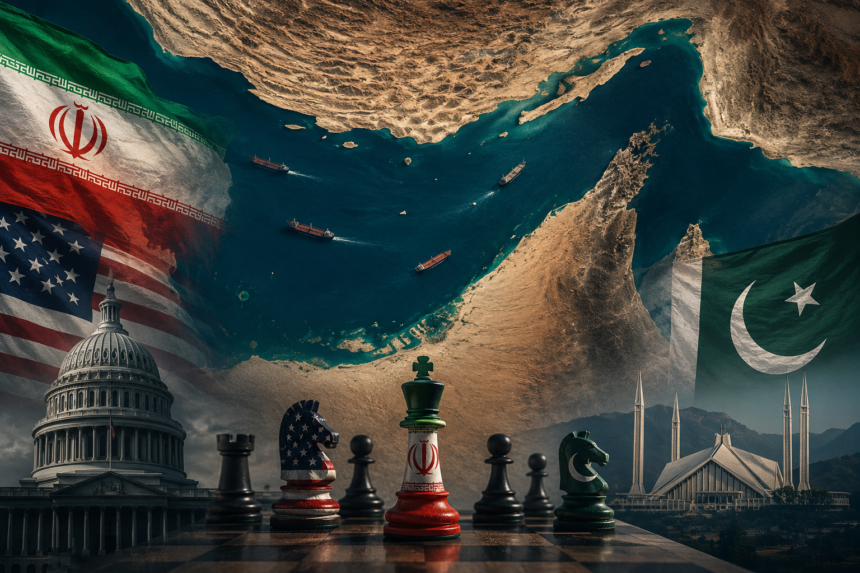
The Strait of Hormuz is a geostrategic energy shipping channel, where geography shapes power. The waterway is about 167 km long, lying between Oman and Iran, linking the Gulf north with the Gulf of Oman to the south and the Arabian Sea beyond. Whoever influences Hormuz gains leverage over energy routes, global trade, military mobility, and regional security because geography transforms the Strait of Hormuz from a maritime corridor into a geopolitical instrument of influence, coercion, and deterrence.
Recent diplomatic developments show that the Strait of Hormuz has become a principal sticking point in negotiations between the US and Iran.
President of the United States of America Donald Trump, on May 23, said on Truth Social that a framework for reopening the Strait and managing broader tensions with Iran was largely negotiated; however, disagreements over uranium enrichment and maritime authority remain unresolved. However, the US president did not discuss any further details on the deal, but he emphasized that any agreement would “absolutely” prevent Iran from obtaining a nuclear weapon.
For Iran, the Strait of Hormuz is not simply a commercial passageway but a geopolitical-security asset central to sovereignty, regime survival, deterrence, and regional influence. For Iranian policymakers, the Strait of Hormuz functions as strategic leverage in an asymmetric struggle with a militarily superior adversary. Iran’s foreign Ministry spokesperson, Esmail Baghaei, said that the future management of the Strait of Hormuz should be decided jointly by Iran and Oman. Spokesperson Baghaei said that the reason Oman and Iran were trying to establish a mechanism to ensure sustainable security in the strait was that “we believe in the use of this international waterway for free trade and safe navigation.” Iran understands that some form of sovereign management over Hormuz is a legal and strategic right.
Spokesperson Baghaei also clarified that Iran was not proposing tolls for ships, but charging “fees for navigational services.” As already, the disruption in Hormuz raised energy prices, unsettled global markets, and increased diplomatic urgency, which granted Iran uneven influence over negotiations.
On the other side, Marco Rubio, US Secretary of State, in New Delhi, said that there was a strong proposal being discussed to reopen the Strait of Hormuz. According to reports, the proposed plan would fully reopen the Strait of Hormuz within 30 days after any deal to end hostilities between the two countries. During this period, Iran would remove mines from the strategic waterway.
Iran’s strategy in the Strait of Hormuz is best understood not as a purely maritime or economic issue, but as a geopolitical-security doctrine. Tehran sees control or at least minimum influence over the Strait of Hormuz as essential to safeguarding its strategic autonomy. Since the 1979 Islamic Revolution, Iran’s worldview has been shaped by external insecurity, such as sanctions, military pressure, regional isolation, and the sustained US military presence across the Gulf. Therefore, the Strait of Hormuz has become a deterrent and an emblematic assertion of sovereignty.
Iran cannot put its security at stake by engaging in simple short-term deals or even transactional diplomacy. Iran seems less interested in transactional diplomacy than in restructuring the strategic environment surrounding it. Besides, nuclear concessions cannot be detached from regional security guarantees. Iran’s Strait of Hormuz strategy is not simply about ships or transit fees, but it is about recognition. Iran wants acknowledgment that Gulf security cannot be designed against Iran but must include Iran.
However, for the US, this has created a strategic paradox. Because the US seeks to reopen maritime trade, reassure Gulf allies, and curb Iran’s nuclear ambitions without legitimising Iranian dominance over the Strait of Hormuz. Moreover, US policymakers are anxious that accepting any Iranian authority over passage through the Strait would institutionalise coercive power and weaken freedom of navigation principles.
Sanctions, naval deployments, and military signaling reinforce Iran’s fears of encirclement and regime vulnerability. Meanwhile, Iranian missile capabilities, proxy networks, and maritime assertions heighten anxieties in the US and among Gulf allies. As a result, both conflicting parties are trapped in a cycle in which efforts to enhance security ultimately generate greater instability.
The current US–Iran negotiations reveal a deeper contest over power and order in the Gulf in which Pakistan’s strategic significance is emerging. This is exactly where Pakistan enters the equation.
Often overlooked in Gulf geopolitics, Pakistan occupies a uniquely advantageous position in the evolving US–Iran negotiations. Pakistan shares a border with Iran, maintains long-lasting ties with Gulf states, enjoys strategic relations with China, and retains diplomatic channels with the US. Pakistan has significantly acted as an interlocutor in facilitating messages and de-escalatory diplomacy between the US and Iran. The whole effort has upgraded the stature of Pakistan at the international and regional levels. The US Secretary of State Rubio said that Pakistan remained the main interlocutor for the US. This highlights Pakistan’s growing relevance in regional crisis management.
Pakistan knows that any disruption in Hormuz directly affects Pakistan’s economy through energy imports, inflationary pressures, and maritime trade disruptions. Pakistan’s economic security is tied to Gulf stability. Furthermore, Pakistan holds the diplomatic flexibility to maintain communication with Iran, Saudi Arabia, China, and the US simultaneously. This balancing capacity boosts Pakistan’s value as a stabilising intermediary.
The Strait of Hormuz, today, has become a theatre where sovereignty, deterrence, nuclear bargaining, and regional order converge. Iran seeks strategic recognition, and the US seeks stability without concession. And between these competing purposes, the structural limits of diplomacy are evident. In this scrappy geopolitical environment, Pakistan’s role may not be decisive, but it is becoming strategically crucial. It has proved capable of facilitating dialogue and trying to prevent confrontation in one of the world’s most volatile regions.
The author is a senior researcher at CDS and a PhD scholar in Peace and Conflict Studies. Her research focuses on terrorism and extremism. Her work also focuses on peace-based approaches to economic development, growth, and regional cooperation. She also writes on geopolitics, regional security, and global power dynamics.