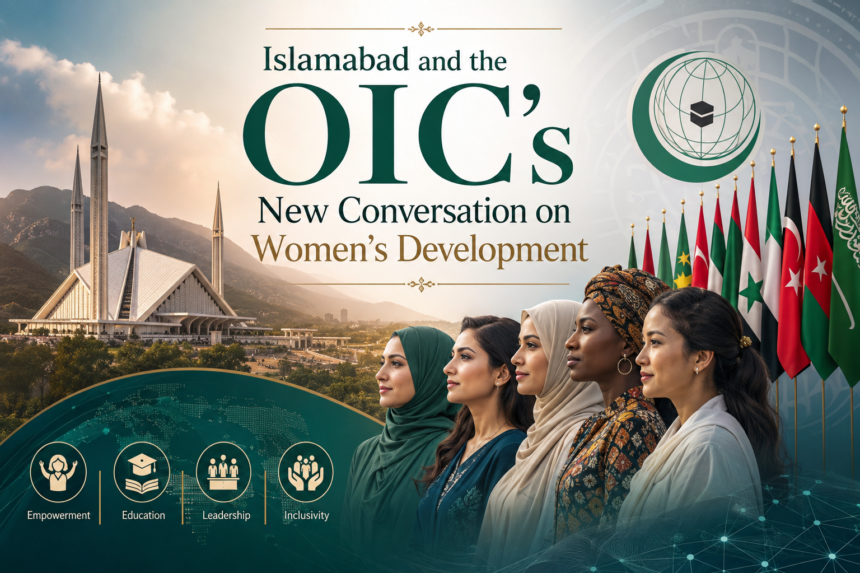

The 9th OIC Ministerial Conference on Women marks an important shift in the Organisation of Islamic Cooperation’s agenda, highlighting women’s empowerment as a strategic driver of economic growth, inclusive governance and sustainable development. It examines the conference’s significance for the Muslim world, Pakistan’s diplomatic opportunity as host, and the potential for stronger policy cooperation, institutional partnerships and practical initiatives to advance the collective development agenda of OIC member states.
Nuzhat Nazar
As Islamabad prepares to host the 9th OIC Ministerial Conference on Women on 12 and 13 July, the importance of the event extends well beyond protocol and diplomacy. Bringing together ministers and senior policymakers from the 57 member states of the Organisation of Islamic Cooperation (OIC), the conference reflects the organisation’s growing recognition that the future of the Muslim world will be shaped as much by investments in human capital as by political and security cooperation.
The OIC has traditionally been viewed through the lens of geopolitics, focusing on Palestine, regional conflicts, humanitarian crises and collective diplomacy. Over the past two decades, however, its agenda has steadily expanded to include education, science, technology, youth and women’s development. The Ministerial Conference on Women reflects this evolution by providing a dedicated platform where member states review progress, formulate collective strategies and coordinate policies on issues affecting nearly one billion women across the Islamic world.
This year’s conference comes at a particularly important moment. OIC member states collectively account for a significant share of the world’s youth population, yet many continue to face common challenges, including low female labour force participation, unequal access to education, digital exclusion, financial barriers, maternal healthcare concerns, gender based violence and limited representation of women in legislatures and decision making. While these challenges differ in scale across member states, they continue to impede economic growth, inclusive governance and sustainable development.
Pakistan itself illustrates why these discussions are so important. According to the World Economic Forum’s Global Gender Gap Report 2025, Pakistan ranked 148th out of 148 countries, achieving 56.7 per cent gender parity, marking its second consecutive annual decline after reaching its highest score in 2023. Labour market disparities remain equally pronounced. According to the International Labour Organisation (ILO), women in wage employment earn approximately 30 per cent less per month than their male counterparts. These figures highlights the scale of the challenge and reinforce why policy dialogue must now be matched by practical reforms and implementation.
Consequently, the conference is expected to focus on practical policy areas including women’s economic empowerment, entrepreneurship, digital inclusion, education, healthcare, political participation and institutional cooperation. These discussions are no longer confined to social policy. They increasingly intersect with national development strategies, economic competitiveness and sustainable growth. The conference also provides an opportunity for member states to exchange successful policy experiences, strengthen institutional cooperation and explore collective approaches to overcoming shared development challenges.
For Pakistan, hosting the conference carries strategic diplomatic significance. Beyond demonstrating its capacity to convene one of the Islamic world’s largest ministerial gatherings, Islamabad has an opportunity to reinforce its role as an active stakeholder within the OIC while deepening engagement with member states across the Middle East, Africa, Central Asia and Southeast Asia. At a time when Pakistan seeks to expand its diplomatic footprint and strengthen multilateral partnerships, hosting such a high level forum enhances its standing as a country capable of facilitating dialogue on issues that extend beyond traditional security and political concerns.
Equally important is the diversity represented within the OIC. From Indonesia and Malaysia to Saudi Arabia, Türkiye, Nigeria and Morocco, member states possess different governance models, economic capacities and social experiences. This diversity creates opportunities for sharing best practices, institutional learning and policy coordination. Countries that have successfully expanded women’s access to education, entrepreneurship and public leadership can offer valuable lessons to others confronting similar developmental challenges.
The economic rationale behind the conference is equally compelling. Across much of the Islamic world, women’s participation in formal economic activity remains below global averages. Numerous international studies have shown that increasing female participation in the workforce enhances productivity, stimulates entrepreneurship, strengthens household incomes and contributes to long term economic growth. For many OIC countries seeking to diversify their economies and improve competitiveness, expanding opportunities for women is increasingly viewed not simply as a social objective but as an economic imperative.
The Islamabad meeting offers more than an opportunity to adopt another declaration. It provides a platform for member states to deepen cooperation, exchange successful experiences and build practical partnerships that can accelerate women’s empowerment. If this momentum is sustained beyond the conference, Islamabad could mark an important milestone in advancing a more inclusive and prosperous future for the Muslim world.
Historically, the conference also reflects the broader transformation of the OIC itself. The organisation increasingly recognises that sustainable development, social cohesion and economic resilience are inseparable from investments in education and human capital. Women’s empowerment has therefore become not only a developmental objective but also a strategic component of national resilience across the Islamic world.
For Pakistan, successfully hosting the conference represents more than a diplomatic milestone. It presents an opportunity to help shape the Muslim world’s development agenda while projecting itself as a constructive and responsible partner within the OIC. More importantly, it allows Pakistan to contribute to a broader conversation about inclusive development, one that recognises that stronger economies, more resilient societies and better governance are impossible without the full participation of women.
Ultimately, the success of the 9th OIC Ministerial Conference on Women will not be measured solely by the discussions held in Islamabad, but by the partnerships it strengthens and the momentum it generates for future cooperation. If the commitments made during the conference translate into expanded educational opportunities, greater economic participation, stronger institutional protections and improved representation of women in leadership and decision making across the 57 member states, Islamabad will be remembered not only as the host city, but as the starting point of a renewed collective effort to advance the development agenda of the Muslim world.
Nuzhat Nazar is a journalist and strategic affairs analyst with more than ten years of experience reporting on foreign policy, defence, and economic developments. Based in Islamabad, she focuses on geopolitics, regional security dynamics, and Pakistan’s positioning in a shifting global order.