

Nuzhat Nazar
History is rarely kind to powers that confuse military superiority with moral authority. It is even less forgiving when mass suffering is justified in the language of security, deterrence and national survival. Wars are often explained in real time as necessary. But history judges them later by their human cost, political intention and long-term consequences.
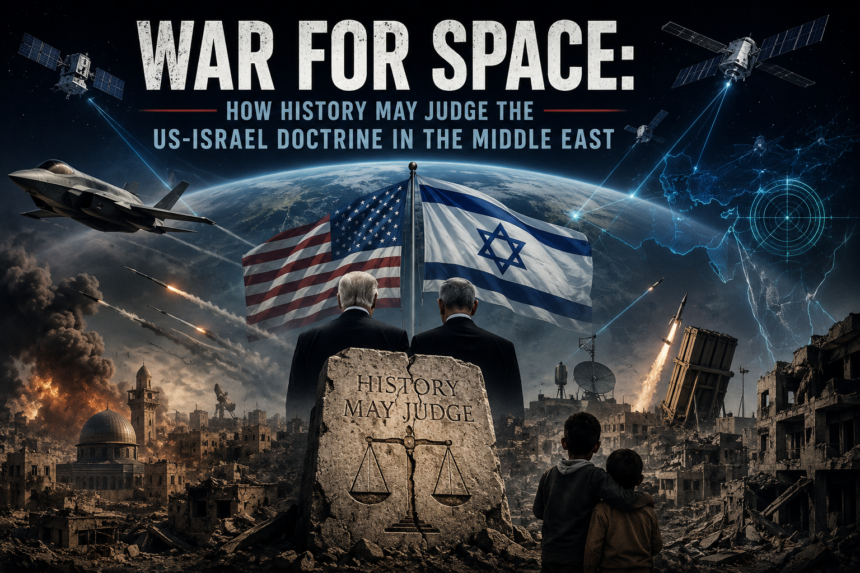
This is the frame through which the current US-Israel doctrine in the Middle East may one day be judged.
The comparison with Operation Barbarossa is not literal. Israel is not Nazi Germany, and today’s Middle East is not Europe in 1941. But historical analogies are useful when they reveal patterns of thinking. Barbarossa was born from overconfidence, ideology, expansionist ambition and the belief that a future threat had to be crushed before it became impossible to defeat. It showed how a state, convinced of its own power, could try to reshape geography and politics through overwhelming force, only to trigger consequences it could not control.
That warning matters today because the crisis in Gaza, Lebanon, Syria and Iran is not only a war for security. It is a war for strategic space.
In geopolitics, strategic space means the room a state has to survive, influence, deter, expand and shape its surroundings. For Israel, Gaza, Lebanon, Syria and Iran are not separate theatres. They are part of one wider security environment. For Iran, its regional alliances are not simply ideological projects. They are defensive depth against US-Israeli pressure. But for Palestinians and Lebanese civilians, this language of strategic depth often translates into destroyed homes, displacement and loss.
Every side claims defence. Israel says it is protecting itself from Hamas, Hezbollah and Iran. The United States says it is defending regional stability. Iran says it is resisting encirclement and protecting deterrence. Yet the result is a widening battlefield where civilian populations pay the highest price.
This is the classic security dilemma. One state’s search for security becomes another side’s evidence of aggression. Military action taken in the name of defence creates more insecurity, more retaliation and more war. The stronger side often presents its violence as order, while the weaker side’s response is described only as extremism or destabilization.
That is why Gaza, Lebanon and Iran cannot be understood separately. Together, they show a larger US-Israel attempt to create a new regional balance in which Iran is weakened, Hezbollah is contained, Gaza is controlled, Palestine is politically sidelined and Israel’s security doctrine becomes the organizing principle of the Middle East.
This is not merely deterrence. It is the pursuit of regional hegemony.
Regional hegemony means one power, or one alliance, tries to shape the political and military order of an entire region in its own favour. The US-Israel approach appears to be moving in that direction. The aim is not only to defeat armed groups or prevent a nuclear threat. The broader objective seems to be to reduce every source of resistance around Israel and force a regional order where normalization proceeds without justice for Palestine and where Israel’s military dominance is treated as permanent reality.
This is where the debate around Greater Israel becomes impossible to ignore. For some, Greater Israel is a religious or historical idea. For others, it is a political project linked to permanent control, settlement expansion and the weakening of surrounding Arab and Muslim resistance. Its modern danger is not only in formal annexation or declared maps. It lies in facts on the ground: expanding military control, deepening occupation, pushing security zones, and treating Palestinian statehood as something that can be delayed, diluted or erased.
The American side of this equation is equally important. The MAGA-style Middle East plan is not built around traditional diplomacy, Palestinian justice or equal regional security. It is built around transactional power: pressure Iran, protect Israel, expand the Abraham Accords, push Arab and Muslim states toward normalization, and present this as peace.
But peace without justice is not stability. If normalization is used to bypass Palestine, isolate Iran and reward Israel without ending occupation, then it becomes a geopolitical tool for legitimizing an unequal order. It offers recognition without rights, stability without accountability and diplomacy without political settlement.
History shows that domination is not the same as stability.
Operation Barbarossa was launched with the belief that the Soviet Union would collapse quickly. Instead, Germany underestimated Soviet resilience, geography, manpower and memory. What was imagined as a swift campaign became a strategic disaster.
The Soviet intervention in Afghanistan offers another warning. Moscow entered Afghanistan in 1979 believing it could secure its strategic interests through a controlled military operation. Instead, the war became a decade-long drain on Soviet resources, legitimacy and confidence. What began as a show of power exposed the limits of Soviet strength.
The United States later faced a similar lesson in Iraq and Afghanistan. Washington won the early military phases quickly and removed regimes with overwhelming force. But it struggled to build stable political orders afterward. These examples show that battlefield dominance does not automatically produce political control or historical legitimacy.
This is also the logic of imperial overstretch. Great powers weaken themselves when military ambitions expand beyond their political, economic and moral capacity to sustain them. From Nazi Germany in the Soviet Union, to the Soviet Union in Afghanistan, to the United States in Iraq and Afghanistan, history shows that powers can look strongest at the very moment they begin creating the conditions of their own strategic decline.
That is the danger in the current US-Israel doctrine.
In Gaza, the world has watched civilian life become unbearable. In Lebanon, military pressure expands under the argument of neutralizing Hezbollah. Against Iran, the language is about preventing a future nuclear threat and breaking regional networks before they become too powerful to contain. This is the logic of preventive war: the idea that a rival must be weakened today because it may become more dangerous tomorrow.
Preventive war carries a moral and strategic risk. It turns fear of the future into justification for present destruction. It blurs the line between defence and aggression. Once that line is blurred, almost any level of violence can be explained as necessary.
There is also moral hazard. In geopolitics, moral hazard occurs when a state takes greater risks because it knows a stronger power will protect it from consequences. Israel’s conduct has repeatedly been shielded by US diplomatic, military and political support. This creates a dangerous imbalance. When a state believes accountability will be blocked, it may expand military action and treat international criticism as manageable noise.
This does not only damage the victims. It also damages the credibility of the protecting power. The United States speaks of international law, but its protection of Israel has created a visible contradiction between what Washington claims in principle and what it enables in practice.
Future historians may look back and say the warning signs were visible: Gaza’s devastation, Lebanon’s suffering, pressure on Iran, the normalization agenda that tried to bypass Palestinian rights, the Greater Israel logic of permanent control, and the repeated use of military force as a substitute for political settlement.
The US and Israel may still believe they can force a new Middle East into existence, one where Iran is weakened, Hezbollah is contained, Gaza is controlled, Palestine is sidelined and Arab states are pushed into normalization. But a region cannot be stabilized by erasing its central injustice. Palestine cannot be pushed out of the equation. Lebanon cannot be bombed into calm. Iran cannot be permanently coerced without consequences. And Israel cannot build lasting security on the ruins of other people’s dignity.
The final judgment of history is often slow, but it is rarely blind. Today’s planners may speak of deterrence, precision and strategic necessity. Today’s politicians may speak of normalization, peace deals and a new Middle East. But tomorrow’s historians may speak of occupation, collective punishment, expansion and moral collapse.
If Operation Barbarossa is remembered as the catastrophic overreach of a power that tried to reorder geography through force, the US-Israel project may one day be remembered as the moment when security became the language of expansion, and peace became the cover for domination.
If the current path continues, history may not remember this as Israel’s war for survival. It may remember it as the moment when a state, protected by the world’s strongest power, mistook impunity for destiny and forced an entire region to pay the price.