
By Maimona Saleem
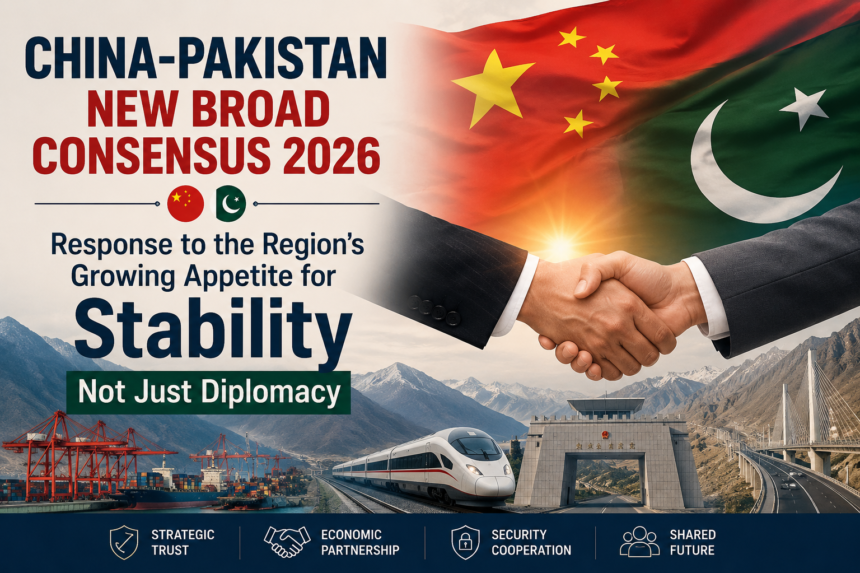
For seven decades, China and Pakistan have called their bond higher than the Himalayas, deeper than the oceans, sweeter than honey, and stronger than steel. This was always a stunning phrase. But on May 25, something had shifted when Prime Minister Shehbaz Sharif shook hands with President Xi Jinping and the two nations declared a “New Broad Consensus.” This was not merely a ceremony. This was a necessity.
The relations between states are not built on affection or preference; rather, the true foundation of these relationships lies in their interconnected mutual interests. Therefore, the rapidly evolving security and economic situation in the region has also further connected the strategic interests of China and Pakistan.
So, this consensus came not out of comfort, but out of crisis. The consensus is basically a need for stability, investment, and strategic cover that no other power on earth is currently willing to provide. In 2026, Pakistan is facing challenges on multiple fronts.
To comprehend why this consensus is important, one must first understand Pakistan’s geography of crises in 2026. To its west, Pakistan is effectively in an open war with Taliban-controlled Afghanistan. Cross-border strikes, retaliatory attacks, and Tehrik-e-Taliban Pakistan (TTP) sponsored terrorism have escalated into a breakdown of bilateral relations.
This has raised serious concerns for China. Because it has deep stakes in both Afghanistan and Pakistan, the conflict is directly threatening the arteries of China Pakistan Economic Corridor (CPEC) and China’s Belt and Road connectivity across the region.
To its north-west, the Iran war began with US-Israeli strikes in late February 2026 and has restructured the Middle Eastern order. Pakistan, which shares approximately 909 Km long border with Iran and is contingent upon the Gulf trade routes, cannot afford to be caught in that crossfire. It has played the role of mediator and walked a tightrope between the US and Iran. That mediation role also earned China’s public appreciation in the joint statement, and it is no quirk.
To its east, the May 2025 India-Pakistan military confrontation wounds are still fresh. India is not letting Pakistan stay stable and peaceful. The mutual suspicion is thick. And Pakistan realised that in that moment of maximum danger, one power showed up with radar support, air defense reconfiguration, intelligence sharing, and fighter jets. That power was not the US; it was China.
This is the situation and environment into which the New Broad Consensus comes. Therefore, it is not diplomatic boilerplate, but it is an answer to a question Pakistan has been screaming across multiple fronts: who stands with us when it matters? So, what the consensus actually declares and what it means can be analysed from the joint statement released on May 26, 2026. It comprises important details that must be unpacked.
In this consensus, both states agreed to advance the progress of CPEC 2.0, the upgraded version of CPEC. Because this is no longer just a highway and pipeline project. The new framework expands into artificial intelligence governance, energy cooperation, industrial zones, and counterterrorism coordination.
Both sides declared that third-party countries and investors are now welcome to participate in CPEC under mutually agreed arrangements. Perhaps most significantly, it insulates the project from being framed as a Chinese debt trap and opens the door for Gulf investment, Central Asian states, and even European investors to join under China’s architecture.
This consensus positioned Gwadar at its geographic heart because this port can rewrite trade history, and both countries are committed to transforming Gwadar Port into a regional connectivity hub linking South Asia, Central Asia, and the Middle East.
Combined with the Karakoram Highway realignment from Thakot to Raikot and the expansion of the Khunjerab Pass for land connectivity, the vision is now clear that Gwadar is not just Pakistan’s port. It is China’s access to the Arabian Sea and a structural challenge to the US-dominated Indo-Pacific maritime order.
Another important aspect on which the two countries agreed was on promoting a multipolar world and opposing unilateral actions by other states. This is a pointed message to the US. At a time when US President Trump has warned that the window for diplomacy with Iran is closing, and when US pressure on Pakistan to reduce its ties with China is increasing, this statement comes as a coordinated declaration that clearly shows where Pakistan stands in the global power competition.
Besides, China reaffirmed support for Pakistan as the next rotating president of the Shanghai Cooperation Organisation and hailed its role as a non-permanent member of the UN Security Council for 2025-2026. China is systematically elevating Pakistan’s multilateral standing, giving it institutional leverage.
Now critics will argue that Pakistan is merely a consumer state with no real agency in this relationship. But here is the deep economic interdependence involved that makes this situation especially serious. Pakistan’s vulnerable economic condition does not diminish this consensus; rather, it amplifies its strategic logic.
A stable and economically functional Pakistan is in China’s direct interest. Obviously, CPEC cannot operate in an unstable state. Similarly, Gwadar cannot become a regional hub due to security and economic vulnerabilities. Therefore, China needs Pakistan to survive, and Pakistan needs China to fund that survival. This is a mutual dependency.
Here is what needs to be contemplated is that no other power is offering Pakistan what China is. China comes with construction crews, fighter jets, and Panda Bonds. In a crisis or conflict, transaction beats sentiment.
The consensus, if implemented, can also shift the economic geography of landlocked Central Asia. Because for Central Asia, the CPEC 2.0 framework with Gwadar provides a gateway to global markets. That is why Kazakhstan, Uzbekistan, and Tajikistan have reason to consider this carefully.
Moreover, this consensus comes at a time when the region is facing geopolitical turmoil. It would not be wrong to say that the region is on fire. Afghanistan is in open hostility with Pakistan. Iran is at war. India remains hostile. US tariffs and great-power competition ruptured the global trading order. Pakistan’s economy is already in dire circumstances.
In this environment, this consensus is not a luxury; it is a lifeline for Pakistan. CPEC 2.0, Gwadar’s elevation, and multilateral institutional backing will consolidate the cordial relations already existing. The China-Pakistan New Broad Consensus is a response to regional appetite, an appetite for security, economic viability, and strategic relevance that neither country can achieve in isolation.
In one of the most tempestuous geopolitical years of the 21st century, China and Pakistan have chosen each other, not out of sentiment, but out of necessity and urgency. Both states have a strong realization and recognition of shared strategic interests. In a world where alliances are under constant pressure, the Iron Brothers, unequal, imperfect, yet still crucial to one another, continue to stand together.
The author is a senior researcher at CDS and a PhD scholar in Peace and Conflict Studies. Her research focuses on terrorism and extremism. Her work also focuses on peace-based approaches to economic development, growth, and regional cooperation. She also writes on geopolitics, regional security, and global power dynamics.