
By Maimona Saleem
Nobody really saw this coming. Not at this scale
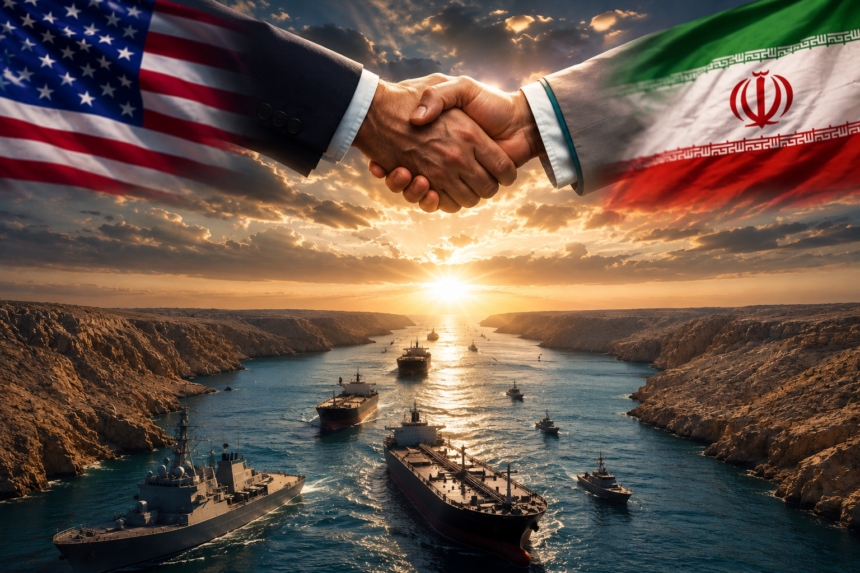
When Prime Minister Shehbaz Sharif posted on X in the early hours of Monday, announcing that a peace deal between Washington and Tehran had been reached. The reaction was one of disbelief. Oil prices dropped. Phones lit up. And in Pakistan, the people who had been running on coffee and back-channel calls for weeks finally had something to show for it.
Pakistan didn’t fight in this war. It has no navy patrolling the Gulf, no permanent seat at the Security Council, no trillion-dollar economy to swing as a bargaining chip. What it had, both sides were willing to talk through it. That’s rarer than it sounds.
The Backdrop
Cast our minds back to February 28. US and Israeli strikes hit Iran simultaneously. Within days, the Strait of Hormuz, the narrow chokepoint through which roughly a fifth of the world’s oil moves, was closed. Fuel prices spiked. Fertiliser shipments stalled. Countries that were already struggling felt it first and worst.
For Pakistan, this wasn’t an abstract geopolitical crisis. It imports oil. It has millions of workers in the Gulf whose remittances keep families afloat. It was in the middle of its own fragile economic turnaround. The smart move, politically, would have been to keep its head down.
Instead, Pakistan stepped in. Deputy Prime Minister/Foreign Minister Senator Ishaq Dar was on calls constantly with Iran, with the US, and with regional partners. Pakistan publicly and privately urged restraint at every turn. It had done something similar during the April ceasefire push, which earned it appreciation from European countries and Qatar. But what happened Sunday night is a different thing entirely.
What Everyone Is Actually Saying
The international reaction has been, and there’s no better word for it, unusually warm.
António Guterres, Secretary-General of the UN, called it “a critical step towards the peaceful settlement of the conflict” and named Pakistan alongside Qatar, Egypt, Saudi Arabia, and Türkiye as countries whose constructive role deserved recognition.
Keir Starmer, Prime Minister of the United Kingdom, talked to reporters in London and said, “I want first to welcome the breakthrough reached last night between the US and Iran, and I congratulate President Trump, the mediators from Pakistan and Qatar, and all those involved.” He also wrote on X that Pakistan and Qatar had “contributed to this breakthrough.
Turkey’s Erdoğan acknowledged Pakistan’s “exceptional mediation efforts.” China’s foreign ministry, not exactly an institution known for generous praise of other countries’ diplomacy, expressed “appreciation for the mediation efforts made by Pakistan.
Japan said it “highly commends the efforts of relevant countries that played a mediating role.” Australia talked about dialogue and diplomacy being “the most effective means” of resolving disputes. Read all of that together and it isn’t a courtesy round of applause. It’s a genuine response.
Why Pakistan, though?
It’s a fair question and one worth sitting with. Because Pakistan is not a neutral actor in the classical sense. It leans toward China on most major strategic questions. It’s a designated major non-NATO ally of the US. It’s a Muslim-majority country with strong cultural and religious ties across the Islamic world.
Washington trusted Pakistan enough to let it carry messages. Tehran trusted Pakistan enough to receive them. Qatar worked alongside it as a co-mediator rather than a rival. That’s the thing about being credible to multiple parties at once: it’s incredibly hard to build and incredibly easy to destroy. Pakistan didn’t destroy it.
It also took real discipline domestically. The political opposition was loud. Some questioned why the final signing is happening in Geneva rather than Islamabad. Others argued Qatar deserved the credit, or China, or Russia. The government ignored all of it and kept working. That’s not easy in Pakistani politics. That’s not easy in any politics.
What Pakistan Gets Out of This
Some will say that the economic gains from a reopened Strait of Hormuz will mostly benefit the big economies. That’s broadly true.
But Pakistan isn’t walking away empty-handed either. Lower oil import costs matter. Gulf remittances flowing through a more stable region matter. And investor confidence, the hardest thing to rebuild once lost, gets a genuine boost when the country facilitates a deal of this magnitude.
Beyond the economics, there’s something harder to quantify but more durable. Pakistan has spent years being defined by what others say it is: a country of instability, of crisis, of perpetual political drama. This weekend offered a different image. Not perfect, not without problems, but capable of serious and sustained diplomacy at the highest level.
It Isn’t done, Yet
It is important to understand the truth about this. Friday’s signing in Geneva is a Memorandum of Understanding (MoU), not a peace treaty. An MOU, not an ending.
Iran’s nuclear programme is the real fault line. Everything else, the Hormuz reopening, the Lebanon provisions, the ceasefire terms, can be managed if that question gets resolved. If it doesn’t, this could easily become another framework that looks good on paper for about six months before unravelling.
Israel is not a party to the deal, and that is a worrisome situation. That’s a live variable with real consequences. The 60-day negotiating window ahead will be harder than the last four months, in some ways.
Pakistan’s specific role going forward is genuinely unclear. Pakistan was the conduit; Geneva is where the architects will take over. Larger powers with larger interests will shape what comes next. That’s just the reality.
Pakistan got something different this weekend
History tends to credit the loudest voice in the room. The country with the biggest aircraft carrier, the largest economy, and the most cameras pointed at it.
Pakistan got something different this weekend: recognition from across the board. The UN said it. London said it. Ankara said it. Beijing said it. Tokyo said it. The critics in Israel, India, and even in Pakistan will keep doing what critics do. That’s fine. Criticism is part of the process.
But on a Monday morning in June 2026, as oil tankers prepared to move again through a strait that had been closed for months, and as world leaders reached for their phones to issue statements they didn’t have to issue, Pakistan’s name was in nearly all of them.
For a country that has been told, repeatedly, that it punches below its weight on the world stage, that’s not a small thing.