
Asif Haroon Raja
When the Elephants Fight: Gulf States and the Cost of Regional War
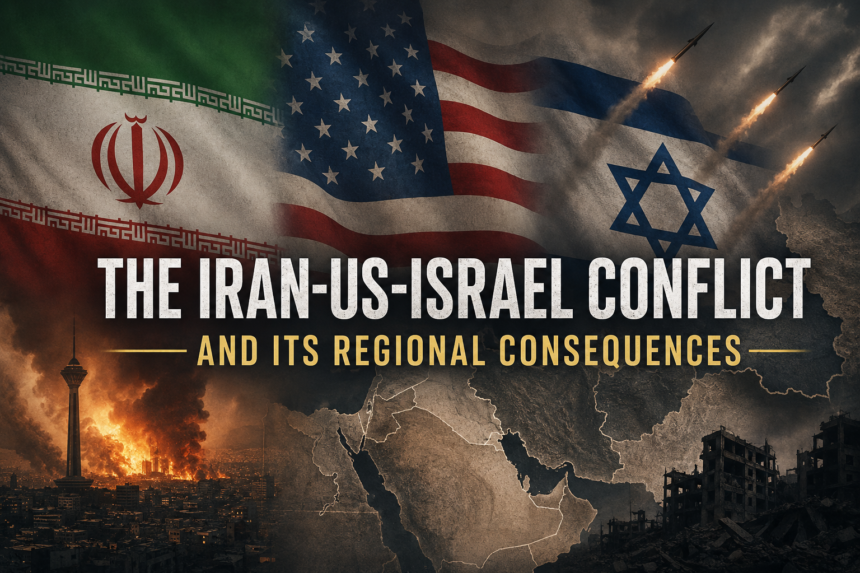
From the very first day, it was evident that the US- Iran war was a war between two powerful adversaries, but the real losses would be borne by the Gulf States—and that is precisely what happened.
The greatest “crime” of the Gulf countries today is their immense wealth. They possess enormous financial resources but lack independent defensive capabilities.
History has shown that when a wealthy individual fails to invest adequately in security, thieves and opportunists eventually plunder his wealth.
The Gulf States have found themselves in a similar predicament. The conflict was initially between Iran and Israel, but the United States entered the fray.
When Iran was unable to respond directly and effectively to Washington, much of the resulting pressure and fallout was shifted onto the Gulf countries.
The conflict highlighted a fundamental strategic paradox of the Gulf monarchies. Despite possessing some of the world’s largest sovereign wealth funds and advanced military hardware, their economic lifelines remain concentrated in a narrow maritime corridor.
The Strait of Hormuz continues to be a strategic choke point through which regional prosperity can be threatened by a relatively limited military confrontation.
Economic Fallout
Some assessments suggested that tourism, trade, and oil exports of the Gulf States suffered significant setbacks, causing billions of dollars in losses.
To make matters worse, these countries are now reportedly being asked to bear part of the financial burden of the conflict, while the United States has largely stepped back from direct involvement.
Unconfirmed media reports suggested the possibility of financial arrangements involving certain Gulf States and Iran, although these reports were denied by Washington and have not been independently verified.
Several energy market analysts projected that the energy sector suffered perhaps the most severe blow. Roughly 20 percent of the world’s oil and 20 percent of global LNG supplies pass through the Strait of Hormuz each day.
Any partial or complete disruption of this strategic waterway immediately impacts Gulf exports.
Energy analysts estimate that during the initial phase of the conflict, Gulf countries faced average losses of nearly $2 billion per day in oil and gas exports. Over the course of a month, these losses were estimated to have reached between $50 billion and $60 billion.
Saudi Arabia, Qatar, the UAE, Kuwait, and Oman all experienced significant declines in oil and gas production. Some estimates suggest that regional daily output fell from approximately 21 million barrels to around 14 million barrels, while worst-case projections warned of a decline to as low as 6 million barrels per day.
According to industry estimates, the shipping industry was also severely affected. Nearly one thousand commercial vessels—including around five hundred oil tankers and five hundred container ships—were stranded or delayed on either side of the Strait of Hormuz.
Maritime insurance premiums surged by more than 60 percent due to heightened war risks, while specialized war-risk insurance rates rose several-fold on certain routes.
The aviation sector suffered substantial losses as well. As Gulf airspace became increasingly risky, dozens of flights were rerouted, fuel costs increased, and regional airlines faced billions of dollars in additional expenses.
The global aviation industry reportedly reduced its 2026 profit forecasts by approximately $18 billion, while worldwide fuel expenditures rose from around $252 billion to nearly $350 billion.
Tourism also experienced a major downturn. Hotel bookings were cancelled in major regional hubs such as Dubai, Abu Dhabi, Doha, Muscat, and Bahrain. Business conferences were postponed, and tourist arrivals declined significantly.
Economic experts estimate that tourism and travel-related sectors lost several billions of dollars in economic activity.
Investment and financial markets likewise came under pressure. Concerns over regional instability prompted numerous international investors to delay or suspend projects. Growth forecasts for Gulf economies were revised downward.
Some economic assessments projected that the overall GDP growth rate of GCC countries could decline by approximately 0.2 percent, representing billions of dollars in lost economic output.
Net Result
In summary, the confrontation involving Iran, the United States, and Israel exposed the Gulf region not only to military risks but also to serious economic disruptions affecting energy, trade, shipping, aviation, tourism, and investment.
Combined economic estimates suggest that Gulf countries either suffered or faced risks amounting to between $70 billion and $100 billion in direct and indirect losses.
Had the conflict continued for a prolonged period, these losses could potentially have risen into the hundreds of billions of dollars.
The principal lesson for the Gulf States is that economic power alone cannot guarantee security. Sustainable prosperity ultimately depends upon a credible combination of military deterrence, regional diplomacy, strategic autonomy, and the protection of critical economic infrastructure.
Becoming wealthy is important, but protecting that wealth is equally important. If adequate resources are not invested in security and self-defense, others may eventually exploit vulnerabilities and appropriate the fruits of that prosperity.
Wealth without security remains vulnerable to the turbulence of great-power rivalries.
To be concluded
About the Author
Brigadier (Retd) Asif Haroon Raja, SI (M) is a war veteran. He is Command and Staff Course and War Course qualified, holds an MSc in War Studies, and served as Defence Attaché in Egypt and Sudan, as well as Dean of the Corps of Military Attachés in Cairo.
He is a defence, security, and geopolitical analyst, columnist, featured columnist of IntelDrop magazine Washington, author of five books, former Chairman of Thinkers Forum Pakistan, Patron-in-Chief of Centre for Development Studies Think Tank, Director of Meesakh Research Centre; he regularly appears on media platforms.