

U.S.-Iran Agreement & Middle East Geopolitics
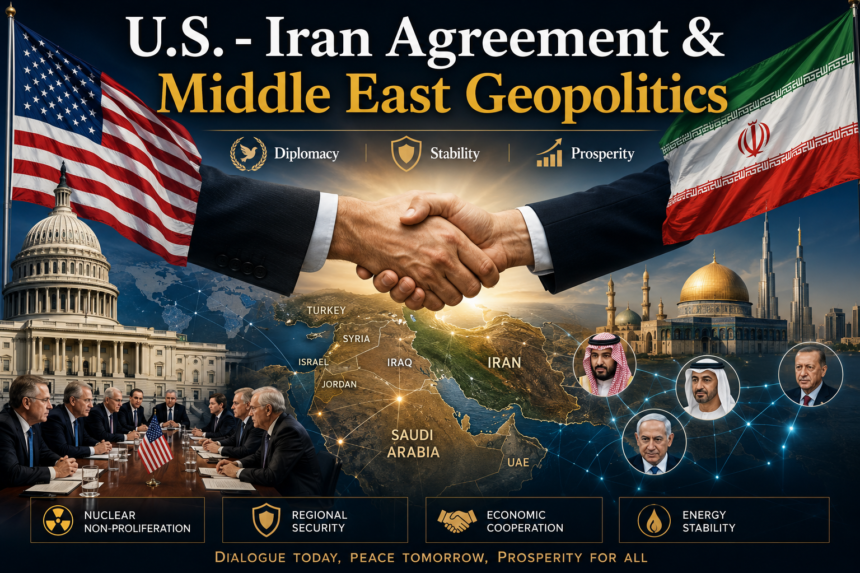
The formal signing of a landmark framework agreement between the United States and the Islamic Republic of Iran in Geneva has introduced a profound tactical realignment within Middle Eastern geopolitics, offering an abrupt release of pressure from an exceptionally dangerous escalatory cycle.
The preceding months had brought the broader region perilously close to the brink of a systemic war, characterized by unprecedented direct military exchanges, heightened shadow warfare, and acute \maritime instability throughout the Persian Gulf.
The critical flashpoint of this crisis occurred when an aggressive, partial naval blockade near the strategically vital Strait of Hormuz sent immediate shockwaves through global commerce, threatening international energy supply lines and exposing the profound vulnerability of international maritime trade. The resulting Memorandum of Understanding functions as an urgent, highly necessary stabilization mechanism designed to reopen vital trade routes and mitigate short-term military friction.
Yet, regional analysts across the Middle East and South Asia are intensely debating whether this newly minted accord represents a durable diplomatic milestone capable of restructuring regional security, or merely a temporary, highly fragile strategic pause engineered by two profoundly exhausted adversaries seeking domestic relief.
The structural gains embedded within this preliminary framework are intensely transactional, carefully calculated by negotiators to address the immediate, pressing domestic vulnerabilities of both Washington and Tehran rather than to resolve long-standing ideological grievances. For the United States, the primary victory is undeniably economic and logistical: the unhindered restoration of free maritime transit through the world’s most critical energy chokepoint.
This single diplomatic achievement immediately stabilized wildly fluctuating global oil prices, averting a broader energy crisis ahead of crucial domestic political and electoral cycles in the West. In return for this maritime concession, Iran secured an immediate, vital economic lifeline through targeted U.S. Treasury waivers on its sovereign crude oil exports and a partial restoration of its international banking and financial access.
The highly sensitive nuclear dimension of the arrangement relies on a novel technical compromise, permitting Tehran to down-blend its existing sixty-percent enriched uranium stockpiles directly on Iranian soil under the continuous, strict supervision of the International Atomic Energy Agency (IAEA).
This concession effectively bypassed previous American and European demands for the absolute, unconditional removal of all highly enriched nuclear material from the country, thereby allowing Iran to maintain its technological pride while temporarily walking back its breakout timeline.
This sudden diplomatic shift has provoked starkly divergent reactions across the highly fragmented regional security landscape, drawing a clear line between those states favoring economic stability and those viewing the deal through a lens of existential survival.
The Arab Gulf states, having experienced the direct economic vulnerabilities, physical infrastructure threats, and security anxieties of maritime conflict, have greeted the agreement with cautious relief. For these monarchies, immediate regional de-escalation is viewed as a necessary prerequisite to protect their massive domestic infrastructure investments, cross-border trade networks, and ambitious long-term economic diversification plans.
Conversely, Israel has fiercely and unequivocally rejected the Geneva accord, characterizing it as a profound, historical strategic failure that provides substantial upfront economic relief to Tehran without structurally dismantling its extensive nuclear enrichment architecture or centrifuge facilities.
With the Israeli defense establishment explicitly maintaining its absolute operational autonomy and continuing intense military operations against regional non-state actors along its northern and southern borders, the possibility of an unexpected external catalyst disrupting the Washington-Tehran understanding remains a constant threat.
Ultimately, this framework agreement does not resolve the deep-seated ideological rivalries, structural security dilemmas, or the highly complex proxy network dynamics that have historically defined Middle Eastern instability and state competition. The accord represents an intersection of temporary, immediate necessities for the signing regimes rather than a fundamental, permanent shift in regional relationships or strategic doctrines.
Washington was highly motivated by a desire to avoid an expensive, unpredictable, and potentially open-ended military conflict in the Middle East that would severely distract political and military resources from its major strategic commitments in Eastern Europe and the Indo-Pacific theater.
At the same time, the political leadership in Tehran desperately required immediate financial relief and sanctions mitigation to stabilize its heavily burdened internal economy, curb rampant domestic inflation, and manage rising domestic public pressures.
Without a subsequent, comprehensive, and legally binding treaty that explicitly addresses ballistic missile proliferation, regional proxy funding, and a permanent, verifiable nuclear verification framework, this preliminary agreement remains structurally fragile. It serves primarily as a precarious, highly transactional truce where a single tactical miscalculation on a secondary front could instantly reignite direct hostilities.
Rimsha is a researcher at Centre for Development and Stability (CDS)
.