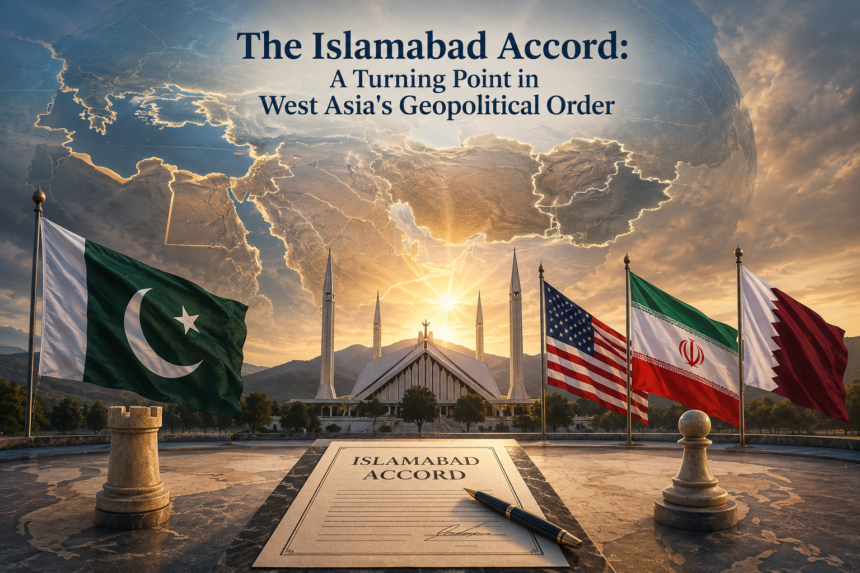

Following the Switzerland Agreement on 22 June, an extremely interesting atmosphere emerged across international social media. The discussions initially centered on the meeting between the Pakistani and Iranian delegations.
This was followed by the arrival of the American delegation, led by the U.S. Vice President James David Vance. The cordial and engaging interaction between the American and Pakistani delegations quickly became a hot topic in international media and journals.
Soon afterward, the Pakistani delegation met with the Qatari delegation, and then came the news that all participating sides had unanimously chosen Pakistan to chair the proceedings, expressing their full confidence in Pakistan’s leadership.
Amid these developments, Indian figures closely associated with the Modi government and its hardline nationalist ideology—most notably Aditya Raj Kaul, who was also among the writers of the film Dharinder—were venting their frustration, almost like a bitter mother-in-law unable to hide her resentment.
Some of their sarcastic complaints were along the following lines:
“Why are the Americans smiling so warmly while meeting the Pakistani delegation? Why are they praising Field Marshal Asim Munir?
Why isn’t this peace process coming to an end? And why has Israel been kept out of it?”
On the other hand, Israeli journalists, politicians, and strategic analysts appeared stunned, wondering what exactly was unfolding.
After the failure of Israeli intelligence to prevent Pakistan from becoming a nuclear power, this was perhaps the second occasion on which Pakistan had effectively placed Israel in a “checkmate” position.
The irony of the situation was striking: the same U.S. Vice President who had rebuked members of the Israeli cabinet and the pro-Israel lobby in Washington a day earlier, by the following morning, he was seen warmly embracing members of the Pakistani delegation.
Meanwhile, even hardline Iranian military-linked social media accounts were projecting an atmosphere of confidence regarding the peace agreement.
In this context, it would not be an exaggeration to describe the outcome as a victory for both.
Pakistan and the Cause of Peace
Those who had mocked the idea of Pakistan acting as a mediator were seen hypocritically applauding Qatar’s role as a mediator, while the very same people had reacted with visible hostility when Pakistan was performing that role.
Likewise, those who had celebrated reports that the Pakistani delegation would not travel to Switzerland were plunged into disappointment when it became clear that Pakistan would, in fact, preside over the “Islamabad Accords” in Switzerland.
After suffering setbacks on every front, these same circles returned to criticizing Pakistan’s internal affairs, as they did before.
As the saying goes:
“The dough shakes the most while it is being kneaded.”
Undoubtedly, Pakistan still faces numerous internal challenges that require urgent attention. The latest is the turbulence in Azad Kashmir. Nevertheless, where genuine success is achieved, there is nothing wrong with acknowledging and celebrating it. As for those asking what Pakistan stood to gain from all this, the precise benefits may become clearer with time.
However, one thing is certain. Had these diplomatic efforts not taken place, the region might by now have been engulfed in sectarian violence, from rising economic pressures to unrest across the Middle East and even within Pakistan itself. Instead of thousands, perhaps hundreds of thousands of innocent people could have become victims of the resulting chaos.
The author Brigadier (Retd) Asif Haroon Raja, SI (M), is a war veteran. He is Command and Staff Course and War Course qualified, holds an MSc in War Studies, and served as Defence Attaché in Egypt and Sudan, as well as Dean of the Corps of Military Attachés in Cairo. He is a defence, security, and geopolitical analyst, columnist, featured columnist of IntelDrop magazine, Washington, author of five books, former Chairman of Thinkers Forum Pakistan, Patron-in-Chief of Centre for Development Studies Think Tank, Director of Meesakh Research Centre; he regularly appears on media platforms.