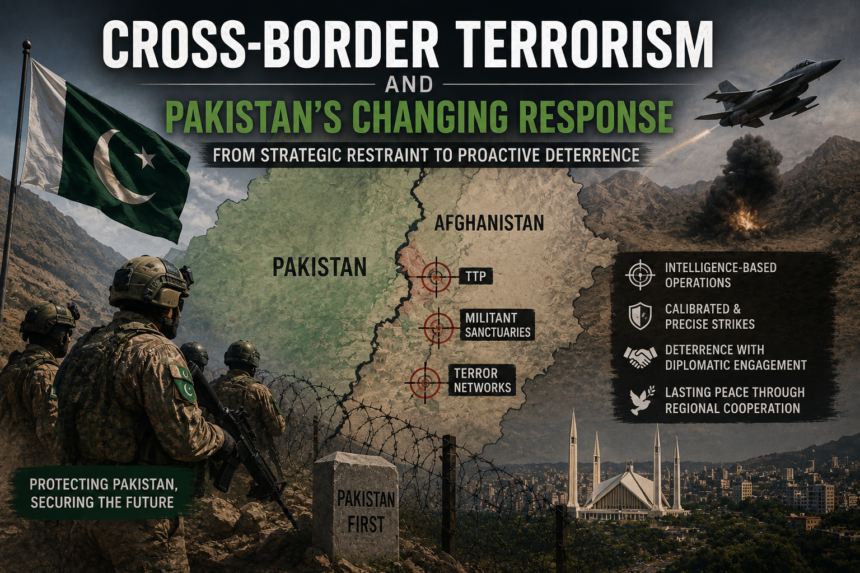

Pakistan has shifted from strategic restraint to proactive deterrence against cross-border terrorism. This reflects growing frustration over militant sanctuaries in Afghanistan. However, long-term security depends on the Afghan Taliban taking effective action against these groups.
Pakistan’s recent cross-border counterterrorism operation shows a significant shift in its security posture toward Afghanistan. Following the deadly attack on a Pakistan Rangers facility in Karachi, Islamabad established that it is no longer prepared to limit its response to defensive measures within its own territory. Instead, it has adopted a strategy of calibrated cross-border action against militant sanctuaries that it believes are being used to plan and facilitate attacks inside Pakistan.
According to the government, the intelligence-based operation targeted hideouts of Jamaatul Ahrar and the banned Tehreek-i-Taliban Pakistan (TTP). Pakistani authorities claim that 29 militants were killed, including senior commander Khan Farosh alias Zabal, while terrorist infrastructure, weapons caches, and training facilities in the border regions of Paktia, Paktika, and Kunar were destroyed.
Officials described the strikes as part of the ongoing Operation Ghazab lil-Haq and the broader counterterrorism campaign under Azm-i-Istehkam. Attaullah Tarar, Minister of Information and Broadcasting of Pakistan, said that in continuation of Operation Ghazab lil-Haq, “precise targeting of terrorist camps and hideouts belonging to Jamaatul Ahrar and Fitna al khawarij have also been carried out on the night of 28/29 June in the border region of Pakistan-Afghanistan border”.
The operation followed a series of terrorist attacks across Pakistan, including incidents in Khyber Pakhtunkhwa, Balochistan, and the Karachi Rangers headquarters. According to the Inter-Services Public Relations (ISPR) the Karachi assault was carried out by the Indian Proxy, Jamaatul Ahrar, and stated that the group was operating from Afghan territory and maintained connections with the TTP. The arrest of a suspected attacker who reportedly entered Pakistan from Jalalabad has confessed that Afghan soil continues to serve as a launching pad for anti-Pakistan militant activities.
These developments emphasize the continuing deterioration in Pakistan-Afghanistan relations since the Afghan Taliban returned to power in 2021. Despite repeated diplomatic engagements, Pakistan upholds that the Taliban administration has failed to dismantle terrorist sanctuaries or restrain groups targeting Pakistan. Consequently, Pakistan views cross-border kinetic operations as a necessary component of its counterterrorism strategy, indicating that attacks traced to Afghanistan will invite direct military retaliation.
At the same time, Pakistan’s approach reflects a broader effort to establish deterrence rather than merely respond to individual attacks. By striking militant infrastructure across the border, Pakistan aims to raise the operational costs for terrorist groups while conveying to Afghanistan that continued inaction will carry strategic consequences.
Pakistan has shifted from strategic restraint to proactive deterrence against cross-border terrorism. This reflects growing frustration over militant sanctuaries in Afghanistan. However, long-term security depends on the Afghan Taliban taking effective action against these groups. However, military action alone is unlikely to provide a lasting solution. Sustainable stability will depend on the Afghan Taliban’s willingness to prevent its territory from being used by transnational militant organizations and to address Pakistan’s longstanding security concerns.
The resurgence of attacks, particularly the Karachi incident, also highlights the evolving nature of the terrorist threat. Whereas violence had largely remained concentrated in Khyber Pakhtunkhwa and Balochistan, the return of terrorism to a major urban centre suggests that militant networks may be attempting to expand their operational reach. This places greater importance on intelligence-driven operations, improved border management, and enhanced coordination among Pakistan’s security institutions.
Pakistan has also coupled its security response with diplomatic measures, including formal protests to the Afghan authorities and strict immigration enforcement against undocumented Afghan nationals. Nevertheless, counterterrorism efforts should remain carefully distinguished from refugee management. While individuals involved in terrorism must be dealt with decisively, ordinary Afghan refugees should continue to be treated in accordance with humanitarian principles and repatriated through orderly and dignified mechanisms.
Overall, Pakistan’s recent operations illustrate a transition from strategic restraint to proactive deterrence. The message to Afghanistan is explicit that continued tolerance of militant groups operating from Afghan territory will result in direct and calibrated military responses. Whether this approach succeeds in reducing terrorism will ultimately depend not only on Pakistan’s military capabilities but also on the Afghan Taliban’s willingness to address the presence of anti-Pakistan militant groups within Afghanistan.