
Pakistan’s terrorism challenge should no longer be viewed solely as an internal security problem or a collection of isolated militant attacks. Instead, it should be understood as part of a broader hybrid security environment in which geopolitical rivalry, proxy actors, intelligence competition, information warfare, and illicit financial networks converge to place sustained strategic pressure on Pakistan
There are moments in a nation’s history when isolated security incidents cease to be viewed as isolated at all. Instead, they begin to resemble pieces of a larger strategic puzzle. For Pakistan, the post-2021 security environment has increasingly come to be understood through precisely such a lens. The resurgence of terrorism in Khyber Pakhtunkhwa, the growing sophistication of separatist violence in Balochistan, repeated attacks targeting Chinese nationals and strategic infrastructure, and an increasingly hostile information environment have collectively shaped a perception within Pakistan’s security establishment that the country is confronting not merely terrorism, but a multidimensional campaign of hybrid warfare.
Whether every component of that assessment can be independently verified remains the subject of international debate. India rejects Pakistan’s allegations of sponsoring militant groups, while the Afghan Taliban deny allowing their territory to be used against Pakistan. Israel’s cooperation with India is publicly acknowledged but is directed, according to both countries, toward legitimate defence and counterterrorism objectives. Yet from Islamabad’s perspective, these developments are not viewed in isolation. Rather, they are interpreted as converging strategic trends that have fundamentally altered Pakistan’s security landscape.
Understanding this perception is important because national security policies are shaped not only by proven facts but also by how states interpret evolving threats.
For decades, Pakistan’s security doctrine revolved primarily around conventional military competition with India. Terrorism, although persistent after 2001, was largely treated as an internal security challenge driven by ideological extremism and instability spilling over from Afghanistan. That framework is no longer sufficient. Modern conflict rarely unfolds through conventional military confrontation alone. It increasingly combines intelligence operations, proxy actors, cyber capabilities, financial disruption, information warfare, diplomatic pressure and economic coercion into a single continuum. Terrorism, in this model, becomes one instrument among many rather than an end in itself.
This broader context explains why Pakistan increasingly analyses violence through the prism of strategic competition rather than purely domestic militancy.
The most visible and least disputed element of this evolving picture is the strategic partnership between India and Israel. Over the past three decades, and particularly since the late 1990s, the relationship has expanded into one of the world’s closest defence and intelligence partnerships. Israel has become a major supplier of advanced military technology to India, including surveillance platforms, unmanned aerial systems, missile defence systems, electronic warfare capabilities, cyber technologies and border management solutions. Intelligence cooperation, counterterrorism exchanges and joint research have also deepened considerably.
None of this, by itself, constitutes evidence of involvement in terrorism inside Pakistan. However, Pakistani analysts argue that these capabilities significantly enhance India’s capacity to wage hybrid competition below the threshold of conventional war. Advanced surveillance, cyber operations, artificial intelligence, precision intelligence and information dominance are increasingly viewed as force multipliers that complement covert rather than conventional competition.
The second dimension lies to Pakistan’s west. The return of the Afghan Taliban in August 2021 initially generated cautious optimism in Islamabad that cross-border militancy might decline. Instead, Pakistan reports a dramatic increase in attacks attributed to the Tehreek-e-Taliban Pakistan (TTP). Pakistani officials, including the military leadership, have repeatedly asserted that TTP commanders continue to enjoy sanctuaries across the border, enabling them to recruit, reorganise and launch increasingly sophisticated attacks against Pakistani security forces and civilians.
The Afghan Taliban have consistently rejected these accusations, maintaining that they neither permit nor support attacks against neighbouring countries. Nevertheless, the persistence of cross-border violence has transformed Afghanistan from a counterterrorism partner that Pakistan once hoped for into what Islamabad increasingly describes as an unresolved security challenge.
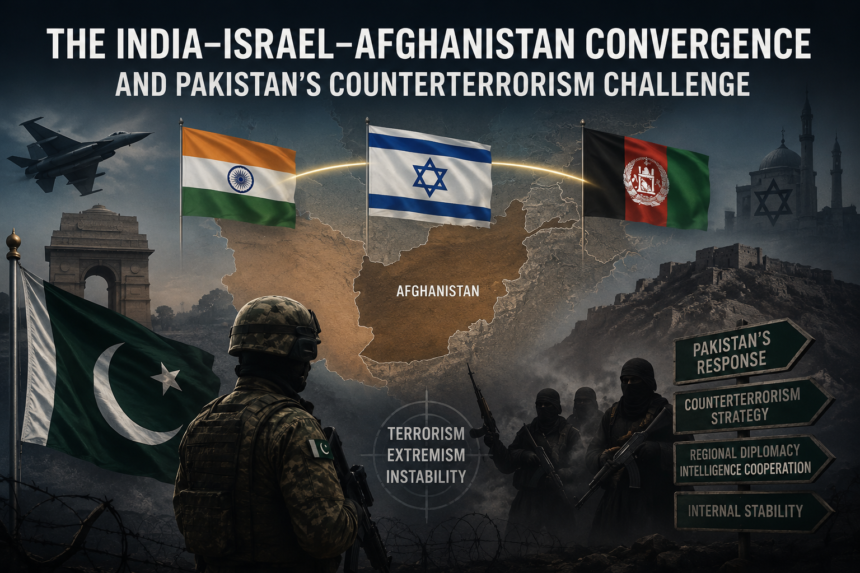
It is at this intersection that Pakistan’s concept of convergence emerges. Rather than arguing that India, Israel and Afghanistan operate through a formal alliance, Pakistani security assessments increasingly suggest that their respective actions, interests and strategic outcomes reinforce one another. India seeks to contain Pakistan’s regional influence and strategic depth. Israel provides India with advanced defence technologies, intelligence cooperation and expertise in intelligence-led security operations. Afghanistan, according to Pakistan’s official position, remains the geographical space from which anti-Pakistan militant organisations continue to operate. Whether coordinated by design or aligned by circumstance, Islamabad believes these dynamics collectively intensify pressure on Pakistan from both its eastern and western fronts.
This perception has been reinforced by the changing character of terrorism itself.
Groups such as the TTP, the Balochistan Liberation Army (BLA) and its Majeed Brigade differ ideologically and organisationally, yet their operational impact increasingly converges. Suicide bombings targeting Chinese engineers, attacks against strategic infrastructure, assaults on military installations and efforts to undermine major connectivity projects such as the China-Pakistan Economic Corridor (CPEC) create consequences that extend far beyond immediate casualties. They raise investment risks, damage Pakistan’s international image, increase security expenditure and complicate regional economic integration.
Pakistan has repeatedly alleged that some of these organisations receive external financial and logistical support. India has categorically denied these allegations. Publicly available evidence has not established direct state sponsorship to the standard required under international law. At the same time, the broader issue of terrorist financing is well documented globally. Hawala networks, narcotics trafficking, extortion, kidnapping for ransom, illicit mining, cross-border smuggling, front businesses, cryptocurrency transactions and informal financial systems remain recognised methods through which terrorist organisations sustain their operations. Distinguishing these established financing mechanisms from allegations of state involvement is essential if counterterrorism policy is to retain credibility.
Equally important is the information domain, which has become inseparable from kinetic conflict. Every major terrorist attack is now accompanied by an immediate contest over narratives. Social media platforms amplify competing claims, fabricated content circulates within minutes and digital influence campaigns seek to shape domestic and international perceptions before official investigations are complete. Pakistan increasingly argues that terrorist violence is accompanied by coordinated information operations designed to erode public confidence, deepen political divisions and undermine trust in state institutions. While attributing such campaigns to specific state actors remains inherently difficult, the integration of physical attacks with digital influence operations reflects a defining characteristic of contemporary hybrid warfare worldwide.
The implications extend beyond Pakistan’s borders. Persistent instability threatens regional connectivity initiatives linking South Asia, Central Asia and the Middle East. It raises the costs of foreign investment, particularly for Chinese-led infrastructure projects, and complicates broader efforts to promote regional trade and economic integration. A Pakistan consumed by internal insecurity is less able to function as a transit hub, less attractive to investors and more constrained in pursuing regional diplomacy. In that sense, terrorism generates geopolitical effects disproportionate to its tactical scale.
For policymakers, the central question is therefore not whether every Pakistani allegation can presently be corroborated through publicly available evidence. Rather, it is whether the cumulative interaction of geopolitical rivalry, proxy violence, intelligence competition, financial networks and information warfare has created a more complex security environment than traditional counterterrorism frameworks were designed to address. Increasingly, the answer appears to be yes.
Pakistan’s response must evolve accordingly. Military operations remain necessary against violent organisations, but they cannot constitute the entirety of national strategy. Financial intelligence must become more sophisticated in identifying illicit funding streams. Border management requires deeper technological integration and greater regional cooperation. Strategic communication should prioritise transparency and evidence to strengthen Pakistan’s international credibility. Diplomatic engagement with Afghanistan must remain open despite persistent tensions, while allegations of external sponsorship should continue to be pursued through recognised international legal and diplomatic mechanisms rather than rhetoric alone.
Ultimately, the debate surrounding an India-Israel-Afghanistan convergence is unlikely to disappear. Some observers will view it as an accurate reflection of an emerging hybrid security architecture, while others will regard it as an overextension of geopolitical analysis. Regardless of where one stands, one reality is difficult to ignore: Pakistan’s security challenges are no longer confined to the battlefield. They now encompass finance, cyberspace, intelligence, diplomacy, information ecosystems, and regional geopolitics. Any strategy that seeks to defeat terrorism without recognising this broader strategic context risks addressing symptoms while leaving the underlying dynamics untouched.
The future of Pakistan’s national security will therefore depend not only on defeating militant organisations, but on understanding the evolving ecosystem that enables them to survive, adapt and generate strategic consequences far beyond the battlefield.
The author Nuzhat Nazar is a journalist and strategic affairs analyst with more than ten years of experience reporting on foreign policy, defence, and economic developments. Based in Islamabad, she focuses on geopolitics, regional security dynamics, and Pakistan’s positioning in a shifting global order.