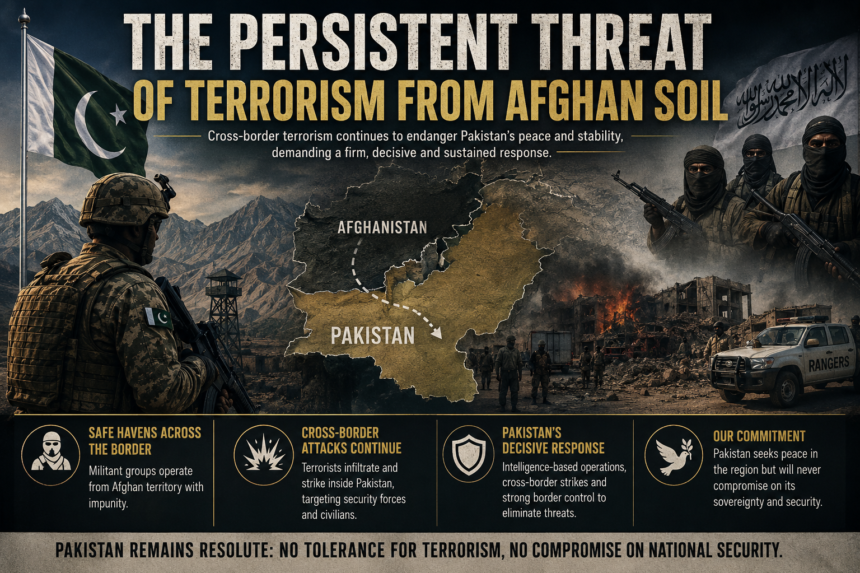

Pakistan’s counterterrorism strategy has entered a new phase, combining intelligence-led operations, cross-border strikes, and stricter border controls. It contends that these measures are intended to deter militant groups operating from across the border and strengthen Pakistan’s internal security.
On 27 June 2026, at 8:10 p.m., a suicide attack was carried out on the Karachi Transport Company of the Sindh Rangers. Immediately after the explosion, five armed terrorists stormed the premises.
According to reports, all five terrorists were killed, while the identities of six other terrorists have not yet been established. The attack resulted in the martyrdom of two security personnel, while three others sustained injuries. The operation was successfully concluded by the Qalandar Group and the 92 Wing of the Pakistan Rangers (Sindh)
During the operation, authorities also captured a wounded terrorist alive, an Afghan national. His interview can be viewed on various social media platforms, where he explains how he entered Pakistan from Afghanistan, first stayed in Bajaur, and then traveled to Karachi. He provided detailed information regarding the route used to enter Pakistan from Afghanistan, individuals who facilitated their movement, those who prepared their suicide vests, and suppliers of their weapons.
Afghan Taliban Regime Facilitated the Attack on Pakistan Rangers Sindh Camp
The wounded Afghan terrorist involved in the attack on the Pakistan Rangers Sindh camp made the following disclosures: “My name is Usman Ali, and I came from Jalalabad, Afghanistan. Three other men accompanied me: Abdul Hadi, Janan, and Umar Farooq. Abdul Hadi, who came with me, has already been killed. Janan threw the bomb at the Pakistan Rangers camp. We entered Pakistan seven days ago and stayed with Abdul Hadi, who was a resident of Bajaur. We were accommodated in an under-construction building. The weapons used in the attack were brought from Waziristan by Abdul Hadi. While I was trying to escape to the other side, I was shot and fell to the ground. I belong to Jamaat-ul-Ahrar (A branch of TTP). Our commander in Afghanistan is known as Ahrar Maulvi Sahib. We all received training in Afghanistan. I was only given a suicide vest. We know how to prepare the suicide jackets ourselves because we were trained beforehand. The suicide vest training and other military training in Afghanistan were provided by Umar Qari. Before we came to Karachi, all arrangements had already been made in Afghanistan. Abdul Hadi knew everything here because he had visited before. Initially, we did not know the difference between the Pakistan Army and the Rangers. After arriving here, we were told about the Rangers and were instructed that they were all ‘infidels.”
Irrefutable Evidence Presented by Pakistan
Pakistan has repeatedly presented irrefutable evidence of cross-border terrorism to the Afghan Taliban authorities as well as to the UN and the USA. It has repeatedly claimed that the Afghan Taliban regime is allowing Afghan territory to be used as a safe haven for terrorists, who are carrying out attacks against Pakistan. Pakistan further claims that all attacks on Pakistan’s security institutions have been carried out by militants entering from Afghanistan.
Reliable intelligence reports have confirmed that the Afghan Taliban have provided safe houses to the leaders of all terrorist organizations operating against Pakistan. Following a “special investigation,” authorities identified three locations in Afghanistan where these terrorists stayed and from where they launched their activities: Paktia, Paktika, and Kunar. These localities and Khost are the safe havens of Hafiz Gul Bahadur Group and of Jamaat Al Ahrar, affiliated with TTP, and they enjoy the patronage of the Haqqanis. These hideouts have been attacked by the Pakistan Air Force earlier also.
Pakistan’s Response
Following the attack on the Sindh Rangers Headquarters, two things were considered certain: those responsible and their handlers would face retaliation, and that retaliation would be severe enough to serve as a lasting deterrent. Initially, operations were conducted at 37 Afghan settlements and refugee camps in Karachi on 28 June. Preparations were made to deport large numbers of undocumented Afghans, while several suspects were taken into custody for questioning. Once it was confirmed that the attackers were Afghan nationals from Jalalabad who had received training from Jamaat-ul-Ahrar, preparations for the operation were finalized.
Using this intelligence and its network inside Afghanistan, the Pakistan Air Force conducted successful calibrated cross-border air strikes around midnight of 28- 29 June against targets in three provinces of Paktia, Paktika, Kunar, as well as the Giyan and Chamkani districts, killing more than 30 terrorists. Simultaneously, coordinated intelligence-based ground operations in Bajaur and adjoining border areas reportedly killed 29 more militants, bringing the total to 59 terrorists eliminated in one night, according to the account.
Highly wanted Kharji commander Khan Farish, aka Zabal, was killed in PAF airstrikes. He was the mastermind behind the Rangers compound attack on 27th Jun Federal Minister for Information and Broadcasting Attaullah Tarar stated that Pakistan’s security forces had dealt a major blow to terrorist organizations through coordinated operations along the Pakistan-Afghanistan border.
According to his statement on the social media platform X, after a highly organized intelligence-based ground operation, precise and limited strikes were carried out against terrorist camps and safe havens in the border region. Tarar added that these operations followed recent terrorist attacks in Khyber Pakhtunkhwa, Balochistan, and the Karachi camp of Pakistan Sindh Rangers, and that the attackers belonged to Jamaat-ul-Ahrar and Fitna al-Khawarij.
He confirmed that their three hideouts were destroyed, 30 militants were killed, and large quantities of weapons and ammunition were destroyed. He emphasized that Pakistan has always sought peace and stability in the region, but will make no compromise when it comes to protecting the lives and property of its citizens.
He reaffirmed that, under the National Action Plan’s Vision Azm-e-Istehkam, Pakistan’s security forces and law enforcement agencies would continue indiscriminate counterterrorism operations to eliminate terrorism supported from abroad and to eliminate the handlers responsible for orchestrating terrorist attacks inside Pakistan. Pakistan had already warned that any future terrorist attack would be met with overwhelming retaliation that would leave a lasting impression on terrorist organizations.
Crackdown on Illegal Afghan Residents
Pakistan’s Ministry of Interior has decided to launch a nationwide crackdown against illegal foreign residents, particularly Afghan nationals. According to the notification, beginning 10 July 2026, action will be taken against all Afghan nationals residing in Pakistan without valid visas or legal documentation.
The federal government has directed the chief secretaries of all four provinces, Gilgit-Baltistan, and Azad Kashmir, provincial police chiefs, and the Islamabad administration to strictly implement the Illegal Foreigners Repatriation Plan (IFRP).
From 11 July, daily reports on arrests and enforcement actions will be mandatory.
Taliban Propaganda
The Taliban spokesman Zabihullah Mujahid instructed Taliban social media teams to recycle old videos and photographs of children and present them as victims of Pakistan’s airstrikes. This is a deliberate propaganda campaign intended to generate sympathy, shape public opinion against Pakistan, and attract international support. The target struck at Madar Khel, Chamkani, in Paktia Province was a military objective. The compound was originally constructed by NATO forces in 2017 and continued to serve as a radio base until their withdrawal from Afghanistan in 2021.
Note: The compound is surrounded by prefabricated perimeter walls and includes a watchtower at one corner, indicating its military nature.
The facility was being jointly used by the Taliban and Fitna al-Khawarij, specifically Jamaat-ul-Ahrar (JuA), as a secure sanctuary and operational base for planning and conducting terrorist activities.
Drones Attack in Baluchistan
On 30 June, the Afghan Taliban regime launched four rudimentary drones across the border in Balochistan as part of their patronisation and support of terrorist outfits operating from inside their controlled territories. The hostile aerial platforms were immediately picked up by Pakistan’s robust air defence network. Demonstrating high operational readiness, security forces successfully neutralized all four incoming drones using sophisticated countermeasures.
Due to the swift and effective response, the malicious attempts were effectively thwarted. Such gimmicks of the Afghan Taliban regime are aimed at misleading the Afghan population suffering under their oppressive regime. The Afghan Taliban should realise that their irresponsible behaviour is only adding to the hardships of the Afghan people. Instead of trying to sedate their population through such antics and hollow rhetoric, they should eschew sponsorship of terrorism and adhere to the principle of peaceful coexistence.
However, if the Afghan Taliban continued to provoke Pakistan, they would receive a befitting response, which would cost them heavily. The Pakistan Armed Forces remain fully vigilant and capable of defending every inch of the motherland. Any misadventures or cross-border provocations threatening the sovereignty of Pakistan and endangering our people will continue to be met with swift, decisive, and overwhelming responses under Operation Ghazab-lil-Haq.
Employment of Commandos
I had said earlier that given the way the situation with Afghanistan was developing, airstrikes alone would no longer be sufficient. Instead, Pakistan would eventually have to undertake targeted ground operations. Now, Pakistan has reportedly begun deploying its commandos inside Afghanistan. The first operation took place in the Angoor Adda border region opposite Wana, where a large number of terrorists were reportedly eliminated.
The Afghan Taliban’s greatest strategic advantage has always been the rugged mountainous terrain. Paktika’s geography is so harsh and inaccessible that, apart from the local population, few people truly know the area. The United States remained in Afghanistan for twenty years, yet never established effective control over Paktika’s mountain ranges. It relied instead on extensive aerial bombardment.
Pakistan’s commandos, however, have reportedly decided to carry out operations regardless of how difficult the terrain may be. They are trained both in covert guerrilla-style operations and in openly confronting and defeating the enemy. The Taliban will now discover what a professional army is capable of. Against the Soviet Union and later the United States, they benefited greatly from local infrastructure and indigenous support networks.
But their assumptions do not necessarily hold when confronting Pakistan. Unlike previous powers, which were foreign forces operating far from home, Pakistan faces a different strategic environment. Pakistan is under no pressure to rush. It intends to pursue terrorists methodically and demonstrate what modern warfare entails. The campaign has now reportedly entered a phase of striking militants inside their own sanctuaries.
Offensive Posture by Pakistan
Pakistan should continue conducting cross-border operations to eliminate terrorist sanctuaries inside Afghanistan. The collateral damage may occur because militants use mosques and civilian areas as hideouts or receive shelter from locals who consider them “guest mujahideen.” They even use women and children as human shields whenever surrounded.
Pakistan’s survival must take precedence over broader notions of Muslim unity or brotherhood. A policy of deterrence through overwhelming retaliation is the need of the day. While expressing sympathy for innocent Afghan civilians who have lost their lives in military operations, critics should also recognize, with fairness and objectivity, that Pakistanis equally mourn the innocent men, women, and children killed in terrorist attacks inside Pakistan—just as ordinary Afghans naturally grieve for their fellow citizens who become victims of cross-border military strikes.
The author, Brigadier (Retd) Asif Haroon Raja, SI (M), is a war veteran. He is Command and Staff Course and War Course qualified, holds an MSc in War Studies, and served as Defence Attaché in Egypt and Sudan, as well as Dean of the Corps of Military Attachés in Cairo. He is a defence, security, and geopolitical analyst, columnist, featured columnist of IntelDrop magazine, Washington, author of five books, former Chairman of Thinkers Forum Pakistan, Patron-in-Chief of Centre for Development Studies Think Tank, Director of Meesakh Research Centre; he regularly appears on media platforms.